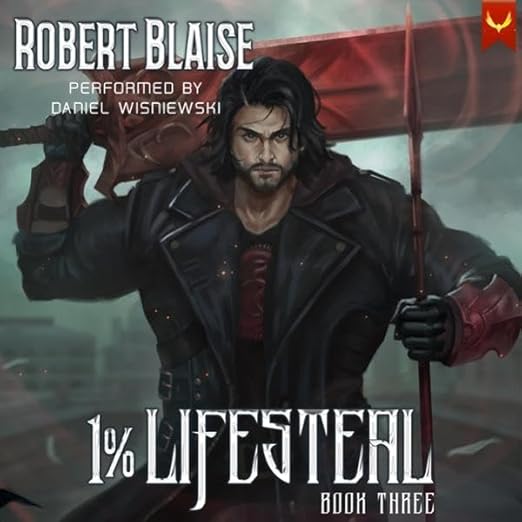
Freddy arrives in the Northern Belt as a fugitive, and the audiobook version of 1% Lifesteal, Volume 3 by Robert Blaise arrives as the third installment in a LitRPG series that has been building its power system and its protagonist's identity across two previous volumes. Neither arrival is comfortable, and both are productive in the ways that matter for the genre. At nearly 23 hours narrated by Daniel Wisniewski, this is a full-immersion continuation rather than a standalone listen.
The Northern Belt is a smart setting for this volume's specific conflict. A borderline lawless subordinate territory where four-star ranked individuals are prohibited, the Belt imposes a hard ceiling on power accumulation, which is precisely what Freddy needs. He is on the run from the law after acting in self-defense, and the Belt's geography (hemmed in by the Northern Spine, with almost no entry or exit routes) and its culture (greed and personal benefit above all, vigilantism normalized) make it both a plausible hiding place and a structurally interesting constraint. The "poison jar" metaphor Blaise uses, anyone who reaches peak third star gets extracted by the Empire, turns the Belt into a pressurized ecosystem. Freddy can grow, but only up to a point.
Is 1% Lifesteal, Volume 3 Worth Your Time?
Reviewer Leonardo Jimenez flags what may be the most useful piece of honest feedback for potential listeners: "The character seems very different to how he is on the previous novel. Also in some ways it seems the character has been de-powered." Both observations are accurate, and both are worth understanding before you start. Blaise makes a deliberate choice here to recalibrate Freddy's personality and capabilities coming into this volume. The de-powering is structurally motivated, the Northern Belt's power ceiling means Freddy cannot operate at the level he achieved in Volume 2, but it does create a version of the character who feels smaller and more uncertain than readers may expect.
That said, Jimenez also notes that the last section of the book delivers genuine development: "the last part of the book is really good with a few not predicted character developments." Reviewer Lonnie-Moore, whose enthusiasm for the series runs high, specifically highlights that Freddy appears to be establishing something resembling a life, "a new city, a new place to call his own, maybe even make a friend or two", alongside mentions of a doctor's appointment for a character named Sophia, and crime faction politics. The book's back half is where Volume 3 earns its position in the series arc.
The weak-to-strong power fantasy that defines the series is operating here at a longer timeline than usual. If Volumes 1 and 2 showed Freddy acquiring power, Volume 3 is the volume where that power has costs and constraints placed around it, where the growth has to happen sideways and underground rather than in clear ascending lines. That is narratively sophisticated for the genre, but it requires patience from listeners who arrived for the clean escalation of the earlier books.
The Best Parts of 1% Lifesteal, Volume 3
Daniel Wisniewski's narration sustains the necessary tonal shift. The Northern Belt is grimmer, colder, and more politically unstable than the settings of the previous volumes, and Wisniewski conveys Freddy's adjustment without losing the forward momentum that defines Blaise's prose. At 22 hours and 56 minutes, the audiobook is a genuine commitment, and Wisniewski's consistency across the runtime matters. He handles the action sequences and the quieter character moments with equal investment, which keeps the listener present through the slower opening arc.
Reviewer Brad's one-line response, "a fantastic work of art from the incredible imagination of a fantastic author", tells you about the core fanbase rather than the book's specific qualities, but it points toward something real: Blaise has built genuine investment in this universe across three volumes, and the payoff for committed listeners is accumulative. The Drexian universe rewards readers who understand the full context of where Freddy has been, and Volume 3's emotional weight comes from that accumulated history rather than from the individual novel's self-contained arc.
Before You Commit to 1% Lifesteal, Volume 3
This is not a standalone entry point. Reading Volumes 1 and 2 is an absolute prerequisite. The world-building, the power system rules (including the significance of the one percent lifesteal mechanic that gives the series its name), Freddy's relationships, and the political stakes of the Empire versus the Belt's vigilante culture all depend on prior context. Listeners who start here will be lost from the first chapter.
The opening pacing is genuinely slower than the previous volumes, and listeners who found Volumes 1 and 2 tight and propulsive should recalibrate for a longer establishment arc. Blaise is constructing a new environment and a new social web for Freddy from scratch, which takes time. The payoff in the back half, the unpredicted character developments Jimenez flags, is worth the setup, but requires willingness to stay present through chapters that feel transitional.
The LitRPG mechanics in Volume 3 lean more toward the social and political dimensions of the power system than the combat dimensions that dominate earlier volumes. If the system-building and the numerical progression are your primary draw to the genre, note that this volume contextualizes those mechanics within a more constrained environment. Freddy cannot grind freely; the Belt's structure forces a different kind of gameplay.
Should You Listen to 1% Lifesteal, Volume 3?
Readers who have completed Volumes 1 and 2 and are already invested in Freddy's arc will find this volume rewarding despite its slower opening. The Northern Belt is a genuinely interesting setting, the power system constraints create narrative tension rather than frustration, and the back-half character developments justify the commitment. Series fans who appreciate when LitRPG fiction slows down to develop its world laterally rather than always escalating will find Volume 3 a satisfying continuation.
Skip this entirely if you have not read Volumes 1 and 2. And approach with adjusted expectations if you are coming from the more kinetic energy of the earlier books, this is a volume about Freddy adapting to reduced circumstances, which is a different kind of story. It resolves into something promising for Volume 4, but the journey there is more patient than the series has required before.
- Narrator: Daniel Wisniewski carries Freddy's escalating desperation well, navigating the Northern Belt's grim atmosphere without losing the series' underlying energy.
- Subjects: Survival under political constraint, the cost of power systems with artificial ceilings, fugitive reinvention
- Tone: Grim and propulsive, with moments of genuine character surprise in the back half
- Bottom line: A strong continuation for readers already invested in Freddy's arc, though the slower opening and character recalibration make this a rewarding rather than an immediately satisfying volume.
Frequently Asked Questions
Can this audiobook be listened to without reading the first two volumes of 1% Lifesteal?
No. Volume 3 assumes complete familiarity with the power system, Freddy's established relationships, and the political context built across the first two books. Starting here would mean missing the foundational world-building and character history that gives this volume's events their weight. Begin with Volume 1.
Does the audiobook address concerns about Freddy feeling de-powered compared to earlier volumes?
The de-powering is structurally intentional. The Northern Belt imposes a hard ceiling on power accumulation, which forces Freddy to operate more cautiously and laterally than in previous books. Reviewers flag that this changes the character's feel in the opening arc, but the back half of the audiobook delivers meaningful development that addresses the sense of diminishment.
How does Daniel Wisniewski handle the tonal shift toward the grimmer Northern Belt setting in this audiobook?
Wisniewski adjusts effectively. The Northern Belt's cold, lawless atmosphere comes through in his delivery without the narration becoming oppressive. His consistency across the nearly 23-hour runtime is one of the audiobook's stronger qualities, particularly in sustaining listener engagement through the slower opening chapters.