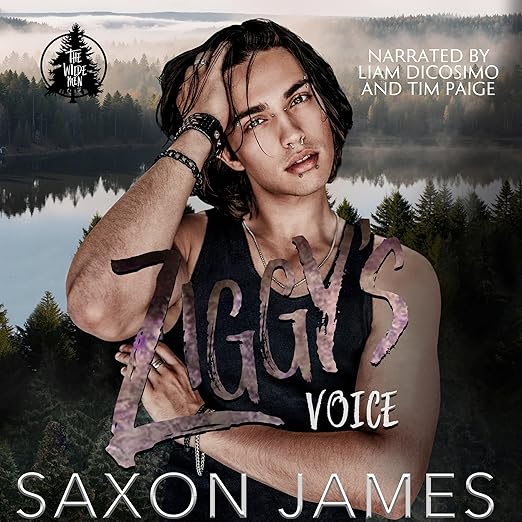
Ziggy the Electrician Who Simply Does Not Talk
Saxon James writes queer romance with a precision for emotional interiority that sets her apart from most contemporary practitioners of the genre, and Ziggy's Voice, the second book in The Wilde Men series, is among her most affecting. Tim Paige's audiobook narration handles the dual perspective structure with enough distinction between Kennedy and Ziggy's voices that the listener always knows whose inner world they are inhabiting, which matters considerably in a book where those two inner worlds are so deliberately contrasted. I came to this audiobook after hearing Ziggy described as 'the quiet one,' which is an accurate label and also a significant understatement of what James does with the character.
Ziggy is the town electrician in Wilde's End, described in the synopsis as 'our not-so-abandoned town,' and he does not talk. Not in the way of someone who is shy or reserved, but in the way of someone for whom language, when the 'voices in his head get too loud,' becomes impossible. Kennedy, the new arrival in town, is his opposite: big energy, sunny personality, the relationship guy who loves fast and hard and has a documented history of making that speed destroy the very things he values. The sunshine-and-shadow dynamic between them is established quickly and worked with considerable care across the full seven hours and forty minutes of the audiobook.
Tim Paige Finds the Tonal Distinction Clearly
The audiobook's emotional core is Ziggy's experience of being made to feel visible by another person for what might be the first time in his life. Kennedy, who 'doesn't expect me to talk when the voices in my head get too loud, doesn't expect me to be funny or witty or anything that I'm not,' is the character who holds space for Ziggy's way of being in the world rather than asking him to change it. James writes this dynamic without sentimentality and without reducing Ziggy's internal experience to a problem for Kennedy to solve. He has his own desires, his own agency, his own determination: as the synopsis says, he is 'determined to win Kennedy over, no matter what it takes.'
Tim Paige's narration finds the tonal distinction between the two perspectives clearly. Kennedy's chapters have an extroversion to them, a forward momentum that matches his characterization. Ziggy's chapters are quieter, more internal, more precisely rendered in their observation of the small details Kennedy brings to his attention. One reviewer described moments where they 'genuinely thought, oh wow, I've felt that too,' in relation to both characters' 'insecurities, hopes, and emotional reactions.' That kind of recognition is what the best queer romance achieves, and it requires a narrator who does not flatten the interiority the author has built.
The Wilde's End setting does quiet but consistent work. A town described as not-so-abandoned, a community of misfits and people who chose to be somewhere out of the mainstream, functions as a natural context for Ziggy's presence and for the possibility that Kennedy might choose something slower and more honest than his previous relationship history. James does not over-elaborate the town's mythology, but it is present as a structuring context throughout the audiobook.
Ziggy's Inner Voices Are Not Pathologized Here
This is the second book in The Wilde Men series, and while it functions as a standalone narrative with its own complete romantic arc, listeners who have read or listened to the first book will arrive with additional context about Wilde's End and its community that enriches the experience. One reviewer noted excitement about 'the next book to come out,' suggesting that the series hook is working; the audiobook ends with enough narrative momentum that the world feels like one worth returning to.
The treatment of Ziggy's relationship with communication is handled with sensitivity but not with the clinical distance of a book treating neurodivergence as a subject of explanation. James writes from inside Ziggy's experience, and the 'voices in my head' that the synopsis references are not pathologized or resolved by the romantic arc. Ziggy does not become a different person because Kennedy loves him; he becomes more fully himself. That distinction is important and it is handled consistently throughout.
Kennedy's Moratorium Reflects Real Self-Awareness
The slow-burn structure is genuine. Kennedy's self-imposed moratorium on relationships and Ziggy's status as someone who has 'never so much as been kissed' create a context in which the physical and emotional development of their relationship proceeds at the pace James wants rather than the pace the genre convention might demand.
James also writes Kennedy with more psychological complexity than the sunshine archetype typically receives. His history of loving hard and fast and watching relationships collapse as a result is not presented as a character flaw to be cured by meeting the right person; it is presented as a pattern he understands, has reflected on, and is actively trying to change. The moratorium he has placed on relationships before arriving in Wilde's End is not romantic game-playing; it is a genuine attempt to understand himself before he hurts someone else the way he has before. That self-awareness makes him a more interesting counterpart to Ziggy than the uncomplicated sunshine figure the trope might suggest.
Feeling Seen Matters More Than Fast Plot
Queer romance listeners who value emotional depth, slow-burn pacing, and protagonists rendered with genuine psychological specificity will find this audiobook one of the stronger entries in the M/M romance genre. Readers of the first Wilde Men book will find a natural and emotionally satisfying continuation of the series.
Listeners seeking high heat content or fast-paced romantic plot will find the quiet, interior pace of Ziggy's Voice slower than they prefer. This is a book about the texture of feeling seen rather than about dramatic romantic incident.
A Few Questions About Ziggy's Voice
Do I need to listen to the first book in The Wilde Men series before this audiobook?
Ziggy's Voice works as a standalone, with a complete romantic arc. Prior knowledge of the first book adds context for the Wilde's End community, but the story is accessible without it.
How does the audiobook handle Ziggy's relationship with speech and communication?
With consistent sensitivity and from inside his perspective rather than from clinical distance. James does not position Ziggy's difficulty with speech as a problem the romance resolves; it is part of who he is, and Kennedy's acceptance of it is central to the emotional core of the audiobook.
Is Ziggy's Voice appropriate for listeners new to queer romance audiobooks?
Yes. The emotional content is handled with warmth and clarity, the heat level is moderate rather than explicit, and the dual POV structure is easy to follow in Tim Paige's narration. It is a good entry point for the genre.
How does the sunshine-and-shadow dynamic play out in audio specifically?
Paige gives Kennedy's chapters a forward momentum and Ziggy's chapters a more interior quality, which makes the tonal contrast between the two perspectives audible rather than just readable. The dynamic works particularly well in audio form.