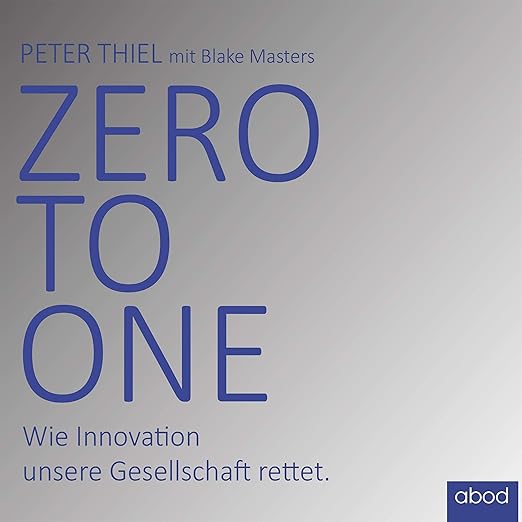
Peter Thiel's Zero to One is among the most quoted and most contested business books of the past decade, and this audiobook edition, narrated by Matthias Lühn, delivers the argument in German. That is the first thing English-speaking listeners need to know: the synopsis and the reviews attached to this edition are in German and Spanish, and the recording itself is a German-language production. Listeners who want the English version should verify the edition before purchasing. For German-speaking listeners, Lühn handles the material with professional composure across the book's nearly five-hour runtime.
Monopolies, Secrets, and the Zero-to-One Argument
Thiel's core argument, delivered across a series of lectures he gave at Stanford with Blake Masters, is that genuine innovation moves from zero to one rather than from one to n. Copying what already works, globalizing existing models, and iterating on established products creates more of the same. Building something that does not yet exist is categorically different work, and Thiel contends that it requires a different kind of thinking than the competitive optimization that business culture typically rewards. His counterintuitive claim that monopolies are better than competitive markets, that definite optimism beats the passive hope of indefinite futures, that secrets still exist and are worth pursuing, makes Zero to One genuinely stimulating to argue with even when the conclusions resist easy acceptance.
Reviewer housemeister71 noted that Thiel's success demonstrates that innovative thinking about business formation produces real results, even as a conservative investor might question some Silicon Valley valuations. That tension is precisely where the book earns its keep. Thiel is not offering a template for incremental improvement. He is making a philosophical argument about how value is created, and the provocative framing is deliberate. Whether you end up agreeing with his positions on competition, monopoly, or the nature of progress, the book forces a precision of thinking that most business writing does not demand.
The chapters on secrets and on the psychology of founders are among the most original in the book. Thiel's claim that we live in an era of insufficient secret-seeking, that people have stopped believing that important undiscovered truths remain available to those willing to look, is the kind of argument that seems philosophical until you apply it to a specific industry and find that it is actually diagnostic. His analysis of what makes a founder distinct from a manager or operator, the combination of extreme vision and willingness to act on unconventional beliefs, is one of the sharper accounts of entrepreneurial psychology in a field full of shallow treatments of the same question.
Lühn's Measured, Unadorned Narration Suits the Structure
The audio format suits Thiel's lecture-derived structure well. Each chapter functions as a self-contained argument, which means the listening experience is modular, and the ideas remain clear even when you pick up the thread after a break. Lühn's narration is measured and unadorned, which serves a text that relies on logical construction rather than narrative momentum. The book does not perform its ideas; it states them. That directness can feel bracing after the anecdote-heavy approach of most popular business titles.
Reviewer Soheyl K. noted that the book rewarded slow, deliberate engagement, reading it in small pieces over an extended period precisely because the ideas needed time to settle. That rhythm may actually be better suited to audio than to print for some listeners. Driving, walking, or pausing to let an argument sit rather than flipping pages can produce a more genuine encounter with the material. The nearly five-hour runtime is short enough to finish in a few sessions but dense enough that it does not benefit from being consumed all at once.
Silicon Valley Reads Differently in Translation
Thiel's political and philosophical leanings surface throughout the book, and they color some of his arguments in ways that can feel distracting. His skepticism about globalization, his treatment of competition as inherently destructive, and some of his commentary on education and the future carry ideological freight that not every listener will find persuasive or even relevant to the business claims. The book is sharpest when it stays close to first principles about how to build a company and most vulnerable when it extends into broader cultural diagnosis.
The German edition also introduces a specific linguistic context that matters. Thiel's examples are drawn almost entirely from American technology culture, and some of the cultural references require familiarity with that world to fully land. A German reader encountering Silicon Valley as an outsider may find the translation slightly distancing from the book's most concrete claims. This is a minor issue in an otherwise well-executed edition, but worth noting for listeners who want full texture from the source material.
Skip This Recording If You Need English
German-speaking entrepreneurs, startup founders, and investors who want to engage seriously with Thiel's framework will find this edition well-suited to the purpose. The audiobook is also a reasonable choice for anyone who has heard Thiel discussed extensively but has not read the primary text, as long as you confirm you want the German-language recording. Business school students and professionals interested in how Silicon Valley insiders theorize innovation will get substantive material to argue with.
Skip this edition if you need the English-language recording. Skip the book entirely if contrarian provocations without systematic empirical support frustrate rather than stimulate you. Thiel is making arguments, not presenting data, and the book works best for listeners who enjoy engaging with a strong, opinionated thesis rather than accumulating validated case studies.
At a Glance
- Voice: Matthias Lühn delivers the German-language edition with clarity and appropriate gravity. The narration is professional throughout, though English-only listeners should note this edition is in German.
- Big ideas: monopoly vs. competition, technological stagnation, startup thinking
- Atmosphere: Contrarian and cerebral, with flashes of genuine provocation
- Worth it?: Peter Thiel's business philosophy is worth engaging even when you disagree with it, but confirm you want the German edition before purchasing this specific audiobook.