Quick Take
- Narration: Jerry Dixon brings real weight to this story, particularly in the voices of the elderly musician and young Juniata, creating a cast that feels lived-in rather than constructed.
- Themes: Racial inequality, survival, the courage of ordinary people, community in crisis
- Mood: Urgent and emotionally demanding, with moments of genuine warmth
- Verdict: One of the strongest middle-grade treatments of Hurricane Katrina, honest about institutional failure without being hopeless, and essential for classrooms covering this period of American history.
I was living in New York when Hurricane Katrina hit in August 2005. I remember watching the news coverage with a growing, specific dread, not just at the storm but at what the response revealed. Twenty years on, talking about Katrina with people under the age of twenty requires a different kind of framing. It has become history rather than living memory. Rodman Philbrick’s Zane and the Hurricane is one of the better books I’ve encountered for bridging that gap, and Jerry Dixon’s narration gives it an urgency that the written page alone might not achieve.
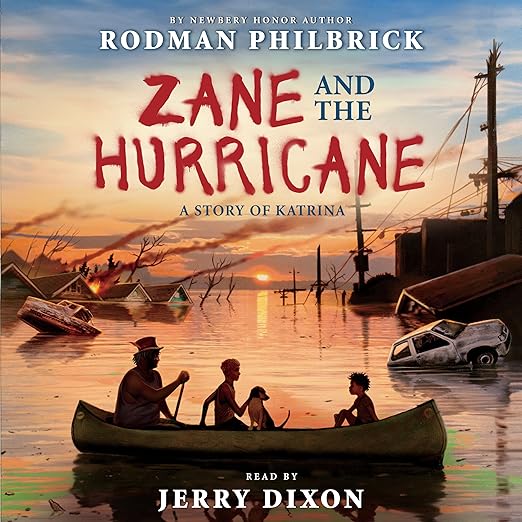
Twelve-year-old Zane Dupree is a boy of mixed race from New Hampshire, visiting his great-grandmother in New Orleans when the storm hits. The geographical displacement is deliberate and smart: Zane is not a New Orleans local, which means the city’s geography and social reality can be introduced naturally through his perspective without feeling like exposition. He is separated from family almost immediately, left to navigate the flooding, the lawlessness, and the institutional abandonment with a musician named Bandy and a scrappy young girl named Juniata. His dog Lil’ One is with him throughout.
Philbrick’s Willingness to Name What Happened
What distinguishes this book from more cautious middle-grade historical fiction is Philbrick’s commitment to telling the truth about what the government did and did not do during Katrina. He doesn’t use the storm as mere backdrop for a survival adventure. The chaos and the lack of official rescue, the armed police who are sources of danger rather than protection, the shelter conditions, these are part of the story rather than politely omitted. A reviewer on Missouri’s Mark Twain nominee list praised this directness, and it’s right. Children who listen to this will understand something specific about race, class, and institutional failure in the United States that gentler treatments of this period don’t convey.
Philbrick includes the lawlessness the synopsis describes but also the generosity, which is the more important balance. Bandy and Juniata are not just plot devices rescuing Zane from the attic. They are fully rendered human beings whose own experience of Katrina is shaped by being Black residents of New Orleans in a way Zane’s is not. The book doesn’t preach about this, but it doesn’t pretend the difference doesn’t matter either.
Jerry Dixon and the Voice of a City
Dixon’s narration is one of the audiobook’s primary pleasures. His Bandy has the particular quality of elderly Southern Black men whose dignity is absolute and whose humor is a survival mechanism, not a performance. His Juniata crackles with the joke-telling energy the synopsis mentions, a characteristic that could easily read as cute but instead comes across as armor. Zane himself is rendered as the mixed-race kid from New Hampshire he is, slightly out of place linguistically, learning the city’s rhythms in real time.
The dog, Lil’ One, is handled with restraint. Animal jeopardy in middle-grade fiction can tip into manipulation, but Philbrick uses the dog’s vulnerability carefully. Lil’ One’s presence is what grounds Zane in his worst moments without the book ever exploiting the threat to him cheaply.
The Classroom Case and the Empathy Architecture
This book appeared on Missouri’s Mark Twain nominee list for 4th through 6th grade readers, which gives a sense of its intended audience and its educational utility. The Newbery Honor is cited in the author’s credentials rather than this specific title, but Philbrick’s pedigree, he also wrote Freak the Mighty, gives the book immediate classroom credibility.
For teachers and parents looking for a way into conversations about Hurricane Katrina, systemic racism, or disaster preparedness with children in the 9 to 14 range, this is a better tool than most. It generates questions rather than closing them down. The empathy architecture is well-designed: Zane’s outsider perspective invites identification across a wide range of listeners, and his gradual understanding of what New Orleans meant to its residents, and what was lost, tracks the listener’s own emotional journey through the story.
Who Should Listen and Who Should Approach Carefully
Young listeners aged 9 to 14 are the core audience, particularly those studying American history or interested in survival narratives. The content includes scenes of real peril and institutional violence that are age-appropriate for middle schoolers but may be too intense for younger elementary-age listeners. Parents should be aware that the book doesn’t soften the police’s role in the storm’s aftermath. Adults interested in accessible Katrina narratives will find this rewarding listening even outside a children’s literature context.
Frequently Asked Questions
Is this book accurate about what happened during Hurricane Katrina?
Philbrick grounds the novel in documented fact, including the flooding, shelter conditions, and the failure of official rescue systems. He also depicts police contributing to dangerous conditions, which reflects documented accounts from the storm. A note at the end addresses the historical basis for the events depicted.
Is ‘Zane and the Hurricane’ appropriate for elementary school children or is it better for middle school?
The Missouri Mark Twain nominee list places it for 4th through 6th graders, roughly ages 9 to 12. The book includes genuinely frightening survival scenarios and honest depictions of institutional failure. It’s best suited for listeners who can handle emotionally demanding content, younger or more sensitive children may find certain scenes too intense.
How central is the dog to the plot?
Zane’s dog Lil’ One is present throughout and serves as an important emotional anchor for Zane during the crisis. Philbrick uses the dog’s vulnerability carefully rather than exploiting it, so while animal jeopardy is present, it doesn’t dominate the book or feel manipulative.
Does the book address race explicitly?
Yes. Zane’s mixed-race identity and his outsider perspective as a Northerner are central to how the book explores Katrina. The experiences of Bandy and Juniata as Black New Orleans residents differ from Zane’s in ways the book takes seriously, without delivering a lecture. This is one of the things that makes it valuable for classroom discussions.