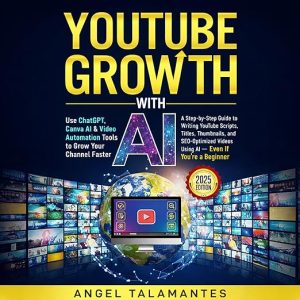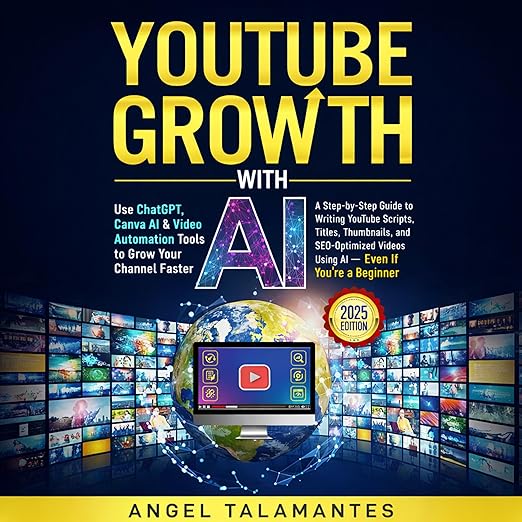
Faceless YouTube channels built entirely around AI workflows are one of the more striking promises inside this audiobook, and Angel Talamantes treats the idea as a realistic strategy rather than a gimmick. YouTube Growth With AI walks through using ChatGPT, Canva AI, and a stack of automation tools to build a channel from nothing, and the pitch is squarely aimed at beginners with no technical background, no budget for a production team, and no existing audience. Jacob Baird narrates the guide, and the material moves through the entire content pipeline, idea generation, scripting, thumbnails, editing, and monetization, treating each stage as something AI can meaningfully accelerate rather than replace.
Fifty-Three Perfect Ratings, Zero Written Reviews
The scope here is genuinely comprehensive for a four-hour runtime. Talamantes covers understanding how the platform's algorithm behaves, choosing a profitable niche through AI-assisted competitor research, and writing scripts around a hook-story-CTA structure meant to hold retention, then continues into production: Canva AI and Midjourney for clickable thumbnails, and editing tools including Descript, CapCut AI, Runway, and Pictory for turning long-form footage into finished video and standalone Shorts. That's a lot of ground for one audiobook to cover credibly, and the real test is whether it goes deep enough on any single tool to be actionable rather than just naming software.
Fifty-three ratings sit behind this title, all resolving to a perfect five-star average, though none arrive with a written review attached, so Talamantes's own framing is the only account currently on record until listeners weigh in themselves. That's worth naming plainly rather than treating the rating alone as a stand-in for detailed feedback. The book is positioned as the first entry in an AI Business Blueprint Series, which suggests Talamantes intends to keep building out this same beginner-to-creator pipeline across future titles.
A Keyword-Dense Title That Teaches by Example
The faceless-channel angle deserves its own scrutiny, since it's one of the more debated strategies in the current creator economy. Building an audience without ever appearing on camera removes a major barrier to entry, no camera confidence, no on-screen personality required, but it also means competing in an increasingly crowded lane where AI-assisted, low-personality channels have become common enough that some viewers actively distrust them. Talamantes treats the approach as a legitimate path rather than addressing that skepticism directly, a notable gap for a book this otherwise systems-minded.
The book's own title is worth reading as a small demonstration of its subject matter: a long, keyword-dense string covering ChatGPT, Canva AI, video automation, scripts, titles, and videos all at once is exactly the kind of maximalist, search-optimized naming convention the book itself teaches for video titles and descriptions. Whether that reads as clever self-demonstration or slightly exhausting marketing depends on a listener's tolerance for keyword-forward branding, but it is at minimum consistent with the book's own stated philosophy about optimizing for discovery first.
Building Smarter Systems With AI Instead of Grinding
The strongest case for this one is the systems framing rather than any single tactic. The synopsis is explicit that the goal is building smarter systems with AI instead of grinding harder, and that promise shows up in the content-batching and scheduling material aimed at avoiding burnout, plus a section on using AI insights to read watch time and engagement data rather than guessing at what's working. For a creator who has tried posting inconsistently and stalled out, a systems-first approach is a genuinely different pitch than most quick-growth guides make.
Monetization gets real space too: ads, affiliates, sponsorships, and digital products are all covered as distinct revenue paths rather than folded into a single afterthought chapter, which matters for a beginner audience that may not know these options exist separately. The book also splits long-form growth from Shorts strategy rather than assuming one approach covers both, a distinction newer creators often miss when they're just trying to post anything at all, and the separation gives each format its own actionable checklist.
The SEO material, optimizing titles, descriptions, tags, and metadata specifically through AI tools, sits at the intersection of two skills beginners usually learn separately: understanding what the algorithm rewards, and writing copy that satisfies both a human viewer and a recommendation system at once. Folding both into one AI-assisted workflow is a genuinely practical simplification for someone starting from zero, rather than asking a beginner to master keyword research and persuasive writing as two separate disciplines.
Platform Policy Risk the Book Never Addresses
The obvious tension in any AI-tools guide is how fast the underlying platforms change, and this one names its own shelf life directly by branding itself updated for 2025 AI tools, trends, and algorithms. That's honest framing, but it also means a listener picking this up later should expect some specific tool names and interface details to have shifted, even if the underlying systems-thinking holds up. Screenshots and interface walkthroughs, if the print or ebook edition includes any, wouldn't translate to audio anyway, so the format naturally favors the strategic material over anything requiring a visual step-by-step.
It's also worth being clear-eyed about genre: this sits in the crowded self-published business-guide space, and promotional language promising real systems rather than hacks or gimmicks is the kind of claim every competing title in this niche makes about itself. The perfect rating average is encouraging, but with zero written reviews to check that claim against, a cautious listener should treat the book as a promising starting framework rather than a guaranteed shortcut to channel growth.
A broader tension is worth naming plainly for any AI-content-creation guide right now: platforms including YouTube have signaled ongoing policy shifts around how heavily automated or AI-generated content gets treated in recommendations and monetization eligibility. Nothing in the synopsis addresses that regulatory uncertainty directly, and a listener building a strategy this dependent on automation should treat platform policy as a moving target worth monitoring independently, not a fixed rule set the book can guarantee will hold steady.
Talamantes and Baird Aim at Total Beginners
Total beginners without an existing audience or a niche picked out yet are exactly who Talamantes is writing for, and the systems-over-hacks framing should appeal to anyone tired of chasing individual viral tactics one at a time. Aspiring builders of faceless or automated channels specifically will find that angle addressed directly rather than treated as an afterthought.
Creators specifically interested in the Shorts format, rather than long-form video, will find the automated repurposing workflow, turning existing long videos into vertical clips, one of the more immediately actionable sections, since it applies to content a creator may already have sitting unused in their library.
Established creators with an existing production workflow, or anyone allergic to AI-assisted content creation on principle, are unlikely to find much here they haven't already worked out for themselves.
Good to Know
Is this audiobook only about ChatGPT, or does it cover other AI tools too?
It covers a full stack: ChatGPT for research and scripting, Canva AI and Midjourney for thumbnails, and Descript, CapCut AI, Runway, and Pictory for editing, alongside AI-driven analytics for tracking performance.
Will the strategies in this audiobook still work as YouTube's algorithm changes?
The book is explicitly branded as updated for 2025 tools and trends, which is honest but also means some specific tactics may age faster than the underlying systems-thinking the audiobook teaches.