Quick Take
- Narration: Virtual Voice delivers the science-heavy framework adequately but strips warmth from Reed’s personal anecdotes, which are meant to ground the neurochemistry in lived experience.
- Themes: Dopamine reward circuitry, behavioral addiction, motivation reset
- Mood: Urgent and practical, with a pop-psychology energy that keeps moving
- Verdict: A solid entry-level primer on dopamine’s role in modern unhappiness, best suited to readers new to the neuroscience who want actionable steps alongside the science.
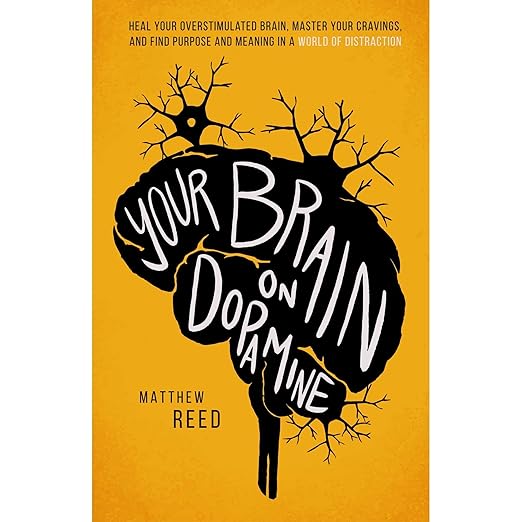
I came to Your Brain on Dopamine on a Tuesday afternoon when I was about forty minutes deep into a phone-scrolling spiral I hadn’t consciously chosen to start. That context felt almost too on the nose. Matthew Reed’s central argument is that our brains were never built for the relentless stimulation cycle we’ve engineered around ourselves, and that dopamine, the molecule that drove our ancestors toward food and safety, is now being hijacked dozens of times a day by systems designed to exploit it. I knew this intellectually before pressing play. What kept me listening was the way Reed translates the neuroscience into the specific, embarrassing texture of modern life.
At four hours and twenty-three minutes, this sits in that useful middle zone between a long magazine feature and a full academic treatment. Reed is a certified health coach rather than a research neuroscientist, and the book reflects that positioning. The science is accurate at a general level and clearly explained, but the real value is in the translation layer: how do you take what we know about reward circuitry and actually change your behavior on a Monday morning? That is where Reed invests most of his attention.
Anticipation, Not Pleasure: What Dopamine Actually Does
Reed opens with a reframing that I think is genuinely useful and often missing from popular accounts of dopamine. Most people have absorbed the idea that dopamine equals pleasure, the chemical you get when something feels good. Reed corrects this almost immediately: dopamine is anticipatory. It fires in response to the expectation of reward, not the reward itself. This distinction is load-bearing for everything that follows. It explains why you keep reaching for your phone even when you know the next scroll will probably disappoint you, why the promise of a snack matters more neurochemically than eating it, and why modern platforms are engineered specifically to keep the expectation loop running without ever fully resolving it.
Reviewer Daniel described the book as going beyond surface-level explanations, and I would agree with that characterization. Reed doesn’t stop at telling you that social media is bad for your dopamine baseline. He traces the mechanism: the variable reward schedule, the hit-then-dip pattern, the tolerance buildup that requires increasing stimulation to feel normal. That mechanistic clarity is what makes the practical sections land with more weight than they would if they were just lifestyle advice.
The Five-Step Detox Framework in Practice
The structural core of the book is a five-step process centered on a dopamine detox, and this is where your mileage will vary depending on what you’re bringing to it. Reed’s framework is sensible and the individual components are well-explained: audit your triggers, reduce the most disruptive stimuli, build replacement behaviors, track your baseline over time, reintroduce stimuli consciously. Reviewer Doris DeVelder praised how Reed explains addiction patterns without condescension, which tracks with my experience. He is genuinely trying to give you working knowledge rather than a surface motivational bump.
That said, readers familiar with Anna Lembke’s Dopamine Nation or Andrew Huberman’s protocol-heavy content will find some of this well-trodden ground. Reed’s contribution is partly in the consolidation and partly in the personal framing. He draws on his own experience as someone who went through a significant recalibration process, and those sections carry a different weight than the explanatory chapters. The certified health coach background shows in the coaching-register warmth of the practical chapters, which is a feature if you respond well to that format and a friction point if you wanted more primary sourcing.
What the Virtual Voice Narration Does to Personal Material
This is the honest caveat that matters for the audio format. A significant portion of the book relies on Reed’s personal voice, including his own experience with compulsive behavior and his account of working through the detox process. In print, that material functions as the human anchor that stops a self-help book from feeling like a Wikipedia summary. In this audiobook, delivered by Virtual Voice, those same sections lose the tonal variation that makes personal testimony convincing. The synthetic narration reads the anecdotes with the same even cadence it uses for the biochemistry sections, which flattens the emotional differentiation.
Reviewer Nuki Da described the book as becoming a compass for understanding motivation and enjoyment, and I believe that response is genuine. But it likely emerged more strongly from the print experience. For the audio version, the science chapters and the framework chapters carry better than the personal narrative sections, which need a human voice to breathe. If you are primarily interested in the dopamine science and the practical protocol, the Virtual Voice delivery is a workable trade. If you are hoping for the memoir-adjacent quality that Reed seems to intend in his more personal passages, consider whether you would rather read than listen.
Who Should Listen / Who Should Skip
This works well for anyone who has noticed they cannot stop a specific digital or consumption habit and wants a neurological vocabulary to understand why, combined with a structured starting point for change. It is particularly useful if you have absorbed fragments of dopamine science from podcasts or social media and want a coherent through-line that connects the biology to the behavior to the intervention. Skip it if you are already past the introductory level, whether that means you have read Lembke or Huberman extensively or you work in behavioral health. And if Reed’s personal narrative is a significant draw, the audiobook format shortchanges it enough that the print or ebook version would serve you better.
Frequently Asked Questions
Is this book written by a neuroscientist or a health coach, and does that affect the science quality?
Matthew Reed is a certified health coach, not a research neuroscientist. The science is accurately presented at a general level but the book’s orientation is practical and coaching-focused rather than academic. Reviewers note it explains dopamine mechanisms clearly without being condescending, and the accuracy holds for general-audience purposes.
How does Reed’s dopamine detox framework differ from a standard digital detox?
Reed’s five-step framework is grounded in dopamine reward circuitry rather than simple screen-time reduction. It includes an audit phase to identify individual triggers, a structured reduction period, and a conscious reintroduction process designed to reset baseline sensitivity rather than just create a temporary break from stimulation.
Does the book address clinical addiction or is it aimed at everyday behavioral habits?
Primarily the latter. Reed covers addiction mechanisms in the context of everyday compulsive behaviors like social media scrolling, snacking, and low-level substance use. The book is not a clinical treatment guide and is not a substitute for professional support for diagnosed addiction disorders, but reviewer Doris DeVelder noted it addresses serious addiction patterns in accessible terms.
Given the Virtual Voice narration, is this better consumed as an audiobook or in print?
Print or ebook is likely the stronger format, particularly because Reed uses personal anecdotes and autobiographical material that benefits from authentic vocal delivery. The science and framework chapters translate reasonably well to synthetic narration, but the memoir-register passages lose tonal credibility without a human voice behind them.