Quick Take
- Narration: Michael Goldstrom keeps pace with Gutman’s relentless comic action, giving the absurd set pieces the straight-faced delivery they need to land with younger listeners.
- Themes: Cross-country American geography, sibling loyalty under impossible circumstances, institutional disbelief in children
- Mood: Frantic and funny, with geography lessons embedded so thoroughly they feel like part of the adventure
- Verdict: A fast-moving third entry in the Genius Files series that rewards listeners who’ve been along for the ride, with American landmarks serving as both backdrop and plot device.
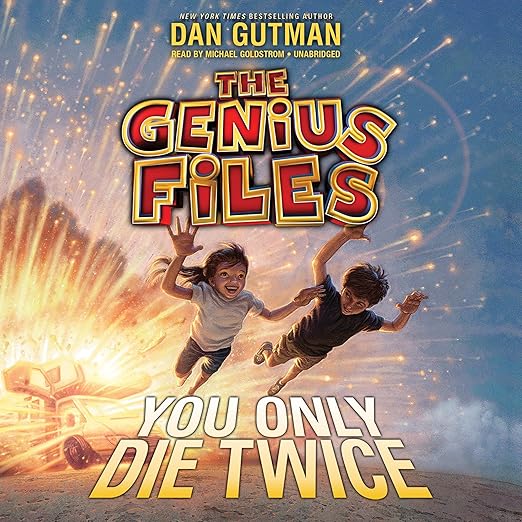
There’s a specific kind of children’s adventure series that treats the continental United States as a setting to be consumed in installments: one landmark, one danger, one outrageous escape per chapter. Dan Gutman’s Genius Files series is that kind of book, and You Only Die Twice is its third entry, which means by this point the formula is fully operational and the twins Coke and Pepsi McDonald have enough behind them that new peril registers as part of an ongoing lifestyle rather than a shocking development.
I came to this one having already spent time with the first two books, and that context matters. Without knowing that these thirteen-year-old twins have already survived an astounding succession of near-deaths engineered by the shadowy forces pursuing them, the flesh-eating soda pool and turbo-charged carnival ride in Book 3 would seem like editorial excess. With that context, they feel like Gutman deliberately escalating to the level his readers have been trained to expect.
The American Road Trip as Plot Architecture
What distinguishes the Genius Files series from a generic action-comedy for middle-grade readers is the geography curriculum hidden inside the chase. Gutman is genuinely interested in American roadside history and peculiarity, and that interest expresses itself as a series of detours to landmarks that range from famous to frankly bizarre. Pedro’s South of the Border in South Carolina appears here, alongside DC-set sequences, and Gutman’s descriptive enthusiasm for these locations is infectious enough that multiple families in the reviews report looking up locations while listening.
That’s not an accident. The books position themselves as adventure-driven geography education, and they execute that positioning with enough energy that the lesson never feels like a lesson. A ten-year-old and a seven-year-old listening with a parent and asking to stop at real locations on a family road trip is the ideal use case for this series, and the reviews suggest it’s exactly what happens.
Goldstrom’s Deadpan and the Comedy Logic
The Genius Files humor depends on a specific register: straight-faced presentation of increasingly absurd situations. An evil Elvis impersonator, flesh-eating soda, a giant shredder, a turbo-charged carnival ride. These are not played for winking irony but for the same narrative urgency as a conventional thriller would give to more plausible dangers. Goldstrom understands this and delivers accordingly, keeping his voice in a consistent medium register that treats each catastrophe with equivalent seriousness.
This is actually harder than it sounds. The temptation with material like this is to signal to the listener that you know it’s ridiculous, which would break the spell. Gutman’s comedy only works when the narrator believes it, and Goldstrom believes it, which is why the joke lands.
Series Position and Entry Point
You Only Die Twice is the third of five books in the Genius Files series. Starting here without Books 1 and 2 means arriving mid-mystery, with the threat logic only partially established. The series is designed to be read in order; the ongoing question of who is really behind the twins’ persecution is addressed across volumes, and arriving at Book 3 without that background will leave some threads without context.
That said, Gutman writes with enough momentum that a new listener could follow the action and enjoy the American geography sequences without needing the full backstory. The tone is consistent enough that it’s self-orienting. But the emotional investment in Coke and Pepsi, the frustration of not being believed, the specific texture of their sibling dynamic, accumulates over the series and pays dividends in later books.
Who Should Listen, Who Should Skip
The Genius Files works best as a family listen in the car, ideally on a road trip where the described landmarks can be cross-referenced with reality. The series is aimed at ages 8 to 12, and the family read-aloud dynamic described in the reviews suggests it hits that target accurately. Listeners who prefer character interiority over action density will find Gutman’s prioritization of plot momentum over psychological depth limiting. This is a book that goes fast and doesn’t stop, and for the audience it’s designed for, that is exactly the point.
Frequently Asked Questions
Can You Only Die Twice be listened to without reading the first two Genius Files books?
The plot works without prior context at the level of individual scene comprehension, but the overarching mystery of who is pursuing the twins is a multi-volume thread and will feel incomplete without Books 1 and 2. Starting at the beginning of the series is the stronger recommendation.
How does the audiobook handle the American geography content?
Goldstrom delivers the landmark descriptions with the same energy as the action sequences, which is the right approach. The geographic content is embedded organically rather than presented as educational asides. Multiple families report looking up actual locations after listening, which suggests the integration is effective.
What makes the humor in this series work in audio specifically?
Gutman’s comedy depends on deadpan delivery of increasingly absurd dangers. Goldstrom keeps a consistent medium register across all the outrageous set pieces rather than signaling to listeners that the material is ridiculous. That straight-faced approach is why the joke lands; ironic narration would undermine it.
Is this series appropriate for family listening with mixed ages?
Yes, and it seems specifically designed for it. Reviews consistently describe parents and children of different ages engaging equally with the material. The pacing and humor work across the 7 to 12 range without requiring different entry points. The road trip setting makes it particularly natural as a car audiobook.