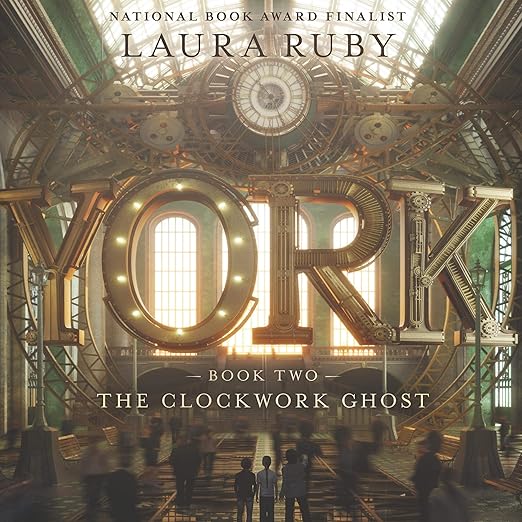
Quick Take
- Narration: Adam Verner continues his strong work with the York trilogy, managing the book’s emotional complexity and hard-stop cliffhanger structure without letting the tension feel manufactured.
- Themes: Alternate history, the weight of secrets, technology with its own intentions
- Mood: Dense and atmospheric, with a cliffhanger ending that demands book three immediately
- Verdict: A worthy middle chapter that deepens the mythology significantly, with some mid-book pacing unevenness and a hard stop ending that makes The Map of Stars essential.
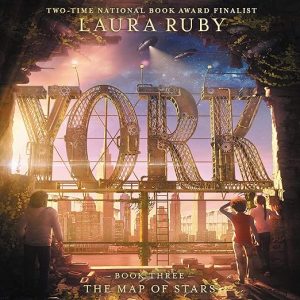
There is a particular experience specific to listening to the second book in a trilogy: knowing you will not get resolution but hoping the middle chapter justifies the time. I listened to York: The Clockwork Ghost during a long train journey, which turned out to be the right context. The alternating rhythm of city and countryside outside the window suited a book about a fictional New York being slowly dismantled and reassembled through an impossible cipher.
The Clockwork Ghost picks up in the immediate aftermath of the first book, York: The Shadow Cipher, which ended with the Biedermanns’ home at 354 W. 73rd Street destroyed in the process of uncovering the next clue. That is the cost of the Morningstarr cipher so far: a demolished building and a mystery that refuses to stay contained. National Book Award finalist Laura Ruby does not ease her characters into the second chapter; she drops them directly into the consequences.
The City as a Living Machine
What Ruby has built in this alternate New York is genuinely impressive. The Morningstarr twins, the enigmatic architects who designed the city and embedded the cipher in its buildings, feel present throughout even though they are long dead. The technology they built has, as the synopsis notes, its own plans for those who pursue it. This is not a passive mystery; the puzzle itself seems to have agency, which gives the trilogy an unusual quality of unease underneath its adventure-story surface.
Adam Verner’s narration captures this quality well. He reads the city’s strangeness with a matter-of-fact acceptance that the characters themselves would have, because they grew up in this alternate New York and accept its impossible features as ordinary. The Morningstarr buildings’ behaviors and the cipher’s escalating demands are treated as facts of life, which is the right register for alternate history aimed at middle-grade readers.
Mind Twisty and Deliberately So
The reviewer who described this book as going to get all mind twisty and bendy was not wrong. The Clockwork Ghost complicates the first book’s mystery significantly, introducing new layers to the cipher, new enemies, and a revelation about Tess and Theo’s connection to the Morningstarrs that sends the story in a direction worth experiencing without spoilers. Ruby manages this complexity without making the plot feel convoluted, which is a genuine accomplishment in alternate-history middle-grade fiction.
The slow patches in the middle of the book are real. There are stretches where the investigation circles back on itself before finding its next momentum, and the villain does feel underexplored in ways that the third book would need to address. These are honest criticisms of a middle chapter that is simultaneously building toward something and withholding it.
The Hard Stop That Makes Book Three Essential
I want to be direct with potential listeners: The Clockwork Ghost ends on a hard cliffhanger. Not a soft curiosity-generating stop, but a structural cut of the kind that sent at least one reviewer rushing immediately to the finale. If you are the kind of listener who needs resolution at the end of a listening experience, I would recommend waiting until you have The Map of Stars ready to begin the moment the credits roll.
This is not a criticism of Ruby’s structural choices. The cliffhanger is earned, and what it reveals reshapes the series in ways that make the finale’s resolution more meaningful. But the warning matters for listeners coming to the trilogy without knowing what they are in for.
Who Should Listen, Who Should Skip
Do not start here. Start with York: The Shadow Cipher, which establishes the alternate New York, the Morningstarr cipher, and the characters who matter. The Clockwork Ghost is a second chapter in the fullest sense; it exists in relation to what came before and what comes after. For listeners who have finished the first book and are already invested, this is a satisfying deepening of the mythology, pacing issues notwithstanding. The ideal listening experience is the full trilogy in close sequence, and that sequence is well worth the time.
Frequently Asked Questions
Can I start the York series with The Clockwork Ghost, or do I need to listen to The Shadow Cipher first?
You need to start with York: The Shadow Cipher. The Clockwork Ghost picks up directly after the events of the first book, and the characters, the alternate New York, and the cipher’s significance all require the context that the first volume establishes.
Does the book explain the Morningstarr cipher’s nature, or does it just add more mystery?
The Clockwork Ghost adds significant layers to the cipher’s complexity, reveals new information about the Morningstarrs themselves, and deepens the mystery around Tess and Theo’s connection to the cipher’s history. It provides genuine revelations while also deferring the full resolution to The Map of Stars.
How does Adam Verner handle the three main characters’ distinct voices across the middle volume?
Verner has narrated the full York trilogy and has a clear sense of each character’s register. Tess, Theo, and Jaime are distinguishable without exaggerated differentiation, and his handling of the trio’s dynamics as their trust frays in this volume is one of the narration’s strengths.
Is the slow pacing in the middle of the book a significant problem?
There are stretches in The Clockwork Ghost where the investigation circles before finding its next momentum, and a few reviewers have noted this. It is a real characteristic of the book, though the ending more than compensates. Listeners who found the first book’s pacing strong should know this one is somewhat denser in its middle section.