In Brief
- Voice: Virtual Voice narration delivers Kulp's instructional prose cleanly, though the warmth of a human narrator would suit the motivational sections better.
- Big ideas: short-book publishing as a six-figure business model, knowledge monetization strategy, the two distinct paths to author income
- Atmosphere: Energizing and directive, like a business planning session with a coach who has already done the thing repeatedly
- Worth it?: For aspiring author-entrepreneurs who want a compressed, practical framework for building a writing-based income, this audiobook gets to the point faster than most in the genre.
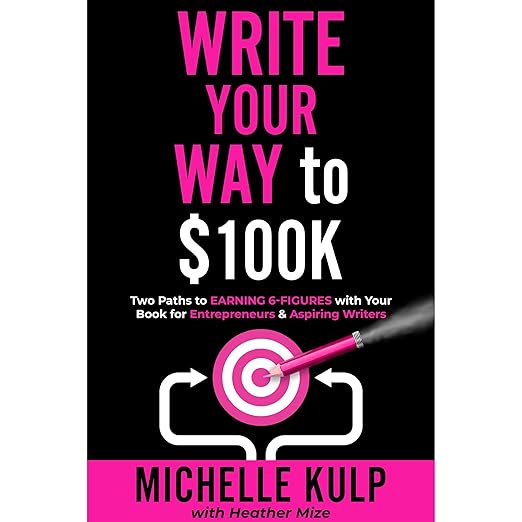
Michelle Kulp's audiobook makes a claim in its title that it then proceeds to defend with specific methods rather than vague inspiration: there is $100,000 worth of knowledge inside your brain, and this book exists to show you how to package and sell it. Kulp has written over 32 books and has coached hundreds of authors through publication and launch since 2013, which gives this material the credibility of a practitioner rather than a theorist. Write Your Way to $100K is not about how to write well. It is about how to write strategically, and that distinction shapes every recommendation in it.
The core argument is structural: short books are not a compromise or a lesser format. They are a strategic choice that allows authors to publish faster, test markets more cheaply, and build a catalog that works as a compounding asset rather than a single bet. Kulp distinguishes between two paths to $100K as an author, and understanding that distinction early changes how the rest of the book reads. The book is not interested in teaching you to write literary fiction or academic nonfiction. It is interested in teaching you to turn specific expertise into a product that solves a problem for a defined audience, and then to sell that product effectively.
The BAM Method and the one-book-to-$100K framework are the two structural pillars of the approach. Kulp explains both with enough specificity to be actionable rather than aspirational. She also addresses the question of AI assistance in content generation, which reflects the current reality of how working authors approach their output rather than pretending that tools have not changed the landscape. That inclusion of AI as a practical element rather than a controversy to be avoided is a mark of the book's pragmatism and its willingness to engage with writing as a business rather than a vocation.
The distinction Kulp draws between creating demand and filling demand is one of the book's most useful contributions. Most aspiring authors think about their book first and their audience second, which she identifies as trying to sell backwards. The framework she presents inverts that sequence: find the high-profit topic first, then write the book that fills the existing demand for that information. That is a different orientation toward authorship than most writing advice operates from, and it is the one that makes the $100K claim credible rather than aspirational.
Virtual Voice Handles Instruction, Prose Handles the Energy
The audiobook runs 2 hours and 46 minutes, which makes it one of the most efficiently packaged guides in the knowledge-monetization genre. Reviewers consistently note that the material is actionable within that runtime rather than using the full length to build toward a single insight. Kulp's background writing a book a month in 2020 while building what she calls her Digital Retirement means that the frameworks she presents are not aspirational case studies but documented workflows she has run herself repeatedly, including in 2024 where she reports continuing the same practice.
The Virtual Voice narration is clean and intelligible. The instructional sections, where clarity matters more than warmth, come through without distraction. The motivational sections, where Kulp's energy as a coach and practitioner would presumably be most present, come through in the prose itself rather than in the vocal performance. Listeners who want the full warmth of an author's personal delivery will notice the absence of a human narrator, but the content is strong enough that the framework's value comes through regardless of the narration's limitations. Knowing this upfront allows you to engage with the material at its strongest.
The 14-Day Writing Challenge Needs a Notepad
The book assumes you are already inclined to pursue writing as a business rather than primarily as an art form. Kulp is explicit that the methods she teaches are about demand-filling rather than demand-creation, which is a meaningful distinction that shapes every tactical recommendation. If you want to write the book you have always wanted to write and find an audience for it afterward, this framework will feel transactional in ways that may be uncomfortable. If you want to build an income stream from the expertise you already have, the framework fits the goal precisely.
The 14-Day Writing Challenge and the specific frameworks for finding high-profit topics are practical tools rather than theoretical concepts, which means the audiobook format requires more active engagement than a physical book where you can tab and annotate freely. Listeners who treat this as an active planning session rather than passive background listening will get considerably more out of it. The reviewers who describe using it to kickstart their creativity are the ones who engaged with the framework while listening rather than filing it away for later. A notepad alongside makes a meaningful difference for the actionable sections.
A Focused, Useful Book Beats a Definitive Statement
This audiobook is designed for entrepreneurs, coaches, consultants, and professionals who have significant domain expertise and are looking for a systematic way to convert that expertise into publishable, saleable books. It is also useful for anyone who has been thinking about writing but feels overwhelmed by the scale of a full-length work, since Kulp's emphasis on short books specifically addresses the paralysis that comes from trying to write a definitive statement rather than a focused, useful one.
Listeners who want a guide to traditional publishing, literary craft development, or long-form nonfiction structure should look elsewhere. The book's framework is explicitly oriented toward indie publishing, shorter forms, and treating books as business tools rather than cultural artifacts. One reviewer describes it as a game changer for aspiring writers, which is accurate for the specific kind of aspiring writer who is trying to monetize existing expertise rather than develop a new literary voice. At under three hours, the cost of finding out which camp you are in is low enough that the investment is sensible even for readers who end up deciding the framework is not for them.
Before You Listen
Does this audiobook cover publishing platforms and distribution, or only the writing process?
Kulp covers the business model broadly, including how to turn a book into a sales tool and how to choose high-profit topics. The distribution mechanics are not the primary focus, but the book addresses the full author-entrepreneur workflow rather than stopping at the manuscript stage.
Is this audiobook appropriate for first-time writers or mainly for people who have already published?
Kulp targets anyone with expertise to share, including first-timers. The framework is designed to make the process of writing and publishing accessible to people who know their subject deeply but have never attempted a book. The short-book emphasis specifically reduces the barrier to entry for new authors.
At 2 hours and 46 minutes, does the audiobook feel rushed or genuinely complete?
Reviewers consistently describe it as concise rather than rushed. The short runtime reflects Kulp's own philosophy about short books: deliver the framework without bloat. Listeners who want comprehensive treatment of every element will find supplemental resources useful, but the core method is complete within the runtime provided.