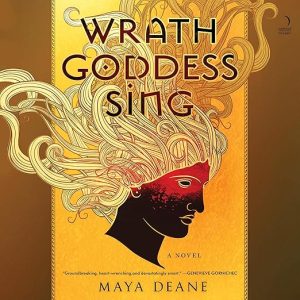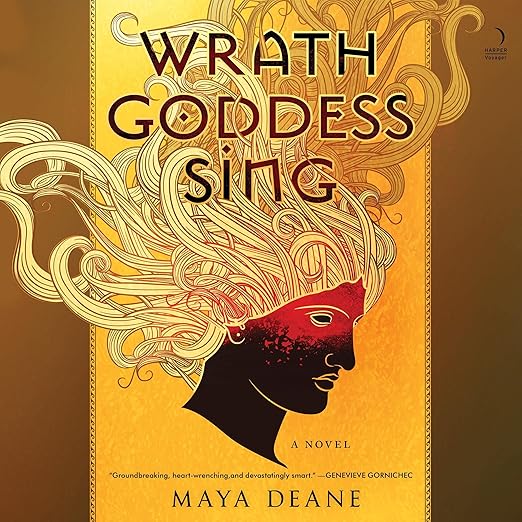
Maya Deane's approach to the Iliad begins not with a creative choice but with a scholarly one. Drawing on ancient texts and modern archaeology, Deane argues that the trans woman's story was always present underneath the well-known myths of Achilles, compressed and misread through centuries of retelling. Wrath Goddess Sing is the audiobook that excavates that story. Narrated by Katherine Pucciariello across fifteen hours and eleven minutes, it is a book that earns its epic scale, and one that a significant portion of its 153 reviewers describe with the kind of intensity typically reserved for books that change how you read everything that comes after.
The craft of this novel operates on several levels simultaneously. Deane reconstructs the Bronze Age world with genuine archaeological specificity, the material culture, the religious practice, the social hierarchies of Myrmidon clan structure, in a way that makes the world feel inhabited rather than merely backdrop. This is not the aestheticized antiquity of popular mythology retellings; the violence is real, the gods are genuinely terrifying, and the political mechanics of the war have weight. Reviewer Siavahda described the experience as being struck like a hammer against bronze, a phrase that captures the kinetic quality of Deane's prose.
Achilles' transformation, granted by Athena as part of a bargain that gives her the body she has always known to be hers in exchange for military glory, is handled with both mythic inevitability and emotional precision. What Deane does brilliantly is refuse to make the divine gift uncomplicated. The body Athena provides is a transaction, not a liberation, and the terms become progressively clearer and more devastating as the narrative advances. Helen, rendered here as an immortal who has watched millennia of human sacrifice and emerged genuinely cruel from the accumulated weight of it, becomes Achilles' mirror and nemesis in a dynamic that has no equivalent in the original text.
Patroklos and his wife Meryapi, the Egyptian sorceress, function as the emotional anchors of the story. Their relationship with Achilles, a triangle of fierce, complicated love, is what makes the later chapters unbearable in the best sense. Reviewer Molly Lazer described the novel as making its own myth as it goes, noting that what at first seems like a familiar story quickly takes a turn for the divine and builds into something genuinely its own. Reviewer Eileen praised the intricate interweaving of mythology and history, with wit and blood and guts and magic and betrayal all present in a single narrative frame. Deane is not simply retelling the Iliad but building a coherent alternative mythology that the source material can support without contradiction, and that is a rarer achievement than it might appear.
The Best Parts of Wrath Goddess Sing
Katherine Pucciariello's narration is the primary reason to choose the audiobook over print. She manages the considerable tonal range of the material, from Achilles' private vulnerability to the formal register of divine speech to the brutal momentum of battle sequences, without losing the specificity that makes each scene feel distinct. Fifteen hours is a genuine commitment, but the pacing never drags; Deane structures the novel so that each section escalates the divine stakes while simultaneously deepening the human ones, and Pucciariello's performance reflects that dual motion throughout.
A supplemental PDF accompanies the audiobook, which suggests additional scholarly context or notes on sources. Given Deane's explicit engagement with ancient texts and modern archaeology as the basis for the retelling, this companion material is likely to reward listeners who want to understand how the myth reconstruction is grounded. It is worth accessing separately from the listening experience itself rather than treating it as supplementary packaging that can be safely ignored.
Before You Commit to Wrath Goddess Sing
This is not a book for readers who want their Iliad straight. Deane diverges significantly from the source material in her characterization of Helen, her treatment of Patroklos and Briseis, and the fundamental nature of the gods, who are described as dysfunctional abusers of human sacrifice on a civilizational scale rather than as magnificent powers with comprehensible agendas. Listeners who arrive expecting a faithful mythological retelling will find something considerably stranger and more ambitious. The novel operates with the assumption that the reader's discomfort is part of what the book is doing.
The novel is also genuinely dark. The divine schemes involve real horror, and some of the violence is rendered with unflinching specificity. The emotional devastation of the later chapters is intentional and sustained. This is not a book that softens its subject to make the reader comfortable, and Pucciariello's performance does not flinch from that either. Listeners should go in knowing that the fifteen hours will ask something of them, not just deliver entertainment.
Should You Listen to Wrath Goddess Sing?
This audiobook is for readers who want their mythological fiction literary, rigorously researched, and willing to go to genuinely dark places in the pursuit of something true. Fans of Madeline Miller's Song of Achilles, which Deane's publishers cite as a comparison, will find much to love here alongside significant tonal differences; Deane is less elegiac and more confrontational than Miller, and her Achilles' story ends at a different emotional register. LGBTQ+ readers and those interested in how trans experience intersects with ancient world frameworks will find the retelling engaging on both the scholarly and the personal level. Plan the fifteen hours as an immersive experience rather than background listening; this audiobook rewards every bit of attention you bring to it, and Katherine Pucciariello's narration ensures that attention is well-directed from the opening chapter through to the end. Deane and Pucciariello together have made something genuinely uncommon: an ancient world audiobook that is also unmistakably contemporary.
Key Details
- Performance: Katherine Pucciariello's performance carries the weight of this fifteen-hour retelling with precision and emotional range, navigating Achilles' interiority and the brutal sweep of divine machination without losing the intimacy that makes Deane's recasting of the myth feel genuinely human.
- What it covers: Trans identity and embodied selfhood in the ancient world, divine manipulation and human agency, the cost of glory and love
- Feel: Epic and pitiless, with moments of devastating tenderness
- Our call: Maya Deane's Wrath Goddess Sing is a rigorously researched, beautifully narrated recasting of the Achilles myth that earns its place alongside the best mythological fiction of the last decade.
Frequently Asked Questions
How does Katherine Pucciariello's narration handle the scope of this fifteen-hour audiobook?
Pucciariello manages the tonal range from intimate personal scenes to epic battle sequences and divine machination with consistent skill. Reviewers and the 4.5 rating suggest her performance is well-calibrated to Deane's demanding material across the full runtime.
Is this audiobook appropriate for younger readers, or is it aimed at adults?
The content is adult. The novel includes graphic violence, sexual content, and sustained psychological horror in its treatment of divine manipulation. It is written for adult readers and older mature YA audiences who are comfortable with dark literary fiction.