Quick Take
- Narration: Derrick Magolski brings just enough vocal energy to keep the questions from feeling like a list being read aloud, he plays the game with the listener rather than at them.
- Themes: Imaginative and hypothetical thinking, family participation, comic absurdity
- Mood: Loud and participatory, designed to be interrupted constantly
- Verdict: A short, reliably entertaining choice for long car rides, waiting rooms, and family game nights, Magolski’s narration makes the format work better than it has any right to as an audiobook.
I pulled this up in the waiting room of a mechanic’s shop, mostly out of curiosity about how a “Would You Rather” book translates to audio. Thirty-seven minutes later, I had a strong opinion. I had also quietly answered seventeen questions to myself while pretending to read something else, which is probably the best evidence I can offer that the format works.
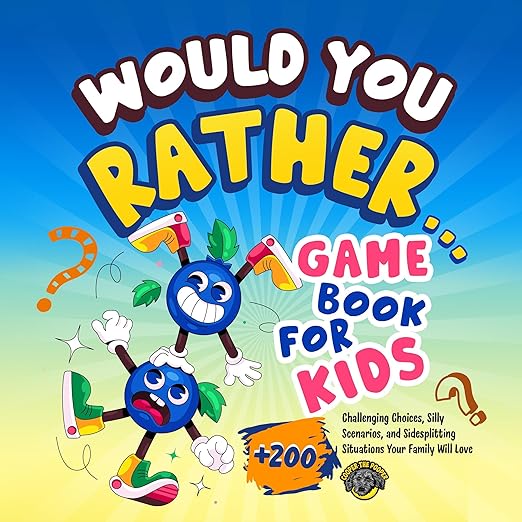
Would You Rather Game Book for Kids is presented as Cooper the Pooper’s debut volume, Cooper being, per the conceit, a dog who has curated the world’s best hypothetical questions. That framing is exactly as silly as it needs to be for a children’s game book, and the author does not push it further than it deserves. The questions are the product. The dog is a hook to make the opening pages feel like something other than a Q&A list.
Two Hundred Questions and One Useful Design Decision
The book organizes its 200-plus questions into themed categories, which is the right call for audio specifically. Organized sections give Derrick Magolski’s narration natural stopping points, let families decide how long to play any given theme, and prevent the experience from feeling like a random infinite scroll. Kristi Dement’s detailed review helpfully breaks down the categories, Human Body questions are one section, Animals another, and highlights specific questions from each. That structure also means the book can be replayed from different starting points rather than requiring the same linear experience each time.
The questions themselves range from the relatively benign (would you rather become a grown-up or stay the same age for three years) to the gloriously absurd (fingernails for eyelashes or eyelashes for fingernails; ears made of cheese; having to fight a leopard). The blend is intentional. Easy questions draw in reluctant participants. The more unhinged questions produce the genuine laughter and argument that make game books worth opening.
Magolski’s Narration and the Participatory Challenge
“Would You Rather” books are participatory by definition. They require pausing, arguing, defending, and being horrified at other people’s choices. Audio narration is, by design, continuous. The question is whether Magolski’s delivery creates space for that participation or steamrolls through it. He does not steamroll. His pacing implies pause even without explicit silence, there is a slight lift at the end of each question, a tonal signal that something is expected before the next one arrives. April Melvin’s review notes using it with her eleven-year-old boys during a baseball game, pulling it up on her phone and reading questions aloud. That is the optimal deployment model: use the audio as a prompt generator, pause it yourself, let the debate happen, resume.
Becky’s review was the one that surprised me most: she is using it as a writing prompt source in her second-grade classroom. “Would you rather” questions make excellent writing prompts because they require the student to take a position and defend it, which is the same cognitive work as a persuasive paragraph but without any of the formality that makes persuasive writing feel difficult to younger students. That is a non-obvious use case that the author presumably did not intend but that the book enables naturally.
The Replay Question
At thirty-seven minutes for 200-plus questions, the book is efficiently paced. A family session of twenty to thirty minutes will cover forty to fifty questions. That means the full collection lasts through roughly four or five dedicated sessions before repetition begins. After that, children start generating their own questions, which is arguably the book’s best outcome. The goal is not to exhaust a question bank but to teach a format that kids then run independently. At thirty-seven minutes, the audiobook is less a replayable product and more a primer that catalyzes the real game.
Who Should Listen / Who Should Skip
Listen if you need something to run in a car, a waiting room, a school hallway, or any space where a group of people need something to react to together. This is social audio, it works because people respond to it, not because they absorb it quietly. Skip if you are hoping for a book your child can engage with independently and reflectively; the format requires other people to reach its full potential. One person listening alone will answer questions in their head and probably enjoy it, but the book’s design assumes a room.
Frequently Asked Questions
Is 37 minutes long enough to keep a family occupied on a long road trip?
For a road trip of several hours, thirty-seven minutes of audio will not carry the whole journey. But the format is designed to generate conversation that extends well beyond the audio itself, reviewers note children starting to invent their own questions after just a few rounds. Treat the thirty-seven minutes as a launch point rather than a complete activity.
How does Derrick Magolski’s narration handle the pause a ‘Would You Rather’ game requires?
Magolski paces the questions with a slight lift and pause at the end that signals a response is expected. He does not build in long silences, so families should simply pause the audio themselves when a debate breaks out. The narration is designed to be interrupted and resumed easily.
Are the questions appropriate for the full stated age range, or is there a sweet spot?
The questions work for roughly ages six through twelve, with different entry points for different ages. Younger children enjoy the sillier body and animal questions. Older kids and teens are pulled in by the more logically demanding hypotheticals. The reviewer who used it in a second-grade classroom confirms the younger end is genuinely engaged.
Can this be used as a writing prompt resource for classroom or homeschool use?
Yes, one reviewer uses it exactly this way in her second-grade class. ‘Would you rather’ questions require position-taking and defense, which maps directly onto the cognitive demands of persuasive writing. The themed organization makes it easy to select questions relevant to a specific topic or writing unit.