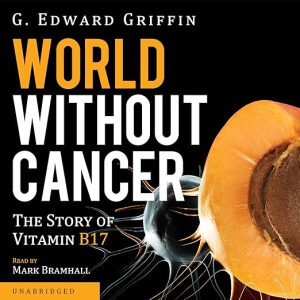
World Without Cancer occupies an unusual position in the audiobook landscape. Originally published in 1974 and still circulating with an active and devoted readership more than fifty years later, G. Edward Griffin's argument about Laetrile, the compound derived from apricot seeds that Griffin identifies as vitamin B17, predates much of the regulatory and scientific context that would eventually evaluate his claims directly. Listening to it now, decades after clinical trials consistently failed to validate Laetrile as a cancer treatment and after the FDA banned its interstate commerce, requires a particular kind of critical engagement that the book itself does not invite. Griffin is a convinced advocate, not a balanced investigator, and understanding the text means holding that distinction clearly throughout.
I listened to the first several hours on a Sunday morning, initially struck by Griffin's rhetorical discipline. He is a careful writer who builds his argument in logical steps, beginning with the biochemical theory of cancer as a nutritional deficiency, analogized to scurvy and pellagra which are indeed deficiency diseases, before expanding into political territory. His central thesis is that orthodox medicine's rejection of Laetrile is not scientific but economic, driven by the financial interests of pharmaceutical corporations and their allies in the medical establishment.
Our Take on World Without Cancer
Griffin draws on the work of Dr. Ernst T. Krebs Jr., a biochemist who developed the trophoblast theory of cancer and who identified amygdalin, sold as Laetrile, as the compound he believed would correct the underlying deficiency. Reviewer Afterthot, who read the original two-part publication nearly four decades before this recording and returned to it with renewed conviction, represents the book's core audience: people for whom the theory has been personally meaningful and for whom the mainstream rejection of Laetrile is itself evidence of the suppression Griffin describes. That circular logic is worth naming, because it is part of what makes the book both compelling to its audience and resistant to external evaluation.
The problem for a contemporary listener is that Laetrile has been extensively studied since 1974. The National Cancer Institute conducted clinical evaluations, and the consensus among oncologists, toxicologists, and biochemists is that evidence for Laetrile as an effective cancer treatment does not exist and that the compound can cause cyanide poisoning in concentrated doses. Griffin's book does not engage with these findings because it was written before most of them existed. Reading it as a historical document of alternative medicine advocacy in the early 1970s is entirely legitimate and intellectually interesting. Reading it as a current practical health guide requires significant independent research beyond what Griffin provides.
Reviewer Guy Denutte made a point about cancer statistics that remains accurate regardless of one's position on Laetrile: cancer affects an enormous proportion of the population, governments and health systems have not treated it with the urgency of more dramatically visible disease outbreaks, and the financial structures of pharmaceutical research create real incentive problems that affect which treatments get developed and studied. These are legitimate institutional critiques. Griffin's error is not in raising these structural questions but in treating them as explanatory of specific clinical outcomes and in using institutional critique as a substitute for clinical evidence.
Why Listen to World Without Cancer
The second half of the book shifts substantially into political territory, tracing what Griffin frames as the hidden economic agenda of pharmaceutical corporations, the Rockefeller interests, and the foundations that shape medical education and research. Reviewer Marc Cleroux noted the book's extensive coverage of I.G. Farben, the Rockefeller cartels, pharmaceutical industry control of educational institutions, and the history of both vitamin B15 and B17. This section is where Griffin's broader worldview, consistent across his many books including The Creature from Jekyll Island, is most visible and most characteristic.
That framework has real analytical tools embedded within it. Pharmaceutical industry influence on regulatory bodies is a documented and legitimate subject of concern that has only become more pressing in the decades since Griffin wrote. Griffin's contribution is not in inventing this critique but in applying it with rhetorical force to a specific case. His limitation is in treating the existence of institutional corruption as sufficient proof of the specific therapeutic claims he is advancing. The gap between those two things is where the book's argument is weakest and where critical distance is most necessary.
What to Watch For in World Without Cancer
Bramhall brings a steady, measured quality to the material that suits Griffin's investigative register. He does not editorialize or add skeptical color, which is exactly what the audiobook format requires of a narrator. He reads the text as written, treating the argument as the author intended it to be received. His pacing is unhurried across the thirteen-hour runtime, giving the argument room to develop without rushing past the sections where Griffin is building his case from primary sources. Listeners who want to hear the book as Griffin constructed it will get exactly that. Listeners who need external perspective woven into the narration will not find it here and will need to bring it themselves.
Who Should Listen to World Without Cancer
This is for listeners interested in the history of alternative medicine advocacy and in understanding the cultural and political landscape that sustained Laetrile as a treatment option for decades despite mainstream scientific rejection. It is also valuable for students of political economy who want to understand how institutional critique functions in health policy contexts, and for anyone curious about how books written before their central claims were tested remain influential in alternative health communities. Skip it if you are seeking evidence-based cancer information. Griffin's book is advocacy built on pre-clinical-trial assumptions, and its recommendations should not be followed without independent consultation with current medical research.
Before You Listen
Has Laetrile been clinically tested since Griffin's book was written in 1974?
Yes, extensively. Multiple clinical evaluations conducted after the book's publication, including studies sponsored by the National Cancer Institute, found no reliable evidence that Laetrile is effective as a cancer treatment. The FDA banned its interstate commerce. Griffin's book does not engage with these later findings because it predates them.
Is this book best understood as a health guide or as a historical document of alternative medicine advocacy?
As a historical document of alternative medicine advocacy and political economy critique from the early 1970s, it is genuinely illuminating. As a practical health guide for cancer treatment, it should be approached with significant critical distance and complemented with independent research into Laetrile's clinical record since 1974.
Is World Without Cancer available as a free audiobook?
Yes. World Without Cancer is available as a free audiobook for Audible subscribers. Its long circulation and dedicated readership make it an interesting listen for anyone wanting to understand the alternative health tradition, provided they engage with it critically rather than prescriptively.