Quick Take
- Narration: Gary Paulsen reading his own memoir is exactly as elemental as you would expect, plain-spoken, unhurried, and carrying the authority of someone who was actually there.
- Themes: Wilderness survival, the bond between humans and working dogs, the Iditarod as personal reckoning
- Mood: Quietly intense, with stretches of lyrical observation and moments of raw confrontation with mortality
- Verdict: One of the most honest memoirs in the middle grade canon, and in the author’s own voice it becomes something close to an oral primary source.
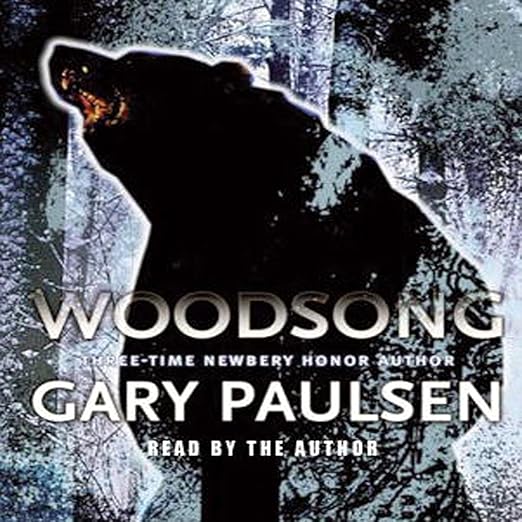
I was halfway through my morning coffee when I started this one, intending to listen for twenty minutes while I caught up on some reading notes. I finished it. The whole thing. That is the effect Gary Paulsen has when he is at his most direct, which in Woodsong he almost always is. The audiobook runs two and a half hours, and the narration is Paulsen himself, which means you are not listening to a reconstruction. You are listening to a man describe the years in Minnesota when he ran sled dogs through the wilderness, the animals he came to love and understand, the violent moments the wilderness imposed on him, and his eventual decision to enter the Iditarod. It is the kind of audio that makes you want to go outside afterward.
Paulsen is best known to young readers through Hatchet and its sequels, survival fiction that draws on the same wilderness knowledge he documents here. Woodsong is where that knowledge lives in nonfiction form. The book covers his years working with sled dogs in Minnesota, which he describes not as hobby or recreation but as a fundamental reorientation of how he understood the natural world. The animals in this book are not pets or sporting equipment. They are collaborators with their own intelligence, hierarchies, and emotional lives, and Paulsen writes about them as such. This is not anthropomorphism. It is careful observation over years of proximity.
The Encounters That Reorient Everything
The memoir is structured around a series of encounters rather than a conventional biographical progression. A bear and her cubs. The death of a dog who runs himself to exhaustion out of sheer will. A moment in a field where Paulsen witnesses something in the relationship between his lead dog and the land that he cannot fully explain but cannot stop thinking about. These incidents accumulate rather than build toward a conventional climax. The effect is cumulative rather than dramatic, which suits both the material and Paulsen’s sensibility as a writer. The Horn Book comparison to Jack London is apt, and Paulsen himself would probably accept it.
What Self-Narration Does for This Material
There is a category of audiobook where a professional narrator would genuinely serve the material better than the author. Woodsong is not that book. Paulsen’s voice carries a flatness that is not a lack of expressiveness but a kind of hard-won simplicity. When he describes something dangerous or terrible, he does not lower his voice or slow his pace for effect. He just describes it. This approach makes the truly harrowing passages, and there are several, land with a weight that performance-oriented narration would actually diminish. The delivery matches the writing: spare, direct, and without sentiment in the cheapest sense of that word.
The Iditarod and the Question That Has No Clean Answer
The book’s final section covers Paulsen’s preparation for and participation in the Iditarod, the 1,100-mile Alaska sled dog race. What makes this section interesting is that Paulsen does not present the Iditarod as a logical culmination of what came before. He presents it as something closer to a compulsion, an answer to a question he could not articulate clearly but needed to answer anyway. That honesty about motivation, the admission that some things are done for reasons that resist clean explanation, is part of what lifts Woodsong above the outdoor adventure memoir genre. The race narrative itself is extraordinarily physical and often brutal, but Paulsen writes it with the same quietness he brings to everything else.
A retired librarian in her sixties and a twelve-year-old both reportedly loved this book, which is exactly the cross-age range it reaches. The writing is sophisticated enough for adult readers but narrated in a register that young listeners can inhabit fully. It is the kind of appeal that comes from writing with genuine simplicity rather than condescension.
Who Should Listen, Who Might Skip
Best for ages 10 and up through adult, particularly those drawn to wilderness nonfiction, survival writing, or the Hatchet series. The encounters with death and animal violence are described plainly enough that sensitive younger listeners should be aware of what they are entering. Anyone who has read Jack London, Jon Krakauer, or Paulsen’s fiction will find this essential context for understanding the source material of his literary sensibility.
Frequently Asked Questions
Is Woodsong a good companion listen to Hatchet or Brian’s Saga, or does it stand alone?
It stands completely alone as a work of nonfiction memoir, but it functions as a biographical key to Paulsen’s fiction. Listeners who have read Hatchet will immediately recognize the wilderness knowledge and survival instincts that populate Brian’s story. It is not a prerequisite for the fiction, but it enriches it substantially.
Does Paulsen discuss the physical demands on the dogs in the Iditarod? Is there content that might upset animal-sensitive listeners?
Yes, and this is worth flagging. Paulsen describes the physical toll on sled dogs with complete honesty, including the death of at least one dog in the memoir. He treats this with respect rather than exploitation, but the content is real and present. Listeners who are sensitive about animal welfare in nonfiction should know it is there.
Is the self-narration technically polished, or does it have the rough quality of author recordings?
It has something of an author-recording quality in the best sense: it sounds like a person rather than a production. There are no major technical problems, but the appeal is in Paulsen’s voice and delivery rather than in studio polish. Listeners who prefer highly produced narration may find it understated.
Where does this fit chronologically in Paulsen’s life? Does it cover the same period as My Life in Dog Years?
Woodsong covers Paulsen’s Minnesota years in the early 1980s leading up to his first Iditarod run in 1983. His other memoir My Life in Dog Years covers related ground and some overlapping events from a different angle. Woodsong is generally considered the primary account of this period.