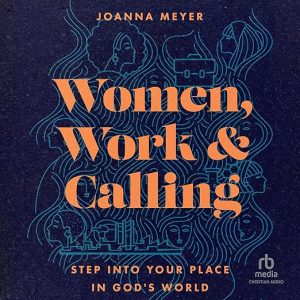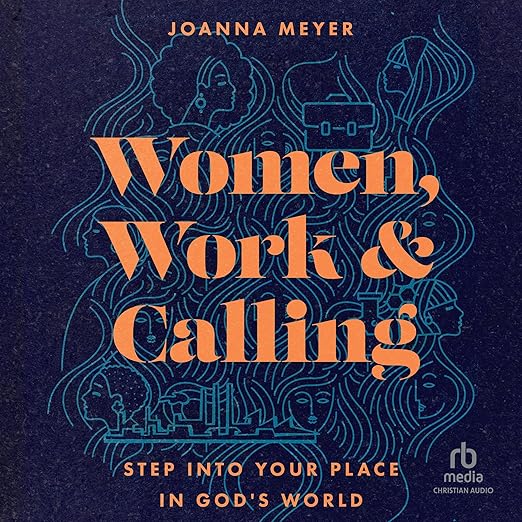
Women, Work, and Calling
Audiobook & Ebook

Women, Work, and Calling by Joanna Meyer | Free Audiobook

By Joanna Meyer

Narrated by Jeannie Sheneman

🎧 2 hours and 23 minutes 📘 Christian Audio 📅 October 24, 2023 🌐 English
🎧 Listen Free on Audible 📖 Read on Kindle

Free 30-day trial · Cancel anytime

About This Audiobook

Women now have professional opportunities beyond what previous generations ever imagined. But as our roles in public life have grown, the church’s vision for women’s work and calling has not grown with us, leaving us feeling isolated and under-resourced. Christian women face multiple tensions between home and work, navigating complex gender dynamics in the workplace and social pressure to hold together picture-perfect lives.

Joanna Meyer addresses a critical gap in Christian women’s discipleship by speaking to the roles we play in public and professional life. Acknowledging the brokenness of workplaces and industries, she provides a theological framework for women’s work and influence and offers resources for the challenges of working life. This book will help you: ignite your vocational imagination, with a biblical framework for work and calling; build strength from within, with emotional and spiritual health to support your work; navigate common workplace challenges, with practical tools to help your influence grow; and pursue purposeful relationships, collaborating and building strong relationships with others.

Learn from the lived experience of godly female leaders and discover how women can have a redemptive impact through our work.

🎧 Listen Free on Audible

Free 30-day trial · Cancel anytime

Quick Take

  • Narration: Jeannie Sheneman narrates with warmth and pastoral attentiveness, a natural match for material rooted in faith community and vocational discernment.
  • Themes: Christian vocation, women’s work in secular and church contexts, faith and professional identity
  • Mood: Reflective and theologically grounded, with a gentleness that doesn’t blunt the book’s real challenges to church culture
  • Verdict: At just over two hours, Women, Work, and Calling is compact but substantive, a theological framework for working women that the Christian market has needed and largely lacked.

I came to this one from outside its primary community, which I think is worth naming upfront. Women, Work, and Calling is an explicitly Christian book written for Christian women navigating the specific tensions that arise when professional life collides with church culture that has been slow to catch up with women’s expanded roles in public life. As a reader without that faith tradition, I’m reviewing it as a work of theological ethics applied to a contemporary social problem, and I found it considerably more rigorous and honest than I expected.

Joanna Meyer works with the Denver Institute for Faith and Work, and the book emerges from twenty-five years of research and ministry engagement with working women across industries. The problem she names in the opening pages is specific and real: Christian women have access to professional opportunities that previous generations could not have imagined, but the theological frameworks their churches offer for thinking about vocation and calling were largely constructed before those opportunities existed, and have not been updated. The result is a structural gap in discipleship. Working women show up in church environments that celebrate motherhood and domesticity with specific theological grounding, but that largely lack an equivalent theological vocabulary for professional work and public contribution.

The Discipleship Gap Meyer Fills

Meyer is careful not to frame this as a simple advocacy document for women’s professional advancement within Christian community. The book is more nuanced than that. She works from within the tradition rather than against it, drawing on a theology of work that takes the idea of vocation seriously across all its domains rather than privileging domestic vocation over professional contribution. Her argument is not that women should work outside the home but that Christian communities need a theological account of what it means to work wherever you work, and that account needs to be robust enough to sustain women through the specific challenges they face in professional environments. Reviewer Candace Chapman noted that the book manages to be theologically grounded without being disconnected from daily professional reality, and that balance is hard to achieve and consistently maintained here.

Workplace Navigation as Spiritual Practice

The chapters on navigating common workplace challenges are where the book moves most firmly into practical territory, and they are stronger than the genre average. Meyer addresses gender dynamics in professional settings, the difficulty of building influence without the formal authority structures that men more readily access, and the particular challenge of working in environments where faith itself may be a source of professional complexity. The emotional and spiritual health chapter is a direct response to the burnout and identity fragility that frequently affect women who are trying to integrate professional ambition with faith community expectations that may be pulling in different directions.

Single Women, No Children, Seen At Last

Reviewer EE, a single woman without children, described feeling seen by this book in a way that most Christian women’s resources do not provide. This is worth emphasizing because it is a genuine distinction. Women, Work, and Calling does not organize its theology of women’s vocation around marriage and motherhood as the primary frame. It addresses working women as a category that includes single women, childless women, women who are primary breadwinners, and women at every stage of professional life. This breadth is not accidental, Meyer is explicitly trying to address a discipleship gap that has left whole categories of women feeling invisible in church communities focused on family formation as the primary arena of women’s faithful contribution.

Short Runtime, Long Implications

At two hours and twenty-three minutes, this is one of the briefer books in any category I review regularly. The brevity is real, and some sections feel compressed to the point where a longer treatment would have added considerably. The chapter on pursuing purposeful professional relationships addresses real and complex dynamics quickly enough that the guidance feels more like orientation than full development. But the book’s core theological framework, the idea that work is a site of redemptive contribution and not just economic necessity, is fully stated and well-argued within its runtime. Jeannie Sheneman’s narration is warm and measured, a match for the pastoral register Meyer writes in, and the audio experience is notably smoother than some books of this length that feel rushed.

Who should listen: Christian women navigating the tension between professional ambition and church community expectations; female ministry leaders looking for a theological framework to share with their communities; pastors and church leaders who want to understand the discipleship gap their programming may be creating for working women.

Who should skip: Listeners who are not embedded in or interested in Christian theological frameworks for vocation will find the book too specifically situated. The professional and emotional observations are broadly applicable, but the prescriptive framework is rooted in Christian theology and is not translated into secular equivalents. Non-religious readers will find more applicable material in the other women-in-business titles in this batch.

Frequently Asked Questions

Does Women, Work, and Calling address the question of whether women should hold leadership roles within churches, or is it focused on secular professional environments?

Meyer’s focus is primarily on secular professional environments rather than intra-church governance questions, which is a deliberate choice. The book addresses how Christian women can bring their faith to bear on their work in public and professional life, and how churches can better support that integration. The contentious question of women’s leadership roles within church structures is acknowledged but not the book’s central concern.

Is the book’s theological framework accessible to Christian women from traditions that have differing views on women in ministry?

Meyer writes with enough theological breadth to be accessible across multiple Protestant traditions. She grounds her argument in a creation theology of work that most traditions share, and she avoids the specific denominational debates about women’s ordination or eldership that would have narrowed the book’s audience considerably. Women from more conservative traditions may find some of the professional ambition framing in tension with their community’s expectations, but the theological work is broad enough to be engaged across the evangelical spectrum.

At two hours and twenty-three minutes, is Women, Work, and Calling substantive enough to use as a small group discussion resource?

Reviewer EJN specifically praised it as a great book for reflection and discussion, and the structure supports that use. Each chapter contains both Meyer’s own thinking and carefully curated quotes from other authors, which gives discussion groups points of entry beyond the main argument. The compact runtime means a group could complete the book over one or two sessions and engage with its framework in a focused way.

The narrator is Jeannie Sheneman rather than the author. Does this affect the intimacy of what is clearly a personal and pastoral book?

Sheneman’s narration is warm and attentive to the material’s pastoral register. A book of this type, rooted in ministry experience and theological reflection, often benefits from a narrator who can hold both the emotional weight of testimony and the analytical weight of theological argument, and Sheneman manages both. Meyer’s personal voice is present through the writing’s specificity rather than through self-narration, and listeners who value professional narration quality over author performance will find the choice appropriate.

Ready to listen?

🎧 Listen to Women, Work, and Calling for free

Free 30-day trial · Cancel anytime

What Listeners Are Saying

★★★★★

Approachable, Inspiring, and Empowering

What I love about this book is that it is approachable – not overly theological which feels out of touch with my daily experience as a working woman in the commercial real estate development industry, yet empowering that a woman is writing it and understands the role of women in…

– Candace Chapman
★★★★★

Great Book for Reflection and Discussion

Joanna Meyer has captured many helpful concepts in her book. Each chapter contains the author’s thoughts and carefully curated quotes from other authors. This combination gives the reader a well-organized collection of material in one concise and easy-to-read book.One of the things that makes this book particularly valuable is that…

– EJN
★★★★★

A MUST READ for Women in the Workforce.

As a single woman with no children, I felt incredibly SEEN. Christian culture often overlooks women working outside the home. This book is not only for working moms and wives, but also for women like me. I'm so grateful for Joanna's work in ministry and the gift of this book….

– EE
★★★★☆

Helpful book

There's a really good list in here about the different types of rest we need and I found it helpful to share with the women in a small group I host. This is a short book so it's a quick, easy read with some good info.

– Tonia Henry
★★★★★

Profound AND practical

This little book is deceiving – it is concise and easy to read, yet is packed with gems of wisdom and practical action steps. Having worked in a professional setting for 30+ years, I can attest to the truth of the author’s insights and I gained new insights that I…

– HNKChicago

Start Listening: Women, Work, and Calling


Free 30-day trial · Cancel anytime

Alexandra Reed

Written by Alexandra Reed

Founder & Literary Critic