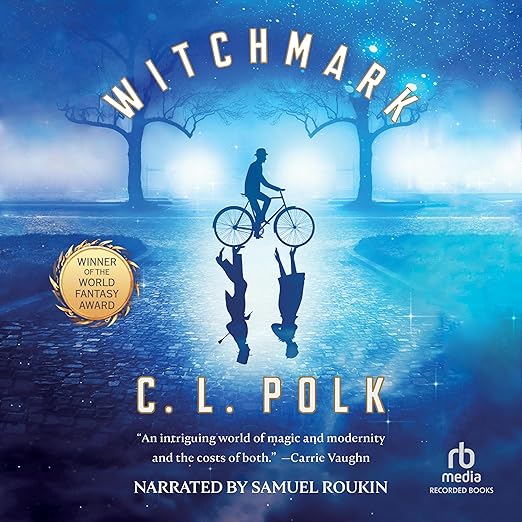
Aeland and Laneer have been at war, and the men coming home from it are strangers to their friends and their families. That is the sentence the description leans on hardest, and it is why this audiobook works as well as it does: Witchmark is a novel about what a war does to the people who survive it long before it is a novel about magic. Recorded Books runs it at eight hours and fifty-three minutes, one credited voice, first book of the Kingston Cycle, and the shape of the thing turns out to be a murder investigation that keeps sliding into a diagnosis.
A Closer Look at Witchmark
Miles Singer was marked by magic at birth and handed two futures, both of them cages: serve his family's interest as their property, or be committed to a witches' asylum. He took a third option instead, went to war, faked his own death and rebuilt himself as a doctor in a hospital that cannot afford him. The premise is doing something clever underneath the fantasy furniture. Every piece of the magical apparatus doubles as a description of class, of inheritance, and of the price of being useful to people who have names worth protecting.
Concealment is the engine, and it is the reason the book earns its romance instead of bolting one on at the side. Everything Miles wants requires him to be visible, and everything he has built requires him not to be. C. L. Polk keeps those two pressures rising together, so that the closer the investigation gets to an answer, the closer it gets to him. That is a genuinely well-made structure, and it does considerably more work than the four nouns in the description, intrigue and magic and betrayal and romance, would lead you to expect.
Recorded Books put Samuel Roukin on it, alone, for a book whose protagonist's whole situation rests on what he does not say out loud. That is a harder assignment than a full cast would be. The voice has to carry a secret across the entire span without letting a listener forget it and without underlining it either, and a sample is the only way to learn whether that balance holds for you. Nothing in the written column touches the reading, so the page offers no help on the question.
Fantasy readers tired of maps and prophecies will find the worldbuilding here refreshingly domestic. Cabals of noble families using magical gifts to control the fates of nations sounds grand in a blurb; in practice the novel spends its hours on hospitals, siblings, money and the machinery of a family that treats a person as a resource to be drawn on. The Edwardian register does much of the work, and it never once tips into pastiche.
Magic in this world is a status system rather than a toolkit. Being marked settles whether you inherit or whether you are inherited, and the book stays unusually clear-eyed about what that arrangement does to the people at the bottom of it. Among the entries on this page, one arrives in German and singles out the worldbuilding above everything else it praises, which is the right thing to single out. The invention here is social before it is magical.
Witches' asylum is the threat hanging over the whole book, and it is the point where the fantasy stops being decorative. A society that has built a facility for people born with the wrong gift has already told you what it thinks of them, and Polk never needs to editorialize about it. That restraint is exactly why the emotional payoffs land when they arrive. The anger lives in the structure rather than in the dialogue, which is rarer than it should be in a first novel.
Things to Know Before Starting Witchmark
Length is where the strongest objection sits. A three-star response argues, in as many words, that the book could have been so much more and would have been better at double the size, then describes the setup it wanted more room for: a doctor working in a veteran's hospital, a man brought in poisoned, and an investigation the two of them take on together. That is a fair complaint about a book that packs a great deal of world into a short volume, and it is the one criticism a prospective buyer should weigh seriously.
Arithmetic on this page does not work, and it is worth saying plainly. The listing counts too few ratings to produce the average it displays, under any rounding convention you care to apply, and the counter also sits below the number of written responses visible directly underneath it. The honest conclusion is not fraud. It is that the figure at the top cannot be a summary of the opinions shown below it, which means the badge is not evidence and the text has to carry the decision.
Samuel Roukin's reading is the only performance element on the page, and the page says nothing else about how the recording was made. The other gap worth knowing about is where this book has been filed. The listing shelves it under a single category and leaves the tag field empty, so a reader hunting for Edwardian fantasy, or for a murder mystery, will never meet it by browsing. Word of mouth is doing most of the discovery work here.
Who C. L. Polk Is Writing For
Mystery readers who want their puzzle embedded in a society rather than laid on top of one will get on with this immediately. Reach for it if you like your fantasy Edwardian, your magic bureaucratic and your romance slow, careful and consequential. It is also, quietly, one of the better entry points for someone who does not usually read fantasy at all, because nearly everything strange in it is explained by something entirely familiar.
Give it to anyone who has enjoyed a country-house mystery and wondered what one would look like with the class system made literal and magical at the same time. Leave it on the shelf if you need a self-contained ending, because this opens a cycle and behaves accordingly, and leave it on the shelf if a compressed debut is the kind of thing that frustrates you rather than intrigues you.
Consider what the page is actually offering: a well-built first novel, a single credited reader, a series opener with no series shelving to help you find the rest of it, and a summary figure that cannot be summarizing anything on display. The book survives all of that without much difficulty, which is more than most debuts manage. Set the badge aside and let the first chapter decide.
Common Questions
Can the star rating on this audiobook listing be trusted?
Not as a summary of the opinions shown. Under any rounding convention at all, the average on display cannot be built from the votes this page counts, and the counter is smaller than the stack of written responses sitting under the badge. Neither fact says anything about the novel itself. Both say the badge is not measuring what a buyer assumes it measures.
Does Witchmark stand alone, or do I need the rest of the series?
It opens The Kingston Cycle and is listed as the first volume, so the investigation resolves while the world it happens in does not. The description promises a thrilling conclusion rather than a complete one. Read it as a series opener and expect the ending to close the case in front of you while leaving the larger arrangement standing.
Who narrates the audiobook and how long does it run?
Samuel Roukin is the credited reader, and Recorded Books lists eight hours and fifty-three minutes, released in June 2018. A single voice covers the whole cast, including an Edwardian household, a hospital ward full of returned soldiers and the relationship running between them, which is a substantial range for one reader to hold across a plot built on concealment.