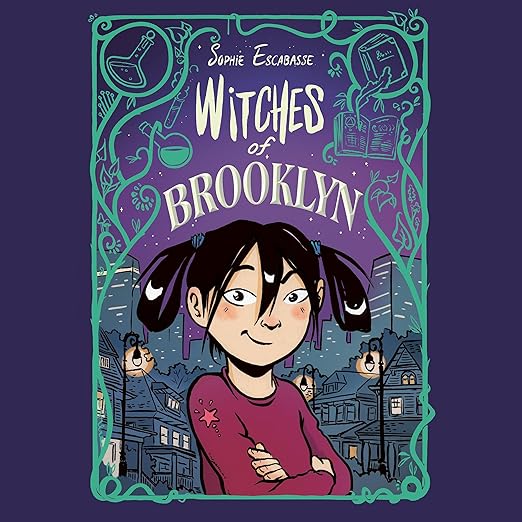
My niece is nine, and she has been in what I can only describe as a sustained witch phase for the past year and a half. When I saw that Witches of Brooklyn, the graphic novel she had pressed into my hands twice already insisting I read it, had an audio adaptation, I put it on during a drive we took together. She sat very still for the entire hour and twenty-seven minutes. That is, in my experience reviewing audiobooks alongside children, the most accurate measure of success available.
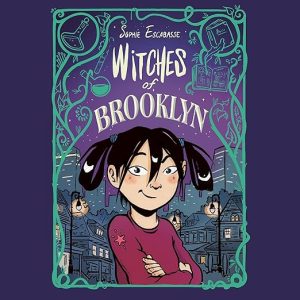
Sophie Escabasse's graphic novel is genuinely beloved in its original form, with the illustration style doing significant work in establishing the witchy-Brooklyn atmosphere and the physical comedy of Effie's aunts. The challenge of an audio adaptation is obvious: how do you translate visual humor, sight gags, and expressive line work into pure sound? Sara Matsui-Colby's performance is the answer to that question, and it is largely a successful one. The characters survive the translation because they are fundamentally built on voice and personality rather than visual spectacle.
Effie is recently orphaned, which is not the central emotional premise in the comic's own framing but becomes more visible when you remove the visual distraction of Escabasse's artwork. She is sent to live with aunts she barely knows in Brooklyn, which in the original graphic novel is immediately offset by visual charm. In the audio adaptation, the aunts' weirdness, their unmistakable magical nature, their warmth underneath all the strangeness, has to be entirely carried by voice.
Matsui-Colby achieves this by leaning into the comedy and warmth simultaneously. The aunts are funny but never ridiculous; weird but never frightening for a middle-grade audience. That calibration is essential for content that is supposed to feel safe while remaining genuinely surprising. One reviewer drew a clear parallel to a grandmother figure she loved, describing the elder aunt as firstly and sweet, an observation that speaks to how specifically the characterization is rendered. That kind of recognition, a character who reminds a listener of someone real, is the mark of characterization that has escaped the generic, and Matsui-Colby's performance brings those characters to life in a way that allows it to happen through sound alone.
The found-family arc is handled with appropriate economy for the short runtime. Reviewers loved that Effie's aunts start as strangers and become a true family as the story develops, and the warmth of that evolution is fully present in the audio version. The grief at the story's core, the loss of Effie's mother, is acknowledged without being dwelt upon at a length that would be distressing for the eight-to-twelve audience this is calibrated for. It is present as context and as emotional texture rather than as the primary emotional note.
Why Witches of Brooklyn Works as an Audiobook
The synopsis mentions a cursed pop star, which is exactly the kind of plot element that works perfectly in middle-grade fiction because it is absurd enough to be funny and specific enough to feel real. This subplot is not the book's emotional center, which is Effie's growing understanding of her own magic and her relationship with the aunts, but it provides the kind of external comic adventure that gives the emotional story room to breathe without becoming too heavy.
The discovery of magical powers plotline is a middle-grade staple, but Escabasse avoids the usual pattern of the child protagonist immediately mastering her gifts. Effie's process is awkward and funny and sometimes alarming, which suits the tone. The aunts are established practitioners and powerful witches, but they are also clearly uncertain how to share their world with a child they are only now meeting. That relationship, two adults and a child learning to be a family while navigating genuine magical stakes, is what makes the story warmer than its genre conventions might suggest.
Weak Spots in Witches of Brooklyn
Graphic novel audio adaptations are inherently challenged by the absence of imagery, and not all of them succeed. This one works because the story's core is character-driven and dialogue-rich rather than visually dependent for plot. Matsui-Colby provides sufficient descriptive context in her narration to orient listeners who have not read the original, and the story's structure is strong enough to stand without the visual rhythm of page turns and panel composition that carries so much weight in the original format.
My niece, who knows the original very well, did not feel anything was missing. She laughed at the same moments she laughs at in the book. That is the most meaningful testimonial to the adaptation's success I can offer. The visual charm of Escabasse's artwork is not replaceable by audio, but the warmth and humor and character of the story are fully present in Matsui-Colby's performance.
The Right Listener for Witches of Brooklyn
This free audiobook is clearly aimed at middle-grade listeners in the eight-to-twelve range, and it is well-calibrated for that audience. Adult listeners accompanying younger children will find it pleasant rather than endurance-testing, which is also worth noting. At an hour and twenty-seven minutes, it is perfectly sized for a car trip or bedtime listening sequence. For a child who has read and loved the graphic novel, the audio adaptation offers a different pleasure rather than a lesser one. For a child encountering Effie for the first time, it is an excellent introduction to a series that has more volumes waiting and a creative universe that clearly has more to give.
- Narration: Sara Matsui-Colby brings effervescent energy to Effie and the aunts, capturing the graphic novel's visual humor and warmth in pure audio.
- Themes: Found family, magical heritage and identity, navigating grief through community
- Mood: Warm and whimsical, gently funny, with genuine emotional stakes underneath
- Verdict: A delightful audio adaptation of a beloved graphic novel series opener that works well even without the original illustrations, ideal for middle-grade listeners discovering witchy adventure.
Questions Listeners Ask
Can my child follow the Witches of Brooklyn audiobook without having read the graphic novel first?
Yes. The audio adaptation is designed to be accessible to listeners who have not seen the original illustrated version. Matsui-Colby's performance and the adapted narration provide enough context to follow Effie's story without the visual support of the original format. Children who have read the book will enjoy the familiar characters in a new form, but prior reading is not a prerequisite.
Is Witches of Brooklyn part of a series, and does this audio adaptation wrap up its story?
It is the first book in a series and it sets up further adventures for Effie and her aunts while resolving the immediate plot of this volume satisfyingly. The story has a complete arc. Children who love it will want to continue with subsequent volumes in the graphic novel series, which currently has multiple installments available.