Quick Take
- Narration: Cris Dukehart handles the multi-character ensemble with grace, her ability to differentiate the five main girls vocally while maintaining warmth is what makes an 11.5-hour sixth-series entry feel intimate rather than exhausting.
- Themes: Growing up, literary reflection, friendship across distance and difference, romance and its complications
- Mood: Bittersweet and warm, the feeling of closing a book you’ve loved and not wanting to say goodbye
- Verdict: A deeply satisfying series conclusion for fans of the Mother-Daughter Book Club, though new listeners should begin at the beginning.
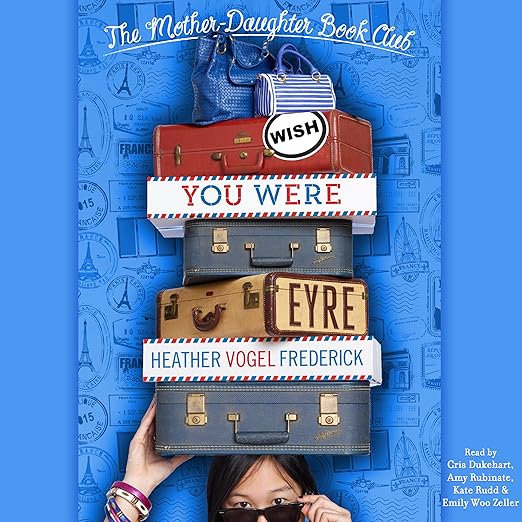
I finished this one on a Sunday evening with a cup of tea that had gone cold without my noticing. That particular distraction, the cold cup, the evening gone without tracking it, is something I associate with books that have earned genuine affection rather than just passing attention. Wish You Were Eyre is the sixth and final book in Heather Vogel Frederick’s Mother-Daughter Book Club series, and it does something difficult well: it ends a series about growing up while the characters are still, technically, growing up, and it does so with enough grace that the bittersweet feeling readers describe feels appropriate rather than abrupt.
For listeners who have followed Megan, Emma, Jess, Cassidy, and Becca through five previous books, this is the send-off the series deserves. For new listeners who have arrived here without context, I will say plainly: go back to the beginning. The emotional payoff depends on the investment.
Jane Eyre as a Mirror for Teenage Life
The series’ central conceit, that each book pairs the club’s reading of a classic novel with storylines that mirror or illuminate the novel’s themes, reaches a natural conclusion with Jane Eyre. Charlotte Bronte’s novel, about a woman of principle who refuses to surrender her identity for the approval of a man she loves, is a smart final text for a series about girls becoming themselves. When reviewer “My Favorite Pastime” describes Becca finding “a Mr. Rochester of her own,” they’re pointing to exactly how Frederick uses the literary parallel: not as a homework exercise but as a genuine emotional touchstone.
The multiple plotlines across the ensemble are confidently managed. Megan in Paris for Fashion Week, Emma and Stewart running Mrs. Wong’s mayoral campaign, Jess competing in a cappella finals with the MadriGals, Cassidy in hockey championships, each storyline has its own momentum and its own stakes. Frederick is a skilled enough writer that none of these feel like filler. They feel like the lives of people you know.
Cris Dukehart’s Work Across 11.5 Hours
An 11-hour-plus middle-grade audiobook is a significant vocal undertaking, and Dukehart has been with this series long enough to have genuine ownership of these characters. The differentiation between the girls’ voices is subtle but consistent: Megan’s aesthetic consciousness, Emma’s literary earnestness, Jess’s quiet sensitivity, Cassidy’s athletic directness, Becca’s complicated social positioning. By book six, a narrator who knows these characters well is a genuine asset rather than a production detail, and Dukehart clearly knows them.
Reviewer Laney B, who raised sons rather than daughters and used this series as a window into teenage girls’ lives, speaks to something the audio format amplifies: the voices make the interiority more accessible, not less. You hear these girls thinking, not just reading their thoughts.
The Series Arc and Its Resolution
Reviewer Danielle describes the bittersweet quality of finishing: “watching these girls grow up… made tears come to my eyes.” That reaction is the appropriate response to a series that has tracked these characters through roughly three years of adolescence, through family upheavals, friendships tested and deepened, first loves and complicated alliances. The wedding mentioned in the synopsis, attended by essentially the entire extended cast, including Annabelle Fairfax, the series’ recurring antagonist, gives Frederick a chance to bring the world of these books together for a finale that feels earned.
The Wyoming pen pals making a spring break appearance is a detail that will mean more to those who have read the series’ earlier books than it will to newcomers. The series rewards commitment.
Who Should Listen, Who Should Pass
For series fans: this is the conclusion you’ve been hoping for. For new listeners: start with The Mother-Daughter Book Club, the first volume. For parents considering this for a young listener: the series is appropriate for ages 10 to 14, and the audio format makes it particularly suitable for car trips or parent-child listening, given the themes of reading and shared literary experience.
Those who prefer faster pacing or less domestic emotional texture should look elsewhere. Those who love series fiction in which characters grow slowly and authentically will find something rare and worthwhile here.
Frequently Asked Questions
Can I start with this book if I haven’t read the previous five in the series?
Not ideally. The emotional payoff of Wish You Were Eyre depends heavily on knowing these characters across five earlier books. New listeners should begin with the first volume, The Mother-Daughter Book Club, and work forward.
Do I need to know Jane Eyre to follow this audiobook?
Familiarity helps but is not required. Frederick incorporates enough of the novel’s themes and story that listeners unfamiliar with Bronte will understand the parallels. That said, teens who have read Jane Eyre will get an additional layer of appreciation from the literary mirroring.
Is this series appropriate for younger children, such as ages 8-9?
The series is generally pitched at ages 10 to 14. Early books in the series can work for engaged readers at the lower end of that range. By book six, the romantic and social complexity is better suited to the middle and upper range.
Does the audiobook include any bonus content beyond the text?
No bonus material is listed for this edition. The production is a straight narration of the novel by Cris Dukehart, without additional interview content or reading group materials.