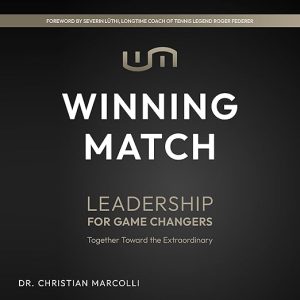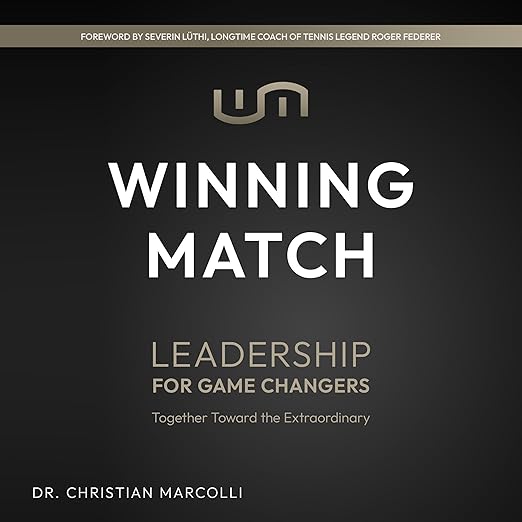
Winning Match, the leadership audiobook by Dr. Christian Marcolli, opens with a foreword from Severin Luthi, the longtime coach of Roger Federer, and that framing choice tells you something important about what Marcolli is attempting. This is not a book about leadership as hierarchical authority. It's a book about the specific conditions under which extraordinary people perform their best, and about the rare quality of relationship - what Marcolli calls the Winning Match - that makes the extraordinary sustainable. At four hours and five minutes, it's tight enough to listen to in a single focused session, and Daniel Greenberg's narration makes that kind of sustained attention easy to maintain.
Marcolli's positioning is unusual in the crowded leadership space. He's a performance psychologist who crossed deliberately between elite sport and C-suite consulting, and that crossover is the structural engine of the book. He introduces a framework built around identifying what he calls Game Changers - the rare individuals whose potential exceeds their current output by a significant margin - and then building the specific leadership relationships that unlock them. The foreword from Luthi isn't decoration; it's context. Federer's remarkable longevity at the top of a grueling sport is, in Marcolli's framing, partly a function of the quality of his coaching relationship, not merely talent or physical conditioning. Transplanting that logic into business leadership is the book's central project, and it works because Marcolli has genuinely spent more than two decades doing this work with global executives, not simply theorizing about it.
Reviewer Raquel Homes observed that the book "feels different from most leadership books" due to its emphasis on partnership and potential over control, and that distinction is observable from the opening chapters. Most leadership frameworks position the leader as the central actor whose qualities and decisions determine outcomes. Marcolli's Winning Match model repositions the leader as someone whose primary function is the creation of conditions - trust, recognition, specific developmental challenge - in which exceptional people can achieve what they wouldn't achieve alone. That's a subtle but significant reframe with real practical implications.
Greenberg Manages the Shift From Rigor to Story
Greenberg's narration carries the material with consistent authority and without the tonal flatness that undermines many business audiobooks. Leadership titles live or die partly on whether the narrator can sustain the register shift between analytical framework and personal story - too analytical and the book becomes a lecture, too casual and the frameworks lose their precision. Greenberg manages this balance throughout, keeping Marcolli's own journey from professional footballer to elite performance coach feeling personal without losing the intellectual rigor of the conceptual sections. The narrative of someone who has lived between the world of competitive sport and the world of global executive leadership carries more weight when the narrator treats both contexts with equal seriousness.
The audiobook format suits this content well because the book builds its case through narrative logic and verbal articulation rather than through visual frameworks. Unlike some business books where diagrams and models carry argumentative weight that audio can't replicate, Winning Match makes its case through story and reasoning. Reviewer Gina's response - "I wasn't expecting to get so much out of this book, but it really applies to any workplace" - suggests the framework's portability beyond its most obvious elite application, and that portability is built through verbal argumentation that audio delivers cleanly.
A Framework Built From Real Client Work
The framework Marcolli introduces is proprietary, developed through his specific practice rather than drawn from established academic literature. That's both a feature and a potential limitation. The upside is specificity: this isn't a synthesis of existing leadership research repurposed under a new title, but an original conceptual architecture grounded in real client work with real Game Changers in real organizations. The caveat is that the framework will resonate more immediately with some listeners than others depending on their professional context. Those working in coaching roles, or in industries where identifying and developing exceptional talent is a central strategic priority, will find the most immediate purchase.
Reviewer Homes notes the book is "especially useful for coaches," and that's accurate - the athletic analogy at the book's core is most directly applicable to formal coaching relationships. That said, the broader principles of trust-based leadership conversation and the specific behaviors that build the conditions for Game Changer performance are abstracted enough to apply across a range of professional contexts. Reviewer "Filled with useful strategies!" notes that the examples from top athletes and executives "make it easy to understand," which speaks to Marcolli's skill at grounding abstract principles in recognizable human situations.
For Leaders Already Operating at a High Level
This audiobook will find its best audience among leaders and coaches who are already operating at a high level and are specifically interested in how to develop their best people rather than simply manage performance across a team. If your question is "how do I get more out of exceptional people?" rather than "how do I build basic management competence?", Marcolli is speaking directly to you. Senior leaders in competitive industries - consulting, financial services, elite professional services - will find the athletic analogy most immediately applicable to their own high-stakes environments.
Those looking for a comprehensive management manual or a broad survey of leadership research will find the book narrower in scope than they expect. But within its specific aim - the cultivation of high-performance partnerships with individuals of unusual potential - Winning Match is precise, practical, and backed by two decades of real-world application that gives the framework credibility well beyond pure theory. At four hours, it asks for focused attention and returns proportional value.
At a Glance
- Narration: Daniel Greenberg delivers a clean, professional performance that maintains the executive coaching register without becoming dry - he keeps the personal anecdotes warm and the frameworks crisp.
- Themes: elite performance partnerships, identifying game-changers, trust-based leadership over control-based management
- Mood: Focused and purposeful, with a warmth that separates it from standard business productivity titles
- Verdict: Dr. Marcolli's framework is genuinely distinct from most leadership audiobooks, grounded in two decades of real-world application with global executives and world-class athletes.
Before You Listen
Is the Winning Match audiobook accessible for listeners without a formal business background?
Yes - the book is designed for people across coaching, leadership, and management roles, and reviewers with varied professional backgrounds have found it applicable. The athletic analogies and personal stories make the Winning Match framework concrete rather than abstract, and the language remains accessible throughout.
Does the audiobook format work well for Winning Match's framework-driven content?
Very well. Marcolli builds his argument through narrative and verbal reasoning rather than charts or visual models, so the audio format doesn't sacrifice any significant content. Greenberg's clean narration makes the conceptual sections as clear as the storytelling ones.
Is Winning Match specifically for executive coaches, or is it relevant to general managers?
The framework is most vividly illustrated through elite coaching contexts, but multiple reviewers emphasize its broader applicability. The core question - how to build the conditions for extraordinary performance in others - is relevant to anyone responsible for developing high-potential talent, not only formal coaches.
At four hours, does the Winning Match audiobook feel complete or too brief for its subject?
The length feels intentional. Marcolli builds his framework systematically but without padding, and the pacing moves efficiently from principle to application. For a conceptual leadership audiobook that makes a specific, focused argument, four hours is sufficient to establish, illustrate, and make the case meaningfully.