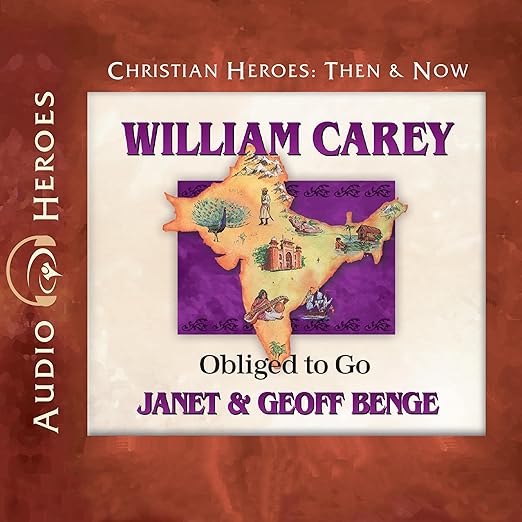
Quick Take
- Narration: Tim Gregory is the reliable voice of the Christian Heroes series, and his warmth and authority across five hours are well-calibrated for this material.
- Themes: Missionary calling and perseverance, the birth of modern missions, faith tested by hardship and personal loss
- Mood: Stirring and quietly harrowing, with the pacing of an adventure story and the weight of genuine historical suffering
- Verdict: Among the most substantive entries in the Christian Heroes series, built around a figure whose historical significance extends well beyond religious biography.
I started William Carey: Obliged to Go expecting a conventional missionary biography of the kind that tends toward reverence at the expense of complexity. What I got was something considerably more honest. Janet Benge does not sentimentalize Carey’s story, and the result is one of the more compelling biographical audiobooks I’ve encountered in this age range, regardless of genre. Tim Gregory narrates it with the steadiness the material requires, and the five-hour runtime, while substantial, earns its length.
William Carey is often called the father of modern missions, a title that reflects his systematic approach to the work of Christian evangelism in the late eighteenth and early nineteenth centuries. He was not planning to be a missionary. He trained as a shoemaker, then as a cobbler, and then felt called into ministry at a Baptist congregation in Northamptonshire. His conviction that the church had an obligation to bring the gospel to people beyond Europe, an idea that seems obvious now but was contested and even ridiculed in his day, drove him to push for organized international mission work at a moment when no such infrastructure existed.
The Dock Scene and What It Establishes
Benge opens the narrative with the dock scene in the synopsis: Carey watching a ship leave without him, his mission society assignment falling apart at the last moment before a passage to India finally becomes possible. It is a strong narrative choice because it immediately establishes the gap between Carey’s sense of vocation and the practical obstacles that nearly derailed it at every stage. The journey to India, when it finally comes, is not a triumph: it is the beginning of a period of hardship that tests everything Carey thought he knew about what service to God would look like in practice.
Hardship Without the Comfort of Resolution
What Benge handles well, and what makes this biography more than inspirational material, is her willingness to follow Carey into the suffering of his life in India. His first wife Dorothy struggled enormously with the displacement of life in Bengal, developing a mental illness that was understood and treated very poorly by the standards of the time. The early years in India involved poverty, fever, and failure by any conventional measure. Carey’s perseverance through this period is not presented as easy or uncostly. For young readers, the biography models something specific and valuable: that commitment to a calling does not insulate you from difficulty, and that faith is something sustained under pressure rather than something that prevents it.
The Serampore Mission and Its Legacy
The second half of the audiobook covers the years of genuine productivity at the Serampore Mission, where Carey and his colleagues eventually established a printing press, a college, and a program of Bible translation into dozens of Indian languages. This is where the biography’s scope expands from personal story to historical significance. Carey’s linguistic work alone, translating the Bible into Bengali, Sanskrit, and numerous other languages, would have been a lifetime’s achievement. Benge contextualizes these accomplishments within the larger history of Christian mission and colonial India carefully enough that young listeners get a sense of the complexity of that context without the biography collapsing into a debate about colonialism it was not designed to have.
Tim Gregory Across Five Hours
Gregory’s narration is a genuine asset over a runtime that would expose a weaker performance. He distinguishes the voices of different historical figures without overdoing it, he manages the shifts between adventure narrative and reflection with ease, and he brings appropriate gravity to the passages describing Dorothy Carey’s illness and the deaths of children in the mission community. One reviewer specifically cited his performance as outstanding, and within the context of the Christian Heroes series, Gregory has become the standard against which other entries are measured.
Who Should Listen and Who Can Skip
Families with an evangelical or broadly Protestant Christian orientation will find this essential. It is one of the strongest entries in the YWAM Christian Heroes catalog and works both as family read-aloud material and for older children listening independently. Listeners interested in early modern missions history, Indian colonial history, or the development of systematic Bible translation will find the content substantive beyond its devotional purposes. Those without interest in the faith framework will encounter a story that is genuinely compelling on human terms, though the narrative is consistently oriented toward Carey’s spiritual motivation as the primary interpretive lens.
Frequently Asked Questions
How does this compare to Paul Brand: Helping Hands, also by Janet Benge with Tim Gregory narrating?
Both are strong entries in the Christian Heroes series with the same author and narrator. Paul Brand’s story has more contemporary medical drama, while Carey’s has greater historical depth and a longer arc of hardship and perseverance. Both reward patient listeners. If you have enjoyed one, the other is a reliable follow-on.
Is the material about William Carey’s wife and her illness handled carefully for young listeners?
Yes. Benge treats Dorothy Carey’s mental illness with respect and appropriate historical context. It is not dramatized for shock value, and the explanation of why treatment was limited in that era is handled sensitively. Parents of younger children may want to listen first and decide whether to discuss the content before their child hears it.
Does the audiobook take a position on the ethics of missionary work in colonial India?
The biography is written from within the evangelical tradition and presents Carey’s mission work as unambiguously positive. It does not engage with the broader scholarly debate about the relationship between Christian missions and British colonialism. Families who want to discuss those complexities will need to bring that context themselves.
At five hours, is this appropriate for younger children in the series’ target age range?
The Christian Heroes series is typically aimed at ages eight and up, and this entry is best suited to older children in that range or to family listening across multiple sessions. The content about Dorothy Carey’s illness and the deaths of missionary children makes it more appropriate for ten and above as a solo listen.