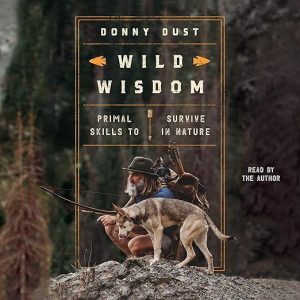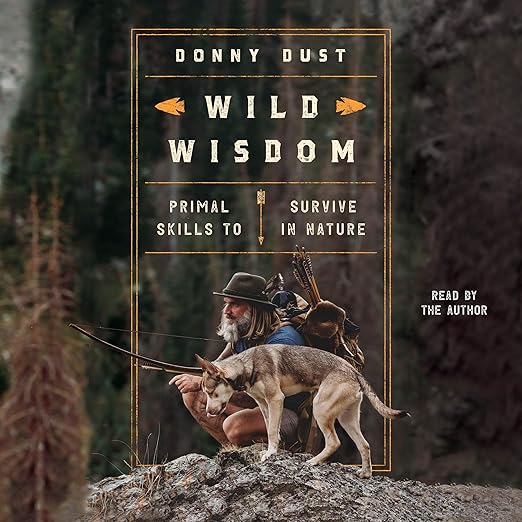
Survival instruction has a format problem, and this audiobook walks straight into it. The description sells illustrations. It promises beautiful and instructive drawings running throughout, and it calls the finished object something to carry with you into the backcountry, which is a sentence written about a thing you put in a pack. Seven hours and twenty-four minutes of Donny Dust reading his own curriculum is a different product from the one that copy describes, and the page never acknowledges the gap between them.
Observation First, From a Twenty-Year Practitioner
Observation comes before equipment here, and that ordering is the real argument. Dust teaches you to be more observant so you can avoid danger before it arrives, to problem-solve, to prioritize shelter, and to stay flexible and creative when the right tool for a job is not in your bag. Gear, fire, water, food, foraging and trapping all follow after that, in roughly the order a person actually needs them rather than the order a catalog would list them. Putting attention ahead of kit is what keeps this from being a checklist, and it happens to be the part that transfers to audio most cleanly, because it is reasoning rather than procedure.
Credentials are stated here, and they are specific. A Marine Corps veteran who owns and runs a survival and wilderness self-reliance school in Colorado, with two decades of primitive living skills gathered everywhere from the jungles of Asia to the mountains of North America. The description adds television work on History Channel's Alone and hosting duties on Mud, Sweat and Beards, plus millions of followers watching him build things out of whatever the ground provides, down to making the saw, chisel and hammer he builds them with.
Written responses run hot and short. One five-star account says everyone should own this manual and stops there. Nichole's is glad the skills got written down at all. Jesse Parra's is the substantial one: extremely well written, perfectly organized, no detail missed, with a list of who it serves running to hunters, trappers, survivalists, knappers, preppers and primitive-skills enthusiasts. That reader reports learning local plants and what can safely be foraged in an emergency, which is the book doing precisely the job it advertises.
Dust Narrates Twenty Years of Field Judgment
Dust reads it himself, and on this material the decision earns its keep. Somebody who has spent twenty years doing the thing puts emphasis in different places than a hired reader would: which step people rush, which small detail decides whether a fire catches, where confidence turns into a mistake. The credit line establishes that the voice belongs to the practitioner rather than to a studio, and for instruction built on judgment rather than on measurement, that is the more useful arrangement by a distance.
Philosophy is promised alongside the tips, and philosophy is the half that survives the format without damage. Deepening your appreciation and understanding of the wild is one of the two audiences named; newcomers taking their first trips outdoors is the other. Both of those are listening audiences, and neither one needs a diagram to follow an argument about attention. Seven hours and twenty-four minutes amounts to a full working day of a very experienced person explaining how to think in a place that has no interest in whether you are comfortable.
Eighty-eight ratings support a 4.7 while all five visible written responses sit at five stars, which places the quiet majority slightly cooler than the vocal minority. That is ordinary, and at this sample size the average is doing honest work rather than decorative work. It also means the enthusiasm on display is not the fluke of two friendly buyers.
Illustrations Lost and a Confusing Category
Illustrations are what you are giving up, and the description sells them twice. Jesse Parra's response confirms they earn the billing, saying they complement the material perfectly. On a book whose subject is identifying plants, shaping and tying things, and reading terrain, that is not a decorative loss. A drawing of a trap trigger does work no sentence about a trap trigger can do, and none of it comes with you into the file.
One entry among the five grades the parcel rather than the contents, reporting that it shipped fast and arrived well packaged, with great content appended almost as an afterthought. Another is titled around reading it on a plane. Those are people describing a physical object they carried somewhere, which is a fair reminder of who the sales copy was written for: it recommends the book as something to bring along into nature, a claim that only makes sense about an item with a spine.
Filing is the other oddity. The listing sits under health and wellness and under home and garden, with a Safety and Emergency Preparedness tag, and nothing in that combination signals a wilderness survival manual by a man who makes his own tools from scratch. Anyone searching the obvious category will not find it, and anyone browsing home and garden will be surprised by what turns up.
Great for Mindset, Useless for Knot-Tying
Competence is the trap a survival recording sets, and it is worth naming before anybody presses play. Hearing a procedure described clearly is not the same as having done it once badly in the cold, and a confident voice makes the gap easy to forget. Dust's observation-first sequence guards against that better than a gear-led book would, since it keeps returning to judgment, but the gap between listening and practicing is wider here than in almost any other subject.
Two audiences are named in the description and both are genuine. Experienced outdoorspeople sharpening skills they already own will value the observation-first framing more than another gear list. Newcomers planning a first trip get somebody patient explaining why shelter outranks food and why adaptability beats equipment. I would add a third the description misses: people with no intention of ever sleeping outdoors who simply want to hear how a person thinks when nothing at all is provided.
Learning a knot by ear is the one thing this cannot teach you. Anybody buying for plant identification, trap construction or cordage work needs the printed edition, because those chapters were built around pictures and the pictures do not travel. Everyone else gets seven and a half hours of hard-won judgment from somebody who has spent twenty years living the material rather than researching it, which is a rarer credential in this category than the shelves suggest.
Before You Listen
Does the Wild Wisdom audiobook include the illustrations the description promises?
No. The description advertises beautiful and instructive drawings throughout, and a five-star response confirms they complement the material perfectly, but a linear recording carries none of them. For the plant identification, trap construction and cordage chapters, that is a substantive loss rather than a cosmetic one, and the page never mentions it.
What qualifies Donny Dust to narrate this audiobook himself?
The description credits a Marine Corps veteran who owns and operates a survival and wilderness self-reliance school in Colorado, with two decades of primitive living skills gathered from Asian jungles to North American mountains, plus appearances on History Channel's Alone and hosting Mud, Sweat and Beards. He is reading his own curriculum aloud.
Is Wild Wisdom aimed at beginners or at experienced outdoorspeople?
Both, deliberately. The description names longtime outdoorspeople hoping to sharpen skills and deepen their understanding, alongside newcomers heading out for the first time. The observation-first sequence serves both groups, since it teaches how to read a situation before it teaches what to carry, and judgment scales in a way gear lists do not.