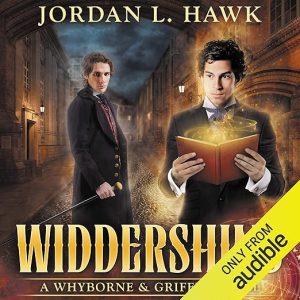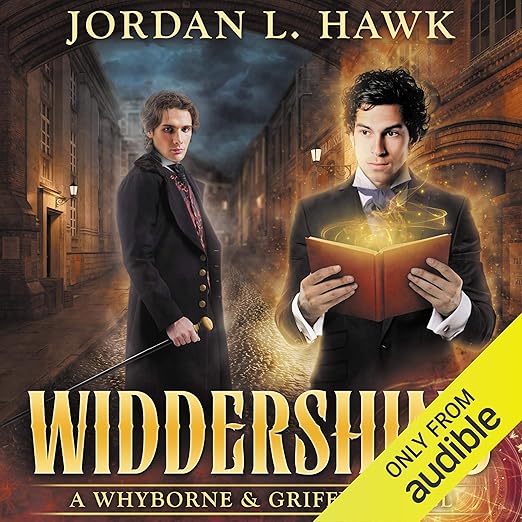
Percival Endicott Whyborne would rather spend a lifetime alone with a dead language than hold a conversation, and this audiobook spends nine hours and fifteen minutes prying him out of his office. Widdershins is the first Whyborne & Griffin book, a Victorian-era supernatural mystery with a slow-burning romance between two men at the center of it, read by Julian G. Simmons and released in 2013. More than a decade on it remains the entry point to one of the longer-running series on this shelf.
Jordan L. Hawk builds the novel on a very old shape and then keeps quietly breaking it. A repressed scholar buried in the Ladysmith Museum, a handsome ex-Pinkerton with a dead partner, and a mysterious book that needs translating: that is a penny dreadful setup, and the pleasure of the opening hours is watching the material get taken seriously instead of winked at. One response calls Whyborne the most awkward, intelligent and adorable character it had ever read, which is a strange combination to aim for and an exact description of what actually lands on the page. The stutter is the tell. Hawk gives Whyborne a physical symptom of his own fear rather than a stated one, and every scene where it eases marks progress the character would never admit to out loud.
Griffin Flaherty is the other half, and the book is careful about how it lets these two close the distance between them. Whyborne has ruthlessly suppressed any desire for another man since the death of the friend he secretly loved, and Griffin left the Pinkertons hoping to start a new life after the cult murdered Glenn. Neither is available in the way romance usually requires, so the investigation does the work instead: the closer they get to the spells in the book, the harder it becomes for Whyborne to keep his iron control intact. Grief is doing most of the structural work in both directions, and the book is unusually patient about it. Neither man is looking for a second chance, which is what makes the eventual one feel earned rather than scheduled.
What Jordan L. Hawk Gets Right
Julian G. Simmons handles both leads on a single credit, and this is a novel where that choice carries genuine consequences. Widdershins is told in close first person from inside Whyborne's head, which means Griffin exists entirely as Whyborne perceives him: the rakish charm, the deliberate warmth, the professional detachment that keeps slipping at the wrong moments. A production with two readers would split that perception in half. One reader has to perform a man perceiving another man, misreadings included, and the romance depends on those misreadings landing. The period register is the second demand. Whyborne's account is formal and self-deprecating, and it has to stay funny without ever winking, and a delivery that plays the archaism for laughs would flatten the whole book inside twenty minutes.
Ladysmith Museum, a cult, a resurrected sorcerer and the terrifying monsters that sorcerer commands: the genre mixture is the real selling point, and it explains why the book has held an audience for over a decade. One response describes arriving as a romance reader with no experience of anything Lovecraftian, admitting to being squeamish and easily spooked, and finding the framework held together anyway by likable characters and events that follow the story's own internal logic. That is a good description of why the blend works. The horror never swamps the courtship, and the courtship never trivializes the horror. Nine hours turns out to be the right length for that balance too. The investigation has room to move through translation, false leads and museum obstruction before the supernatural takes over, and the pacing never feels like a romance waiting impatiently for its plot to finish.
Where Jordan L. Hawk Loses Some Ground
Widdershins carries a publisher field that reads Jordan L. Hawk, which is the author's own name. That single detail explains a great deal about how this page behaves. No house cast the reader, approved the runtime or decided how the series would be positioned; the recording exists because the writer commissioned it. For a first-in-series historical romance between two men published in 2013, that was frequently the only route available, and it means every production choice here belongs to the author rather than to a marketing department. Nothing about that is a warning. It does mean the packaging tells you less than usual, since none of the usual signals about budget or intended audience are being sent by anyone but the writer.
Victorian pastiche and Lovecraftian horror are both easy to over-perform, and nobody on this page says a word about how Simmons handles either one. One response does name the format, describing buying the story as an audiobook for daily walks, then hunting down a sequel and buying both in text instead. Naming the format is not the same as judging the reading, and that response is the closest this column comes to doing either. Take the sample seriously, because the written column will not help you here. On a first-person novel carried by one voice for nine hours, a two-minute excerpt is doing more work than any listing should ask of it, and it is still the only evidence available on this page.
Who Jordan L. Hawk Is Writing For
Romance listeners who normally avoid horror should not be put off, and horror listeners who normally avoid romance should not be either, because neither element is decorative and neither one dominates. One response frames the book as supernatural fantasy set in Victorian-era New England, in the town the title names, centered on a painfully shy linguist at an upper-crust museum whose colleagues either ignore him or bully him. If that sentence appeals, the book will too, and the relationship is written as slow accumulation rather than as an event. Listeners who came to this shelf for queer historical fiction with actual period texture, rather than modern sensibilities in costume, are the other obvious audience, and the museum setting gives Hawk somewhere concrete to put the class detail.
Nine hours in Victorian-era New England will not suit anybody after a fast mystery, since a good deal of the first stretch is translation work and museum politics, and it will not suit anyone who wants the romance foregrounded from the opening chapter, because Whyborne's control does not begin to crack until the investigation forces it to. What this is instead is a series opener that spends its length building two people worth following through the books that come after. Between the museum, the cult and the slow thaw of a man who had decided never to want anything again, the balance here is unusual enough to justify the runtime.
- Narrator: A single reader carries nine hours of Victorian pastiche, cult horror and courtship, with no studio name anywhere on the credit.
- Subjects: Repression and disclosure, a cult rooted in a small New England town, scholarship as a hiding place
- Tone: Gaslit and slow-burning, with real dread running under the courtship
- Bottom line: A strong series opener for listeners who want horror and romance weighted equally, and slow going for anyone who wants only one of them.
Frequently Asked Questions
How long is the Widdershins audiobook, and is it the first in the series?
Nine hours and fifteen minutes, and yes: the listing marks it as book one of the Whyborne and Griffin series. Julian G. Simmons is credited as the reader, and the recording dates from 2013. The cult plot resolves within this volume, so it functions as a standalone, though the relationship is plainly built to continue.
Is the Whyborne and Griffin series worth continuing after this audiobook?
The listing marks Widdershins as the first book of the series, and the closing pages settle the cult while leaving the relationship at an early stage. Both leads finish with unresolved business: the description asks whether Griffin can let go of his past and whether Whyborne can learn to trust. Anyone who enjoys these nine hours has a long run ahead.