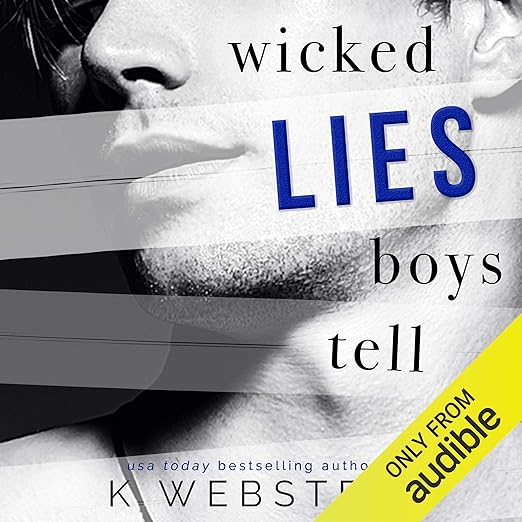
Copeland Justice is the best liar of us all, the description says, and it says so in the voice of the person who loves him. That is the engine of this audiobook: a first-person voice that cannot tell you the truth about the central relationship because it has not yet told itself. Six hours and forty-two minutes is short for a romance and exactly right for this one, which runs on withheld information rather than on incident. Two boys who were best friends, one kiss, two years of silence, and a story that keeps insisting the enemy and the beloved are the same person, in the same body, saying two things at once.
What K Webster Delivers
Dual point of view is how the column describes the structure, and one response lays it out precisely: Penn McAlister and Copeland Justice, friends since childhood, split by a single mistake for two painfully long years, then thrown back together with everything still unsaid. That description does something the publisher copy will not do, because the copy is written entirely from inside one head and refuses to name the other as a viewpoint at all. The book alternates. Knowing that before you press play changes how the first hour lands, because the withholding stops looking like a trick and starts looking like an architecture.
A romance built this way lives or dies on whether the second voice arrives in time, and this one gets there. What impressed me is how little the book softens either boy on the way. The sadist in the heart, the mouth saying one thing while the eyes say another, the heart that beats for somebody else: that is the register the description promises and the book holds to it without flinching. Cruelty and tenderness are not alternated for effect here. They are the same gesture seen from two sides, which is a considerably harder thing to write than most enemies-to-lovers stories ever attempt, and it is the reason this one lingers.
What K Webster Gets Right
Six hours and forty-two minutes is the strongest practical argument for it. A romance pitched this high becomes exhausting at twelve hours and lands correctly at seven. You can begin it after dinner and finish it the same night, which matters for a book whose central tension is engineered to be unbearable rather than pleasant. The response that says the hours felt like minutes is describing a real property of the pacing rather than handing out a compliment: the chapters are short, the withholding is constant, and the book never once stops to explain itself to you. In audio that design is the difference between propulsive and relentless, and this sits closer to relentless.
Hamilton is the only performer credited, and that single name has to cover a story the column itself describes as narrated in dual point of view. Notice the word doing double duty. In that sentence a narrator is a character with chapters of his own, while on the credit line a narrator is the person reading every chapter, and this recording asks one voice to be both boys and whoever else the story puts in the room with them. One listener reports recognizing the reading from a different book altogether, a Sarina Bowen title they knew well, and says the overlap made this feel like a younger version of that story. Take it for what it is, a note about casting rather than about craft, and note that it is the only line in the visible column that comes anywhere near the recording.
Where K Webster Loses Some Ground
One thing to weigh before buying is that the shape of this story is not new, and the book never pretends otherwise. Childhood friends, a kiss, a rupture, two years of silence, a forced return: if you have read widely in this corner of male-male romance you will recognize every beat as it arrives, and the pleasure on offer is the pleasure of a familiar architecture executed at unusually high emotional volume. That is a real pleasure and also a narrow one. A listener hoping for a plot that surprises will find the surprises are emotional rather than structural, which is the trade this subgenre makes deliberately and advertises in its own title conventions.
Webster's book goes further than the description admits, and the listing carries no warning at all. Another response, five stars and unreserved about it, names the specifics: the angst of being outed, jealousy running underneath everything, and heat the response calls hot without qualification. The copy above it mentions none of that. It offers a sadist in the heart and an unraveling at somebody's feet and leaves the rest to be discovered at speed. If explicit content is a decision you prefer to make before pressing play rather than during, that column is the only place on this page where the decision is available to you.
Who Should Pick Up Wicked Lies Boys Tell
Romance readers who want the trope delivered at full strength are the audience, and the response that cheerfully places itself in the minority is the most useful guide to whether you are one of them. It says plainly that very little of the plot is realistic, mentions a fake engagement arriving out of nowhere, and then says the whole thing was entertaining enough that none of it mattered. You want this if you can hold both of those thoughts at the same time and let the second one win. Readers who need a romance to be plausible before it is allowed to be moving will spend the entire recording arguing with it instead of listening.
Cope and Penn are the whole book, and how you feel about spending an evening inside their worst behavior decides everything else. Not for you if you need a romance where the cruelty turns out to be a misunderstanding, because here it is deliberate, sustained and only partly forgiven at the end. Also not, if a single voice moving between two first-person accounts is something you find hard to track without a cast to mark the change. One more thing worth knowing before you buy: the counter under the rating badge reports fewer ratings than the page shows written responses, so whatever that badge summarizes, it is not the opinions printed directly beneath it. Penn and Cope are worth the evening; the page selling them is the part that needs work.