Quick Take
- Narration: No narrator is listed in the metadata, likely self-narrated or unconfirmed; the listening experience depends heavily on how well Moran’s conversational YouTube style translates to audio.
- Themes: monetary theory, inequality and housing, globalisation’s hidden winners
- Mood: Accessible and iconoclastic, occasionally polemical
- Verdict: An engaging primer on heterodox economics from a credible communicator, best for curious generalists who want their assumptions about money and growth genuinely challenged.
I listened to most of this one during a long train ride through the French countryside, which felt accidentally appropriate. The landscape out the window was dotted with housing developments that looked exactly like the kind of financialized sprawl Cahal Moran spends considerable time diagnosing. By the time we pulled into the station, I had a clearer vocabulary for something I had sensed for years but could not quite articulate: that the economy most of us experience day to day was not designed with us primarily in mind.
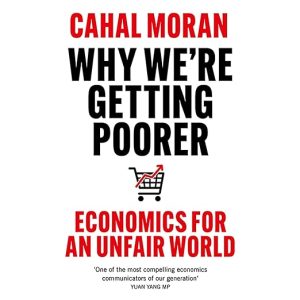
Moran, who runs the YouTube channel Unlearning Economics and has been described by FT columnist Yuan Yang as easily one of the most compelling economics communicators of our generation, brings that pedagogical skill to a ten-hour audiobook that attempts to demystify five major economic topics: money, globalisation, inequality, climate change, and growth. The conceit is straightforward. What most people think they know about each of these things is wrong. Moran sets out to correct the record.
Our Take on Why We’re Getting Poorer
The strongest sections are the ones on money and housing. Moran’s point that the overwhelming majority of money in circulation today is credit created by private banks rather than government-issued currency is not new to anyone who has read modern monetary theory, but Moran explains it with the kind of concrete specificity that makes the abstraction snap into focus. Equally useful is his argument about housing: that we have consistently failed to separate the value of structures from the value of land in our policy thinking, which is why housing keeps getting less accessible regardless of how much we build. These are genuinely clarifying framings, not just contrarian posturing.
The chapters on globalisation are more uneven. The claim that certain countries and currencies have dominated globalisation to their own advantage is compelling in outline, but the treatment sometimes reads as more polemical than analytical, and listeners looking for rigorous engagement with the counterarguments may find the book tilts its scales a bit too visibly. One reviewer called it boring with no interesting ideas; another called it excellent, balanced, and well-researched. That spread probably reflects real variation in how heterodox the listener considers the mainstream view to begin with.
Why Listen to Why We’re Getting Poorer
Moran’s gift is accessibility without condescension. He uses examples drawn from The Simpsons, the German football league, and The Inbetweeners, and somehow manages to make those references feel natural rather than forced. For listeners who have always felt vaguely uncertain that economics as they learned it actually explained what they observed in the world, this book offers a coherent alternative framework with enough intellectual substance to satisfy. The 4.5 rating across twenty-nine reviews, and the endorsement from Grace Blakeley of Vulture Capitalism, suggests the book has found a genuine audience beyond the merely discontented.
What to Watch For in Why We’re Getting Poorer
The book is less balanced than it presents itself. Moran is a self-declared heterodox economist with a clear point of view, and that view inflects the analysis in ways that are not always flagged explicitly. That is not a fatal criticism, but listeners should go in knowing that this is advocacy as much as education. The recommendations for positive change that close each chapter are often broad strokes rather than specific policy prescriptions, which may frustrate listeners wanting actionable conclusions. Metadata lists no narrator, which is a notable gap worth checking before committing to a ten-hour run time.
Who Should Listen to Why We’re Getting Poorer
Well suited for general listeners curious about why the economic experiences of their daily lives so often diverge from what official indicators suggest. If you already have a strong background in heterodox or post-Keynesian economics, the material will be familiar. If mainstream economics courses left you unsatisfied, this is a well-organized entry point. Those expecting a politically neutral treatment should look elsewhere.
One more thing worth flagging for prospective listeners: the narrator field is blank in the available metadata. William Collins is a major imprint, and a release at this length typically has a credited professional narrator. Confirming the audio production quality before purchasing is worth the extra step – ten hours of poorly recorded or automated narration is not a minor inconvenience.
Frequently Asked Questions
Is Cahal Moran a credentialed economist or primarily a commentator?
He is described as an award-winning economist and is known for the Unlearning Economics YouTube channel, which has built a substantial following for accessible heterodox economics. His credentials are genuine, though his perspective is explicitly outside mainstream consensus.
Who narrates the audiobook and is the audio production quality good?
No narrator is listed in the available metadata, which is unusual for a William Collins release. It is worth confirming this detail before purchasing, as the narration quality will significantly affect ten hours of listening.
How does this compare to other popular economics books like Freakonomics or Naked Economics?
Moran is more explicitly critical of economic orthodoxy than either of those titles. Where Freakonomics uses economics as a lens for curiosity, Moran uses it to argue that mainstream frameworks have actively misled policymakers and the public. The tone is more polemical.
Does the book cover the current economic environment, or is it focused on historical patterns?
Released in March 2025, the book engages with contemporary conditions including housing affordability and post-pandemic economic dynamics, though the core theoretical arguments are grounded in longer historical patterns.