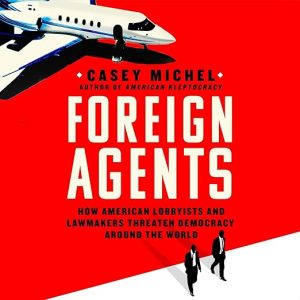
Quick Take
- Narration: Joe Dwyer delivers a measured, investigative register that suits the documentary tone, clean and credible across dense policy and historical material.
- Themes: Foreign lobbying and democratic erosion, the FARA enforcement gap, the long history of autocrat-friendly American influence operations
- Mood: Disquieting and methodical, the tone of an investigation that knows what it found and wants you to understand the full scope of it
- Verdict: A serious and well-sourced investigation into a system most Americans barely know exists, essential context for understanding how foreign money shapes domestic policy.
I finished Foreign Agents on a Wednesday morning and spent the rest of the day thinking about a man named Ivy Lee, who is not a household name but probably should be. He invented the modern public relations industry, whitewashed Mussolini’s regime for American audiences, opened doors between the Soviets and US business interests, and advised the Nazis on managing their image in the United States. He was not prosecuted. He was celebrated. Casey Michel’s book opens with Lee and uses him as a lens through which the entire subsequent history of foreign lobbying in America becomes legible.
Our Take on Foreign Agents
Michel’s central argument is that the foreign lobbying industry, the network of law firms, consultancies, PR specialists, former lawmakers, think tanks, and universities that accept payment from foreign governments and autocrats, represents a system that has been legal, lightly regulated, and systematically used to corrupt American foreign policy for nearly a century. The Foreign Agents Registration Act, known as FARA, was designed to expose this. Michel documents in detail how thoroughly it has failed to do so.
The Paul Manafort section is the most publicly recognizable part of the argument, Manafort as the figure who industrialized foreign lobbying as a service, taking his methods from Ukraine to the Philippines and beyond before his relationship with the Trump campaign brought him briefly into the news cycle. But Michel’s scope is considerably wider than any single operator. The book covers the institutional infrastructure: the former officials who rotate from government positions into lobbying roles, the academic institutions that accept foreign funding without adequate disclosure, the think tanks whose policy positions become quietly shaped by the governments that fund them.
Why Listen to Foreign Agents
Joe Dwyer’s narration suits investigative nonfiction well. He maintains a measured, reportorial tone that does not editorialize beyond what the text itself contains, which matters for material that is already inherently charged. The book’s strength is its documentation, and Dwyer presents it as documentation rather than polemic, which keeps the most damning material from sounding strident. Reviewers described it as engaging and informative, one noted it made them want to learn more, which is the correct response to a well-executed piece of investigative journalism.
At ten hours, the book is thorough without being exhaustive. Michel covers enough historical depth to establish the systemic nature of the problem while staying focused on specific figures and cases rather than getting lost in legislative history for its own sake. What distinguishes Michel’s approach from standard investigative journalism is the sustained historical argument: by tracing this from Ivy Lee forward, he demonstrates that the problem is not a recent aberration but a structural feature of how American political access has been sold for a century.
What to Watch For in Foreign Agents
A note on the reviewer pool: some reviews of this book carried visible partisan framing in their assessments, which reflects the political charge of the subject matter rather than the book’s own approach. Michel’s investigation covers a bipartisan history of FARA failures and foreign influence operations, though the most prominent contemporary figures he examines are associated with one side of the political spectrum. Readers who approach this expecting either a defense or an attack on a particular political movement will find a more complicated and historically grounded argument than either expectation accommodates.
The book is an indictment of a system rather than exclusively of individuals, and that systemic lens is both its analytical strength and the reason it may frustrate readers looking for clear heroes and villains within a partisan framework.
Who Should Listen to Foreign Agents
This belongs to listeners who want to understand the institutional infrastructure through which foreign money shapes American policy, beyond the headline cases and into the law firms, think tanks, and consulting operations that make the pipeline functional. If you read Anne Applebaum’s work on democratic backsliding or follow reporting on FARA enforcement failures, Michel’s book fills in the specific operational history that journalism often lacks space to trace in full. It is not for listeners who need the material to reach a predetermined political conclusion.
Frequently Asked Questions
Is Foreign Agents partisan in its framing?
The book’s documented history covers multiple decades and administrations, but the most prominent contemporary figures Michel examines are associated with the Republican right. Some reviewers read this as partisan; others found it simply reflects where the most egregious recent cases are documented. The analysis itself is systemic rather than designed around party affiliation.
What is FARA and why does Michel argue it has failed?
FARA, the Foreign Agents Registration Act, requires those acting as agents of foreign governments to register publicly with the Department of Justice. Michel documents that enforcement has been chronically weak, that many lobbyists operate without registering, and that the government has routinely failed to prosecute violations.
Does the book focus on a particular era, or does it cover the full history of foreign lobbying?
Michel traces the history from Ivy Lee in the early twentieth century through the industrialization of foreign lobbying under Paul Manafort and up to the present day, making it a genuinely historical argument rather than a response to any single recent event.
Is Joe Dwyer’s narration well-suited to this kind of investigative nonfiction?
Yes. His measured, reportorial delivery keeps the material from sounding strident while maintaining the momentum of a well-paced investigation. The ten-hour runtime feels appropriately thorough rather than padded.