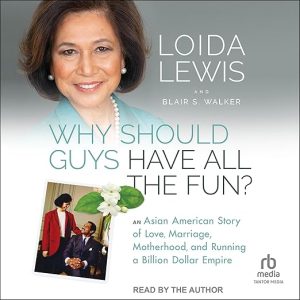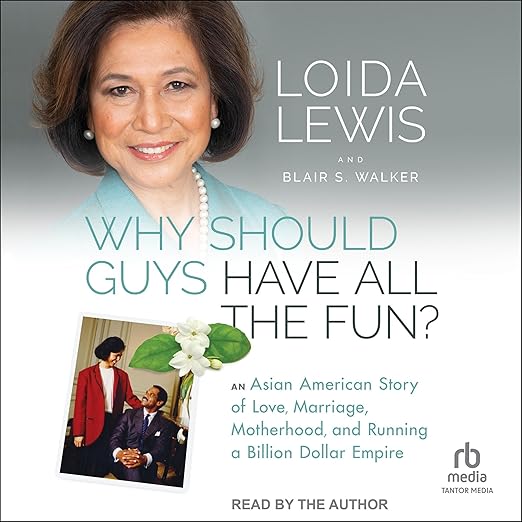
Manila's postwar streets shaped the girl who would eventually run a multibillion-dollar conglomerate, and Loida Lewis narrates that entire arc herself in the audiobook Why Should Guys Have All the Fun? The title is not a random flourish. Lewis's late husband, financier Reginald Lewis, wrote his own bestselling memoir titled Why Should White Guys Have All the Fun?, published after his death from brain cancer at fifty, and Loida's book deliberately echoes and revises that title, dropping 'White' and centering her own version of the same question.
The book's own synopsis stakes out a bold comparison right away, pairing 'Crazy Rich Asians and a Greek tragedy' as the two reference points for the 'literary offspring' this memoir supposedly represents. That's not far off: an adventure-filled Philippine upbringing, a torrid love affair with a brilliant and irascible financier, regal living between Manhattan and Paris, sudden devastating loss, and then Loida shockingly taking the reins of a multinational corporation herself. Across eight hours and fifty-three minutes, the audiobook covers all of it in her own voice.
An Immigration Lawyer Long Before the Marriage
What makes this more than a rags-to-riches business memoir is how honestly Lewis handles the collapse after Reginald's death. She doesn't skip past her own severe depression following his loss at fifty, and she doesn't pretend that grief and running a billion-dollar company coexisted smoothly. Instead, the book presents faith and sheer perseverance as the actual mechanism that got her through both a personal crisis and a genuine corporate leadership crisis simultaneously, raising two daughters while shepherding TLC Beatrice to record earnings in a business world she describes as dominated by hard-charging white men.
The immigration angle deserves more attention than a quick synopsis usually gives it. Lewis arrived as a Filipina immigrant and built a career as a resolute immigration lawyer and activist before her marriage to Reginald ever entered the picture, which means the corporate takeover in the back half of the book isn't a Cinderella twist, it's the second major reinvention of a woman who had already reinvented herself once. That structure, two distinct careers built by the same relentless will, gives the audiobook more shape than a straightforward widow-inherits-empire narrative would have.
Reviewer Elaine, who says she has known Lewis for almost twenty years and shared real adventures with her in 'Cuba, Bimini, New York, and even Beaver Falls Pennsylvania', notes she never wanted to pry into the details of her friend's life before reading this book, which is a genuinely telling piece of context: even people close to Lewis are hearing the full, specific story here for the first time.
Reginald Lewis's own business history is worth spelling out for listeners unfamiliar with it: in 1987, he orchestrated a leveraged buyout of Beatrice International Foods' overseas division, creating TLC Beatrice International Holdings and becoming, by most accounts, the first Black American to build a billion-dollar business empire. That achievement is the backdrop Loida inherited when he died just six years later, and it's part of why her decision to keep running the company rather than sell it off carried real symbolic weight far beyond her own family's financial security.
Narration Pacing Mirrors How Her Years Felt
Self-narration is doing serious work in this audiobook. The author's own voice carries a credibility that a professional narrator, however skilled, simply cannot fake. Lewis's delivery is composed and unhurried, letting real feeling surface at the right moments without ever collapsing into performance, which matters enormously across the sections dealing with Reginald's death and her subsequent depression.
The pacing of her narration also mirrors the structure of her own life in a way a scripted professional reading would likely flatten out. The early Philippine sections move more expansively, unhurried and detailed, while the corporate TLC Beatrice years pick up speed, mirroring how those later years actually felt to her: faster, higher-stakes, less time to reflect in the moment. That's a subtle narration choice that only an author reading her own material would naturally make.
KMB13's review describes the full subtitle accurately, calling it 'An Asian American Story of Love, Marriage, Motherhood, and Running a Billion Dollar Empire,' and praises how it chronicles Lewis's journey 'in the cutthroat world of business dominated by white males.' Robin Surface adds that the writing style is 'fast-paced' and 'holds the reader's interest,' with the love story between Loida and Reginald described as a genuine emotional throughline rather than backstory. Both reviews point at the same real strength: this book moves, even across nearly nine hours.
Glamour and Grief in a Difficult Balancing Act
Listeners approaching this primarily for detailed business strategy or a step-by-step account of running a multinational conglomerate should recalibrate expectations. This is a memoir first, structured around love, loss, faith, and identity, with the corporate leadership material folded into that larger emotional arc rather than presented as a standalone case study. Readers wanting granular deal-by-deal detail on how TLC Beatrice actually operated day to day will find the personal material takes priority throughout.
The subject matter also doesn't soften the harder chapters. Depression, grief, and direct discrimination faced by a Filipina-American woman inside a business world dominated by white men are all treated honestly rather than glossed over for an inspirational arc, which is the right choice artistically but worth knowing before pressing play if you're expecting a lighter business-success story throughout.
The synopsis's own Crazy Rich Asians comparison works specifically because of the settings Lewis moves through: Manila, Manhattan, Paris, the kind of geographic range that signals real wealth and real displacement at once. But the Greek tragedy half of that same comparison is just as accurate, sudden loss at the height of success, a survivor left to rebuild both a family and a company simultaneously. Holding both comparisons at once, glamour and grief, is a genuinely difficult balancing act for a memoir, and Lewis mostly pulls it off.
Her Own Primary Source on TLC Beatrice
Readers of immigrant-to-executive memoirs, and specifically anyone interested in Filipina-American history or the real story behind Reginald Lewis's own famous business legacy, will find this an essential companion piece to his side of the story. Women navigating male-dominated industries will likely recognize plenty of the specific friction Lewis describes, from being underestimated in a boardroom to having her authority quietly tested by subordinates used to answering to men.
It's also a strong pick for anyone who enjoys grief memoirs that don't resolve into easy comfort, since Lewis is honest about how long her depression actually lasted and how faith functioned less as an instant fix and more as a slow, difficult practice.
Set expectations accordingly on one front: this is Lewis's personal account of her own life and marriage, not an independent business biography of TLC Beatrice or a neutral history of the conglomerate she ran, and readers wanting that outside perspective should treat this as the primary source it is rather than the full corporate record.
In Brief
- Read by: Loida Lewis self-narrates with composed restraint, pacing the Philippine years expansively and the corporate years briskly.
- At its heart: Immigration and reinvention, grief and faith, breaking into a male-dominated business world
- Vibe: Sweeping and emotional, grounded by real specificity
- Short version: A genuinely moving self-narrated memoir that earns its Crazy Rich Asians comparison without losing its real grief.
Does the Why Should Guys Have All the Fun? audiobook connect to Reginald Lewis's own memoir?
Yes, deliberately. Loida Lewis's title echoes and revises her late husband Reginald Lewis's own bestselling memoir, Why Should White Guys Have All the Fun?, published after his death.
Is this audiobook more about business strategy or personal memoir?
Personal memoir first. Listeners wanting granular detail on how TLC Beatrice actually operated should expect the emotional throughline of love, loss, and faith to take priority throughout.
Who narrates the Why Should Guys Have All the Fun? audiobook?
Loida Lewis narrates her own story, and her pacing shifts naturally between an expansive telling of her Philippine upbringing and a brisker account of her corporate years.
How long is the Why Should Guys Have All the Fun? audiobook?
Eight hours and fifty-three minutes, covering Loida Lewis's full arc from her Philippine childhood through running a multinational conglomerate after her husband's death.