Quick Take
- Narration: No narrator is credited in the metadata, a gap worth confirming on the Audible product page before purchasing, but the All the Wrong Questions series has consistently paired the deadpan, literary register the material demands.
- Themes: Unreliable memory and narrative, loyalty under pressure, the cost of secrets
- Mood: Dark and witty, train-compartment tense, with a satisfying finality
- Verdict: A worthy series closer for readers who have followed Snicket’s peculiar biography from the first volume, do not begin here.
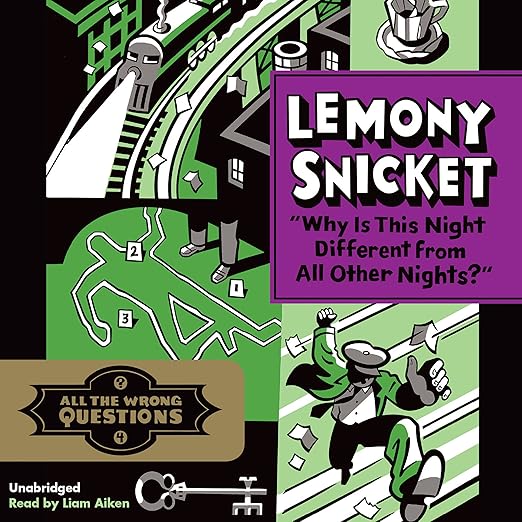
I started listening to All the Wrong Questions on a long drive to visit family, and by the time I reached the fourth volume I was pulling over in rest stop parking lots to finish chapters I couldn’t interrupt. “Why Is This Night Different from All Other Nights?” is the finale Lemony Snicket has been engineering from the very first page of book one, and it lands with the particular satisfaction of a magician finally showing you the trick you didn’t know you’d been watching. The title, borrowed from the Passover seder’s central question, tells you something important about how Snicket thinks: everything here is a ritual, a ceremony, a pattern that conceals a larger truth.
This is the fourth and final book in the All the Wrong Questions series, which predates the Baudelaires and follows a young Lemony Snicket himself through the fading town of Stain’d-by-the-Sea, apprenticed to a questionable chaperone and surrounded by characters with names that announce their moral orientation with old-fashioned literary honesty. The train that forms the setting of this finale is a brilliant structural choice: enclosed, forward-moving, no escape, everyone forced to be in the same space as everyone else. Kirkus called it a series finale with “several bangs (and a poison dart or two)” and that physical precision is accurate.
The Architecture of the Wrong Question
What Snicket has built across these four books is a sustained argument about the difference between asking the right question and asking the useful one. The series title is not a joke. Every mystery in this world is approached from the wrong angle, not out of incompetence but because the wrong angle is often the one that reveals the hidden door. This final volume brings that theme to its fullest expression, and for listeners who have followed the full quartet, the payoff is genuine. One reviewer noted it “raises many, many questions” even as it answers them, and that is precisely true: Snicket closes the story while leaving the philosophical engine running.
The noirish atmosphere that distinguished the series from the Baudelaires books is present in concentrated form here. The town of Stain’d-by-the-Sea, the Inhumane Society, the question of what the Raucous Widow actually is, the mysteries surrounding Ellington Feint’s father, all of it converges on this train, on this night, with the kind of structural elegance that makes you want to go back to book one immediately.
A Series for Children Who Like to Think
One reviewer mentioned reading this aloud to four children aged eight to thirteen, and that range is telling. The series rewards intelligent readers regardless of age; it does not condescend and does not simplify. The humor is verbal, dependent on attention to language, the kind that asks you to notice exactly which words are being used and why. This has always been Snicket’s gift, and it is on full display in the finale. The conspiratorial atmosphere, the moments of genuine solidarity between characters, and the Agatha Christie-adjacent plotting all land, according to reader reports, with children who have followed the series and feel the weight of conclusion.
The 5-hour, 8-minute runtime is generous for a middle-grade audiobook, reflecting genuine narrative density rather than padding. This is a book that uses its length: the train journey is a long one, and Snicket fills it with incident, revelation, and the particular kind of grief that attends the end of a story you have loved.
One Thing to Know Before You Listen
The series metadata lists this under Vehicles and Transportation, which is technically accurate (there is a train) and also completely misleading about what kind of book this is. It is a literary mystery series with a self-aware narrator, intertextual jokes aimed at adult readers, and themes about complicity and institutional evil that are more complex than the age label suggests. Parents listening alongside children will find the experience richer for it. This is not a standalone title. Beginning here would be like reading the last chapter of a novel and wondering why the emotional beats don’t land. Start with “Who Could That Be at This Hour?” and let the series do what it was designed to do: accumulate.
Who Should Listen and Who Should Wait
Listen if you and your household have already worked through books one through three, if you enjoy mystery that rewards close attention to language, or if you are a Snicket enthusiast already familiar with the world of the Baudelaires who wants the backstory that was always promised. Skip for now if you are new to Snicket, if you are looking for something that stands alone, or if the children in your life are under seven and not yet equipped for the series’ sustained irony. The Kirkus quote that opens the synopsis says it best: best to start at the beginning, but the whole’s an enjoyable ride.
Frequently Asked Questions
Do I need to have read the first three All the Wrong Questions books before listening to this one?
Yes, absolutely. This is the series finale and draws directly on events, characters, and mysteries established across all three prior volumes. Starting here would make the emotional and narrative payoffs meaningless. Begin with “Who Could That Be at This Hour?” and listen in order.
How does this series connect to A Series of Unfortunate Events?
All the Wrong Questions is a prequel series following a young Lemony Snicket before the events of the Baudelaires’ story. It expands the same fictional world with its own cast and mysteries, but familiarity with the Baudelaires’ books is not required to enjoy this series.
Why is no narrator credited for this audiobook in the metadata?
The product listing does not include a narrator credit, which is a metadata gap. If you are purchasing, it is worth checking the Audible product page directly to confirm the narrator before buying, particularly if consistency with prior series installments matters to you.
Is this series appropriate for the full 8-to-13 age range, or is there a better fit within that window?
The series is most satisfying for readers aged 9 and up who can follow layered irony and verbal humor. Confident readers at 8 can manage it, especially when listening alongside a parent. Children in the 6 to 7 range will find the deadpan register harder to track without support.