Quick Take
- Narration: Kevin Pariseau is a seasoned audiobook narrator whose clear, measured delivery serves the mystery-of-the-man framing perfectly; he makes the gaps in Shakespeare’s biography feel like legitimate intrigue.
- Themes: Literary ambition, the mystery of biography, Elizabethan theater and culture
- Mood: Informative and gently absorbing, like a very good museum audio guide
- Verdict: A compact, well-narrated introduction to Shakespeare’s life and work for young listeners, with the honest acknowledgment of how much remains unknown making it more interesting, not less.
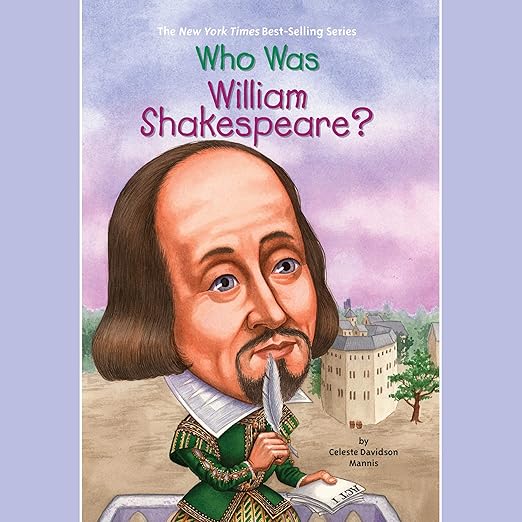
I was in Stratford-upon-Avon as a graduate student doing research that had nothing to do with Shakespeare, and I spent an afternoon in the visitor center absorbing everything I could about a man whose life remains, despite centuries of scholarship, largely unavailable for inspection. The paradox of Shakespeare is that the most influential writer in the English language left almost no direct testimony about his inner life. What we have is the work. What we don’t have is the man. Celeste Davidson Mannis’s Who Was William Shakespeare? confronts that paradox honestly, and Kevin Pariseau’s narration gives the mystery a quality of genuine intrigue rather than frustrating absence.
At sixty-seven minutes, this is one of the shorter entries in the Who Was? audio series. Shakespeare’s biographical record is thin by design, partly because sixteenth-century record-keeping was inconsistent, partly because Shakespeare himself seems to have been deliberately private, and partly because so much of what later centuries produced about him was speculation filling the gaps. Mannis doesn’t fill those gaps with invention. She works with what is documented and builds the picture honestly from the outside in: Stratford’s social context, the grammar school education that gave young Will the Latin and the classical models he would later transform, the move to London, the theater world of the 1590s, and the eventual return to Stratford as a wealthy man.
The Life We Can Confirm and the Rest
The first section of the biography establishes what is known with reasonable certainty: the 1564 birth, the grammar school, the marriage to Anne Hathaway at eighteen, the births of three children, the recorded presence in London’s theater world by the early 1590s, and the steady accumulation of property and investment that characterizes the late career. What’s missing from that account is the interior life, the motivation, the specific circumstances of composition, the relationships beyond the transactional record. Mannis presents this absence directly rather than pretending the biography is more complete than it is.
What works especially well in this entry is the section on Shakespeare’s theatrical context. The Elizabethan theater world was a collaborative, commercial enterprise populated by actors, shareholders, playwrights, and patrons, and Shakespeare occupied multiple roles within it. He was a sharer in the Globe Theatre, an actor with the Lord Chamberlain’s Men, and a playwright producing on deadline for a commercial audience. Mannis explains this working environment clearly and without romanticizing it, which gives young listeners a more honest picture of how the plays came to exist than the pure-genius narrative typically provides.
Pariseau’s Narration and the Who Was? Audio Style
Kevin Pariseau has narrated extensively within the Who Was? series and his familiarity with its register shows. The series writes for young readers but with enough informational density that adults find it worthwhile, and Pariseau calibrates accordingly. He doesn’t perform the material at the level of a picture-book read-aloud; he reads it with the authority of someone conveying real biographical content to an audience capable of handling it. The Shakespeare entry particularly benefits from this approach because the material requires a narrator who can make the absence of information feel like an honest feature of the subject rather than a failure of the biography.
Reviewer Greg Phillips described purchasing the book for a nine-year-old whose interest in Shakespeare had been sparked by a Doctor Who episode featuring the playwright. The book, he noted, did a wonderful job adding historical reality to the fictional depiction. That’s exactly the function a well-executed biographical audiobook should serve: it makes the historical figure real enough to stand alongside their fictional representations and to outlast them in the listener’s memory.
The Works and Why They Matter
One of the book’s practical strengths is its capsule summaries of Shakespeare’s major plays. Reviewer Connor noted feeling significantly more knowledgeable about the plots of the major works after listening. For a young listener who has not yet read Shakespeare but who knows the titles, these summaries provide genuine orientation. The entry on the tragedies explains the dramatic logic of Hamlet and Macbeth in terms accessible to an eight-or-nine-year-old without simplifying away the moral complexity. The comedies are described as theatrical entertainments shaped by the commercial demands of the Globe’s audience, which is the historically accurate framing.
The passage covering Shakespeare’s relationship with Queen Elizabeth and later King James is handled cleanly. The shift in patronage from the Elizabethan to the Jacobean court affected what Shakespeare could write and how, and Mannis notes this without turning it into an academic point about censorship. It’s historical context delivered as biographical detail.
Who Should Listen and Who Should Skip
Ideal for ages eight through twelve encountering Shakespeare for the first time, either through school curriculum or through film adaptations. Excellent as preparation for a first encounter with the plays themselves, or as a companion to a school performance. Adults already familiar with Shakespearean biography will find it compact to the point of simplicity, but for its target audience it is thorough, honest, and well-narrated. Anyone who wants to understand why the man’s life remains a subject of scholarly controversy will find the biography’s honest acknowledgment of what we don’t know a more interesting starting point than a false sense of complete knowledge.
Frequently Asked Questions
Does the audiobook address the authorship controversy, whether Shakespeare actually wrote the plays attributed to him?
The book focuses on the mainstream biographical record and does not give significant space to authorship controversies. For a Who Was? entry aimed at ages eight and up, this is the appropriate scope. The authorship debate is briefly acknowledged as something that has occupied scholars, but the book proceeds from the documented record of Shakespeare’s theatrical career rather than engaging with alternative attribution theories.
How much of the audiobook covers the actual plays versus Shakespeare’s biography?
The majority of the runtime covers biographical material, with summaries of the major plays integrated throughout as context for his career development. The comedies, tragedies, and histories each receive capsule treatment that is substantial enough to give a young listener genuine orientation without becoming a plot-summary catalog. Biography and work analysis are woven together rather than separated.
Is this suitable for a child preparing for a school production of a Shakespeare play?
Yes. The section on how Shakespeare’s plays were produced at the Globe Theatre, the staging conventions, the audience, the commercial context, provides useful background for understanding the theatrical world the plays came from. The capsule plot summaries also give context for specific plays. A child appearing in a production would benefit from this biography as background preparation.
How does the Who Was William Shakespeare? audiobook compare to other Shakespeare introductions for children?
The Who Was? series is specifically biographical in its approach, focusing on the life rather than providing literary analysis of the works. Other children’s introductions to Shakespeare, such as Lamb’s Tales from Shakespeare or illustrated editions of specific plays, take different approaches. This biography is best understood as an introduction to the person and the era rather than as a literary introduction to the plays themselves.