Quick Take
- Narration: Ron Butler brings a quiet dignity to Clemente’s story that reflects the man’s own character, unhurried and clear without a trace of sentimentality.
- Themes: Latin American baseball legacy, humanitarian identity extending beyond sport, the meaning of being first
- Mood: Respectful and moving, with a sense of history earned rather than merely assigned
- Verdict: One of the stronger entries in the Who Was? sports catalog, with a story that extends well beyond box scores into what it means to use athletic achievement in service of something larger than the game.
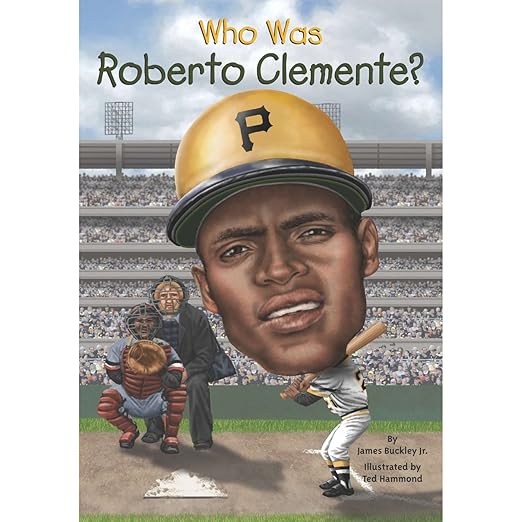
I started this one on a Sunday morning with genuinely low expectations and found myself moved by the end. Roberto Clemente is one of those figures known primarily by name in households without a deep baseball history, present in conversation as a byword for athlete-as-humanitarian without much knowledge of the specifics. James Buckley Jr.’s biography for the Who Was? series is the correct place to fix that for a young listener, and Butler’s narration is the right voice to carry it.
At 59 minutes narrated by Ron Butler, this is a biography that justifies the Who Was? format at its best: compressed, accurate, emotionally honest, and structured around a life that has a genuine shape rather than just a chronological list of achievements.
Growing Up the Youngest of Seven in Puerto Rico
Buckley begins in Puerto Rico, with Clemente as the youngest of seven children in a family where baseball was both recreation and aspiration. The early Clemente sections give young listeners a sense of his Latin American context before he enters the American sports mainstream, which matters for understanding the particular double pressure he faced throughout his career: not only the racial barrier that Black players had confronted since Jackie Robinson’s breakthrough a decade earlier, but the additional dimension of being a Latino in a league that had not yet learned how to hold that identity with accuracy or fairness in its media coverage or its institutional treatment.
Buckley handles this with accuracy and without over-dramatization. He charts Clemente’s path from Puerto Rico through his brief period with the Brooklyn Dodgers organization and then the Pittsburgh Pirates, where he would spend all eighteen seasons of his major league career. The Pirates context matters: Pittsburgh in the 1960s was a specific cultural moment, and Clemente’s relationship with that city, complicated at times and eventually warmly mutual, is part of the story the book tells with appropriate care.
What the Numbers Actually Mean in Context
Clemente’s statistics are extraordinary: twelve All-Star selections, a 1971 World Series MVP performance, exactly 3,000 career hits, a lifetime batting average of .317. Buckley presents these with enough narrative framing that they feel like a portrait rather than a ledger. The 3,000th hit receives the weight it deserves: Clemente reached the milestone in his final regular season game and died three months later. That juxtaposition means something, and Buckley does not avoid it or soften what it implies about the brevity of the life that contained those numbers.
The 1971 World Series MVP performance receives strong treatment. The 1971 Series is remembered as one of the great individual performances in the tournament’s history, and Clemente’s dominance in it was the moment that made a nationwide television audience see fully what Pittsburgh had known for years. For young listeners with access to video clips, this biography is a natural companion to watching the 1971 highlights and understanding why those plays still matter to people who watched them live.
Ron Butler and the Gravity of the Conclusion
Butler’s narration is unhurried and clear throughout, with a tone that suits the specific gravity of Clemente’s life. There is an absence of promotional warmth in his delivery, which is the right choice for a figure whose legacy is serious rather than celebratory in the conventional sports-hero sense. The humanitarian sections of the book, Clemente’s ongoing charitable work in Puerto Rico and across Latin America, and the plane crash of December 31, 1972, during a relief mission to earthquake victims in Nicaragua, are handled with appropriate and quiet weight.
The death sequence is not softened in a way that would mislead young listeners about what happened. Clemente died at 38 in an accident that occurred while he was personally accompanying relief supplies he had organized because he knew they would be diverted from their intended recipients if he was not there to oversee the delivery. The Baseball Hall of Fame waived the standard five-year waiting period and inducted him immediately in 1973. Butler’s narration of this conclusion is the most moving part of the 59-minute experience, and its restraint is precisely what makes it land as it should.
Who Should Listen, Who Should Skip
Ideal for ages 7 to 12, for any child with baseball interest, Puerto Rican heritage, or a family history of connection to either the Pirates or the broader Latin American baseball tradition. Works well as a Black History Month and Hispanic Heritage Month companion, extending the cultural conversation beyond the most commonly referenced canonical figures in both contexts.
Skip it only if you need a full-length adult biography covering Clemente’s complete career statistics, his complicated relationship with the American media, and his full legacy in Puerto Rican culture and Latin American baseball. This is an introduction aimed at young readers, and it performs that function with unusual care and emotional honesty for the format. For that young audience, Butler’s narration and Buckley’s compressed but respectful treatment combine to deliver one of the more memorable 59 minutes the Who Was? sports catalog offers.
Frequently Asked Questions
Does the audiobook address the circumstances of Clemente’s death in a way appropriate for young listeners?
Yes. The plane crash during the Nicaragua earthquake relief mission is covered honestly, and the immediate Hall of Fame induction is framed as a recognition of his full character rather than just athletic achievement. The treatment is appropriate for upper elementary ages and delivered with quiet dignity.
Is this the best Who Was? entry for introducing Latin American baseball history to young listeners?
Clemente is the natural starting point for Latin American baseball history in the Who Was? catalog, given that he was the first Latin American player inducted into the Baseball Hall of Fame. The biographical framing also provides context for the racial and ethnic barriers Latino players faced in mid-century American baseball.
How does the audiobook handle Clemente’s complicated relationship with the American media during his career?
Buckley addresses the media friction Clemente experienced, including the tendency to dismiss his injury complaints and misrepresent his personality. For the age group, the treatment is accessible rather than exhaustive, but it does not pretend the relationship was uniformly positive or fair.
At 59 minutes, is this runtime satisfying or does it feel too compressed?
The runtime works well for the format. Each significant period of Clemente’s life receives proportional attention, and the pacing does not feel hurried. For a school project or a single-session listen, 59 minutes is well-suited to the 7-to-11 age range this targets.