Quick Take
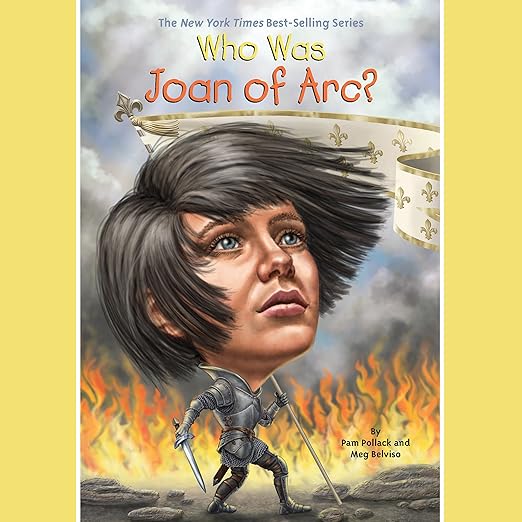
- Narration: Karyn O’Bryant delivers a clean, engaging performance that keeps the 55-minute runtime moving, well-paced for the target age group and the Who Was? format.
- Themes: Faith and conviction, women in history, the intersection of the personal and the political
- Mood: Swift and vivid, with a genuine sense of awe at the improbability of the subject’s life
- Verdict: A well-executed Who Was? entry that does real justice to one of history’s most genuinely strange and moving figures.
I was thirteen the first time I encountered Joan of Arc as a real historical figure rather than an image on a stained-glass window. I remember the collision of disbelief, she was a teenager, illiterate, from a village no one had heard of, and she somehow convinced a king to give her an army. The scale of that improbability still strikes me every time I return to the story. Listening to Karyn O’Bryant read Pam Pollack’s account one morning before the rest of the house woke up, I felt something of that original shock again.
The Who Was? series has a reliable format: accessible prose, historical context woven through personal narrative, and a length calibrated to hold young attention without demanding adult endurance. At 55 minutes, this entry is one of the shorter ones in the series, which is appropriate, Joan of Arc’s life was brief, and the biography honors that compression rather than padding around it.
The Vision That Changed France
Pollack opens with Joan as a child in Domremy, caring for cattle and sheep in a village that had known nothing but war within living memory. The Hundred Years’ War had been running for generations by the time Joan was born, and the biographical context is delivered efficiently: England’s claim on France, the siege mentality that had become the default French condition, the particular despair of a country that had essentially given up on its own sovereignty.
Against this backdrop, Joan’s visions, religious experiences that directed her to join the dauphin’s cause and lead French troops into battle, are presented with the appropriate balance of the miraculous and the historically documented. Pollack does not rationalize the visions away, nor does she claim certainty about their nature. She simply reports what Joan reported and what the historical record shows happened next: a thirteen-year-old girl began preparing to go to war.
O’Bryant’s narration handles this material with the right register, neither mocking the religious dimension nor overselling it, simply moving through the facts with the confidence of a narrator who trusts the story to do its own work. For young listeners who are themselves navigating questions of faith, the treatment is respectful and honest.
A Teenager Leading Troops
The military sequences are the biography’s most propulsive passages, and they benefit from Pollack’s decision to keep the battle descriptions concrete without becoming graphic. Joan was wounded during the siege of Orleans, an arrow through the shoulder, and returned to the field the same day. She was a teenager leading grown soldiers into combat against a better-equipped enemy and winning. Pollack does not understate the physical bravery involved.
One reviewer who read the biography aloud a chapter a day with an eight-year-old grandson noted that it is written simply enough for that age group without writing down to a childish level. That balance is the Who Was? series at its best, and this entry achieves it consistently. The military history is not dumbed down; the personal portrait is not stripped of complexity.
The Capture and What Followed
The biography does not shy away from Joan’s trial, condemnation, and execution at nineteen. Pollack handles this with appropriate care for a young audience, the cruelty is acknowledged, the injustice is named, and the canonization that followed is presented as a form of historical reckoning. For children who have not yet encountered many stories in which the protagonist does not survive, this entry provides a meaningful first encounter with that reality.
The 4.7 rating from 660 listeners is one of the stronger tallies in the Who Was? series, and the review that notes a thirteen-year-old who initially had no interest in Joan ending up choosing her for a book report speaks to something real. The biography makes Joan’s improbability legible without reducing her to a symbol. She was a real person, and this brief audio portrait honors that.
Who Should Listen / Who Should Skip
Ideal for ages eight and up, particularly for children encountering European medieval history or the Hundred Years’ War for the first time. The 55-minute runtime makes it practical for a single sitting or a commute. Parents looking for a biography that addresses faith and conviction honestly, without religious advocacy, will find this one well-handled. Not for listeners seeking deep scholarly engagement, the Who Was? format privileges accessibility over comprehensiveness, which is entirely appropriate for its audience.
Frequently Asked Questions
Is the Who Was? Joan of Arc audiobook appropriate for children who are not Catholic or Christian?
Yes. Pollack presents Joan’s religious visions as historical events experienced by a historical person, not as theological claims. The treatment is respectful of faith without being doctrinally specific, and non-religious listeners will find the biography engaging on purely historical grounds.
Does the biography cover Joan’s trial and execution, and is that handled appropriately for young listeners?
Yes, the biography covers her capture, trial, and execution at nineteen. Pollack handles this material with care, the injustice is clearly named, but the description is not graphic or traumatic. It is a meaningful encounter with historical tragedy rather than a distressing one.
How does this compare to other entries in the Who Was? series in terms of depth and length?
At 55 minutes, this is on the shorter end of the Who Was? series, which typically runs between 45 minutes and two hours. The compression is appropriate given Joan’s short life. The depth is comparable to other strong entries in the series, accessible but not superficial.
Does Karyn O’Bryant’s narration distinguish between different historical figures in the text?
O’Bryant’s narration is primarily a single narrative voice rather than a full character-voiced performance. She brings energy and clarity to the material without attempting dramatic impersonation of historical figures, which suits the documentary tone of the Who Was? format.