Quick Take
- Narration: Kevin Pariseau handles the Who Was? series format with his characteristic efficiency, clear, steady, and calibrated to young listeners rather than adults.
- Themes: Origins and reinvention, music as cultural disruption, poverty as both constraint and creative context
- Mood: Informative and accessible, a compact biographical doorway rather than an immersive experience
- Verdict: A well-crafted entry point for young Elvis fans or students working on a project, covering his Depression-era roots and rock and roll revolution in 50 efficient minutes.
My godson went through an Elvis phase at eleven that I found genuinely delightful, he had absorbed Jailhouse Rock from somewhere and wanted to know everything. Who Was Elvis Presley? is exactly the kind of book I would have handed him at that moment: concise, accurate, and genuinely informative without talking down to a young reader who is arriving with real curiosity rather than just a school assignment.
At fifty minutes, this audiobook is the Who Was? series in its characteristic form. Geoff Edgers covers the arc from Tupelo, Mississippi during the Depression through the transformation of American popular music with the efficient purposefulness that has made the series a classroom staple. Kevin Pariseau narrates, and his performance is clean and calibrated to the audience, children in the eight-to-twelve range who need information delivered at the right pace rather than dramatized for maximum effect.
From Tupelo to Everywhere
The genius of Elvis Presley’s story, as both biography and cultural history, is that it is genuinely about the collision of specific American contexts: the blues of the rural South, the gospel music of Black churches, the country-western tradition, and the particular hunger of postwar American teenagers who wanted something that felt like their own. Edgers does not reduce this to Elvis was influenced by Black music without context, he gives enough geographic and social specificity that young listeners understand the Tupelo origins as generative rather than incidental.
The synthesis that became rock and roll is explained with the right degree of complexity for a children’s biography. It is not oversimplified, but it is also not weighed down with musicological terminology. Pariseau delivers the cultural history passages with a steady informational energy that keeps young listeners engaged without sensationalizing what was, genuinely, a seismic cultural shift.
The Physical Elvis and Why It Mattered
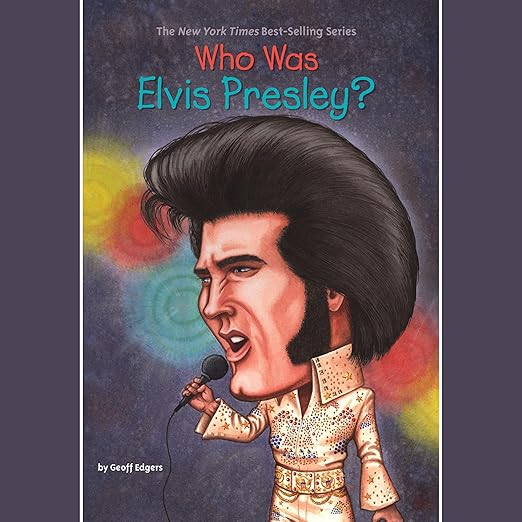
Edgers gives appropriate attention to Elvis’s look and performance style, the curled lip, the swiveling hips, the greased pompadour, not as tabloid material but as cultural data. Young listeners who have only encountered Elvis as an icon may not fully understand why that physicality was specifically controversial in 1956. Edgers provides enough context for the moment to register as something more than fashion history.
The television appearances and their reception are handled well. The decision to shoot Elvis from the waist up for Ed Sullivan is the kind of specific historical detail that makes the Who Was? series useful for young researchers: it is memorable, sourceable, and opens a productive conversation about censorship and cultural anxiety.
What the Format Does and Does Not Do
Fifty minutes is enough to cover the arc of Elvis’s life and cultural significance accurately. It is not enough to go deep on the relationship with Colonel Tom Parker, the Hollywood years’ complicated legacy, or the Memphis Mafia’s social dynamics. Listeners arriving with existing Elvis knowledge will notice what the format leaves out. Young readers encountering him for the first time will have no sense of missing anything, which is exactly how this format is supposed to work.
Reader reviews confirm the book’s primary use cases: it works for school projects, it works as a first biography for young Elvis fans, and it satisfies the curiosity of a child who has encountered the music and wants to understand where it came from. It is not an audiobook for adults who want a complete picture of the man.
Who Should Listen and Who Should Skip
Who Was Elvis Presley? is built for listeners roughly eight to twelve, with particular value for those doing school research or those who have come to Elvis through his music and want biographical context. Parents driving children to school with a passing Elvis question will find this a clean, accurate answer in under an hour.
Skip it if you are an adult seeking a comprehensive portrait, Peter Guralnick’s two-volume biography remains the gold standard for serious Elvis reading, and this format cannot compete with it in depth or complexity. Within its intended scope, however, this audiobook does exactly what it sets out to do.
Frequently Asked Questions
Is the information in this audiobook accurate enough for a school research project?
Yes. The Who Was? series maintains factual accuracy consistently, and Geoff Edgers covers the biographical fundamentals, birthplace, musical influences, cultural impact, television history, and death, with reliable specificity. Children using it for reports should supplement with additional sources for quotable detail, but nothing here will mislead them.
Does the audiobook cover Elvis’s death and the circumstances around it?
Yes, though with the brevity appropriate for a children’s format. The later career decline, the Las Vegas years, and the 1977 death are addressed. The content is factual and age-appropriate without being graphic about the health issues involved.
My child loves Elvis’s music. Is this audiobook a good pairing with listening to his songs?
It is an ideal pairing. The audiobook provides exactly the context that makes the music make more sense, the Tupelo origins, the gospel and blues influences, the specific cultural moment when his sound emerged. Listening to the biography alongside the music will give a young fan a considerably richer appreciation of what they are hearing.
Is Kevin Pariseau’s narration engaging enough to hold a young listener’s attention for the full 50 minutes?
Yes, within reason. Pariseau is a skilled professional Who Was? narrator who understands the audience and paces accordingly. The format is inherently informational rather than dramatic, which means listeners who need high narrative momentum may find their attention drifting in the middle sections. For engaged young Elvis fans, however, the content itself does the work.