Quick Take
- Narration: Nicholas Guy Smith brings appropriate swagger to the material, his delivery captures the theatrical quality of Blackbeard’s legend without tipping into parody.
- Themes: Piracy and historical mythology, life at sea in the early 18th century, the gap between legend and documented fact
- Mood: Brisk and entertaining, with more genuine history than the pirate branding suggests
- Verdict: A well-researched 58-minute introduction to one of history’s most mythologized figures, ideal for young listeners captivated by the romance of the high seas.
There is a particular kind of eight-year-old who becomes obsessed with pirates, and the parent of that child has my complete sympathy and also my recommendation. I listened to this one on a Thursday afternoon while trying to catch up on some reading, and found I had put the reading down before the end of the first chapter. James Buckley Jr. has a gift for pacing that serves the Who Was? format extremely well, and Nicholas Guy Smith’s narration gives Blackbeard exactly the presence the subject demands.
At 58 minutes, this is a tight, efficient biography. Blackbeard is a subject who could sustain a much longer treatment, there is genuine scholarly debate about his origins, his methods, and the mythology that accumulated around him, but for the age group this is aimed at, the compression is a feature rather than a limitation. You want the sword and the burning fuses in the beard before you want the archival disputes about his birthplace.
Edward Teach, Before the Legend
The biography opens honestly with the gaps in the historical record. Blackbeard most likely began as Edward Teach, or Thatch, depending on the source, from Bristol, England, but the early record is thin. Buckley acknowledges this without making a big production of the uncertainty, which is the right move. He then builds the pirate’s career from the documented foundation: hired sailor during Queen Anne’s War, apprenticeship under Captain Benjamin Hornigold in the Bahamas, and the gradual accumulation of ships, crew, and infamy.
The pivot from licensed sailor to outright pirate is one of the more interesting passages in the biography, and Buckley handles it with genuine historical texture. Hornigold’s role as a mentor is given its due, there was an actual school of piracy operating in the Caribbean in the early eighteenth century, with Nassau as its unlikely capital, and Blackbeard was a student before he was a master. Smith’s narration keeps the energy up through this expository material without rushing past it.
The Beard, the Fire, and the Fear
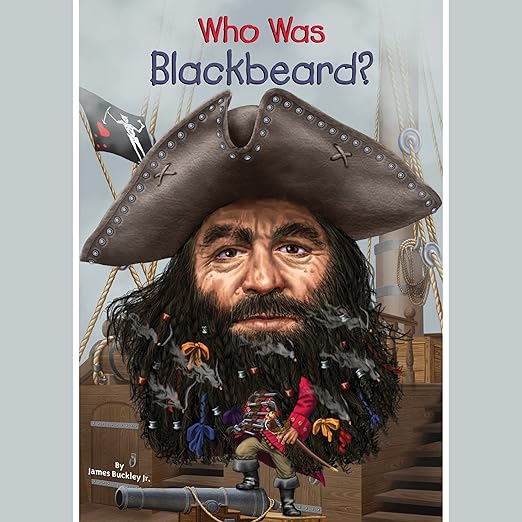
The myth-making dimension of Blackbeard’s career is one of the biography’s most entertaining sections. The thick black beard, the slow-burning fuses woven into it during battle, the deliberate cultivation of a reputation for supernatural ferocity, Buckley explains the tactical logic behind the theatrics, which gives young listeners something more interesting than simple villainy. Blackbeard understood that the terror of his reputation was more efficient than actual combat. He was, in a real sense, a brand strategist operating three centuries before the term existed.
The Eastern seaboard operations, the brief occupation of Charleston, the command of multiple ships, these are covered at the pace the format demands, with enough specificity to feel real and enough momentum to keep attention. The three-hundred-year legacy of Blackbeard’s influence on pirate legend and lore is handled in the final section with appropriate lightness: this is where he becomes the template for every fictional pirate that followed.
Why This Entry Works in the Who Was? Series
The Who Was? series has produced entries of varying quality depending on how well the subject fits the format’s constraints. Blackbeard is an almost ideal subject: a short documented life, extraordinary mythological accretion, genuine historical significance, and enough dramatic material to fill 58 minutes without padding. The reviewer whose son developed a pirate fascination after a beach trip and read this book multiple times is describing exactly the audience this entry is built for.
The 4.7 rating from 913 listeners is one of the stronger tallies in the series, and it reflects a genuine match between subject, format, and execution. The entry works as standalone entertainment and as a gateway to deeper reading about maritime history, the Golden Age of Piracy, and the political economy of the Caribbean in the early eighteenth century.
Who Should Listen / Who Should Skip
Ideal for ages seven to eleven, with particular appeal for children who have developed an interest in pirates through fiction, films, or travel. The 58-minute runtime makes it genuinely practical, a single car ride, a quiet hour before bed. Parents will find it more historically substantive than expected. Those seeking a scholarly account of early eighteenth-century piracy will need adult sources, but as an introduction for young listeners, it does everything it needs to do.
Frequently Asked Questions
How historically accurate is the biography, given how much of Blackbeard’s life is myth?
Buckley is upfront about the gaps in the historical record, particularly regarding Blackbeard’s origins and early life. The biography distinguishes clearly between what is documented and what is legend, which is an important intellectual move for young readers encountering this kind of historical figure. The core facts of his pirating career and death are accurately presented.
Is this entry appropriate for children who have primarily encountered pirates through fiction and film like Pirates of the Caribbean?
Yes, and it is actually well-positioned to give those children a more substantive frame for the pirate mythology they already enjoy. Buckley explains how the legend-making worked and why Blackbeard became the template for fictional pirates, which adds meaning to the pop-culture associations rather than dismissing them.
Does Nicholas Guy Smith’s narration maintain energy through the less dramatic historical sections, such as the background on Queen Anne’s War?
Yes. Smith keeps a consistent tone that is engaging without being overly theatrical. The expository sections feel earned rather than obligatory because Buckley writes them with clear forward momentum, and Smith’s pacing mirrors that approach.
How does the Who Was? Blackbeard entry compare to the many other pirate books available for young readers?
The Who Was? format has the advantage of serious research and editorial oversight, which means the historical content is more reliable than many pirate-themed children’s books. This entry benefits from Buckley’s clear-eyed handling of the gap between documented history and mythological accretion, a more intellectually honest approach than books that simply retell the legend.