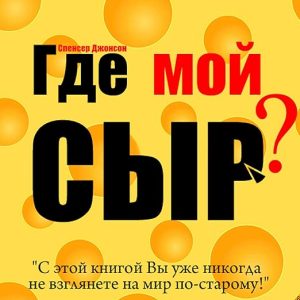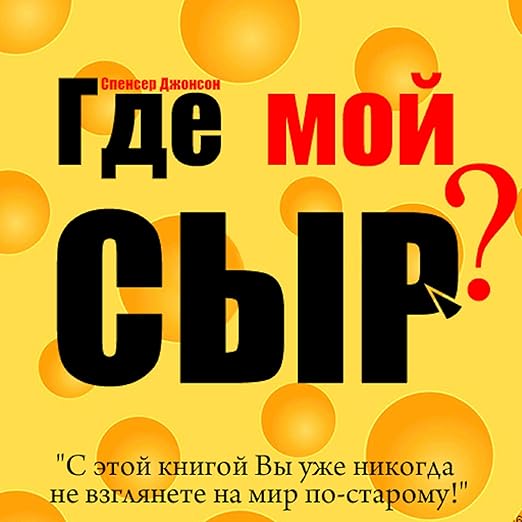
Andrey Krupnik's reading voice carries the flat, patient cadence of someone who has narrated this exact fable many times before, and for a story built around a maze, two mice, and one repeated lesson about accepting change, that steadiness turns out to be exactly right. This audiobook is the Russian-language edition of Spencer Johnson's Who Moved My Cheese?, one of the best-selling business fables ever published, and the listing itself states the language plainly: this is not an English-language production, and English-only listeners should look elsewhere before spending a credit on it.
For Russian-speaking listeners, though, this is a genuinely faithful rendering of a book that has sat on corporate training shelves for over two decades. Johnson's parable follows four characters living inside a maze, Sniff and Scurry, two mice who rely on instinct and quick action, and Hem and Haw, two 'littlepeople' who rely on reasoning and habit, all of them searching for cheese that represents whatever each of us actually wants out of life, a job, a relationship, financial security, peace of mind. When the cheese supply runs out without warning, each character responds differently, and that divergence is the entire engine of the story.
Hem Waits While Haw Starts Writing on Walls
What holds up about this fable, even stripped of its late-nineties management-seminar packaging, is how honestly it treats denial as a normal first response to change rather than a personal failing. Hem's refusal to leave the empty cheese station, convinced the supply will somehow return if he just waits long enough, reads less like a caricature and more like a recognizable human instinct once you separate the story from its corporate training-video reputation.
Haw's arc, the character who eventually does leave the maze's familiar section and starts writing observations on the wall as he searches, is where the book's actual thesis lives: change is easier to navigate once you notice it early, imagine the reward on the other side of it, and move despite the fear rather than after it disappears. It is a simple structure, deliberately so, and Krupnik's narration never oversells that simplicity into something more dramatic than the text actually is.
The Cheese Was Deliberately Left Vague
Spencer Johnson was no stranger to the short-form business parable before this book; he had already co-written The One Minute Manager with Kenneth Blanchard more than a decade earlier, and that same instinct for compressing a management lesson into an easily retold story shows throughout Who Moved My Cheese?. The cheese metaphor itself was deliberately chosen for its flexibility, vague enough that a listener in any job, any relationship, any stage of life could substitute their own specific 'cheese' without the parable needing to spell it out.
One of the book's most distinctive touches, carried over faithfully in this narration, is Haw's habit of writing short handwritten mottos on the maze walls as he searches, lines like 'The Quicker You Let Go Of Old Cheese, The Sooner You Find New Cheese,' which later became some of the most quoted lines from the entire book. Krupnik reads these short interjections with a slightly different, more deliberate pacing than the surrounding narrative, a small performance choice that helps them land as the standalone takeaways they were always meant to be.
Krupnik Skips Distinct Voices for a Measured Reading
The case for listening rather than reading is almost entirely about runtime: at just over an hour, this is closer to a long podcast episode than a typical audiobook, which makes it genuinely easy to finish in a single sitting during a commute or a workout, distinct from most business titles that demand a multi-week listening commitment.
Krupnik's delivery is functional rather than theatrical, with no distinct character voices for the four animals and no dramatized sound design, just a clear, measured reading that lets the parable's own structure carry the emotional weight. That restraint suits didactic fable writing specifically; a more performative narrator risks turning Johnson's deliberately plain prose into something closer to a children's story than a workplace teaching tool, which would undercut the book's whole pitch to adult, corporate audiences.
The book's brevity, both on the page and here in audio, was also part of its original marketing strategy; Johnson and his publisher deliberately aimed for something a manager could hand to an entire team and expect everyone to finish within a single lunch break, a structural choice that suits this 74-minute audio edition especially well for group listening or team training use.
Seven Thousand Ratings Measure the Book, Not This Edition
The most important thing to watch for here is the language itself, stated directly in the source listing and confirmed by Krupnik's own narration: this is a Russian-language production. The rating, 4.8 from over seven thousand listeners, almost certainly reflects the underlying book's global reputation more than this specific narrated edition, since a fable this widely read collects enthusiastic ratings across every language it has ever been published in.
Also worth naming honestly: at 74 minutes, some listeners coming from more substantial business nonfiction may find the ideas here thinner than expected once translated to audio pacing. This was never meant to be a deeply researched framework book; it is a parable meant to be revisited quickly, and treating it as anything more academic than that will lead to disappointment regardless of which language edition you choose.
It's also worth naming the book's mixed legacy honestly: some later critics pushed back on how easily the parable's message could be used to justify layoffs or demand employee flexibility without offering employees any real security in return, reading Hem's resistance as reasonable self-protection rather than simple fear. That criticism doesn't erase the book's usefulness, but it's a fair lens to bring to a story this frequently deployed in corporate settings.
Practicing Listening Comprehension With Material Already Known
This edition suits Russian-speaking listeners already familiar with the book's reputation who want a quick, faithful audio revisit, corporate teams doing a bilingual training rollout, or anyone drawn to short-form parable nonfiction they can finish in one sitting rather than committing to a multi-hour program.
It's also a reasonable choice for listeners who already know the book well in English and want to test or maintain Russian-language listening comprehension using material whose content and structure they already understand.
Skip this specific listing if you need English narration, since nothing here will serve that need regardless of how strong the underlying book's reputation is. Skip it too if you're looking for detailed frameworks or research-backed behavioral science, since the fable format trades depth for memorability by design, and this audio edition doesn't add anything beyond a faithful, unembellished reading of that same short text.
The Short Version
- Read by: Andrey Krupnik's flat, patient delivery suits this Russian-language fable's didactic tone precisely.
- At its heart: Adapting to change, fear of the unknown, workplace resilience
- Vibe: Brisk, parable-simple, faintly corporate
- Short version: A worthwhile 74 minutes for Russian-speaking listeners, though English-only buyers need a different edition entirely.
Is this Who Moved My Cheese? audiobook narrated in English or Russian?
Russian. The listing explicitly notes this production is in Russian, and narrator Andrey Krupnik reads it accordingly throughout.
How long is the Who Moved My Cheese? audiobook, and is that runtime accurate to the original book?
It runs about 74 minutes, which is accurate to the source material. The print book itself is famously short, closer to a long pamphlet than a typical business title.
Is there an English-language audiobook edition of Who Moved My Cheese? available separately?
Given how widely translated and adapted this title has been since 1998, an English-language edition almost certainly exists separately; search specifically for an English-narrated listing rather than assuming this one applies.