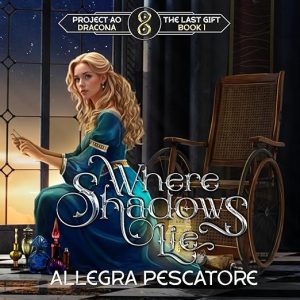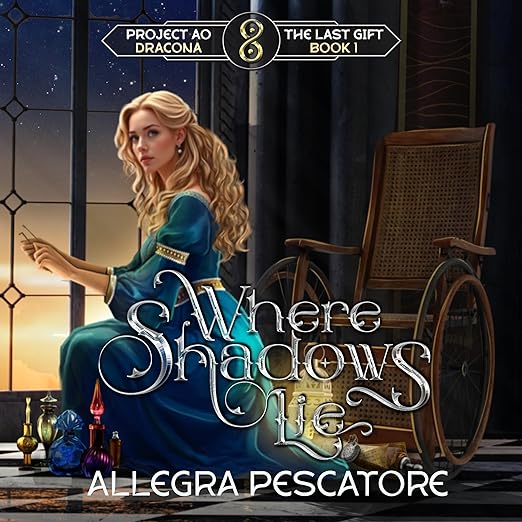
- Read by: Marian Hussey is the sole credited reader for a cast spanning a tyrant's court, a rebel cell and a desert culture, with no second voice on the page.
- At its heart: Rebellion against your own family, queer and disabled leads at the center, a conspiracy five centuries deep
- Vibe: Tangled and long-haul, warmer than its body count suggests
- Short version: A generous, uneven first arc that repays the attention it demands once you push past a soft second quarter.
Twenty-four hours and fifty-one minutes is a heavy ask for the opening volume of a new fantasy world, and the audiobook of Where Shadows Lie wants all of it before it starts paying anything back. Allegra Pescatore begins with a chosen one already dead, a coup already failed, and a princess whose father signed the order that killed her brother. Elenor can look away from what the crown is doing to her people, or she can join the rebellion aimed at her own family. That is the engine, and it runs a very long time.
How Where Shadows Lie Holds Up
Elenor is the axis, and Pescatore builds her out of two refusals: she will not pretend her people are fine, and she will not stop being her father's daughter. The rebellion recruits her, a grouchy old doctor patches her up, a well-meaning assassin trails along behind, and a boisterous set of nobles supplies the noise around the edges. What keeps the ensemble from reading as a checklist is that each of Elenor's choices costs somebody something legible, and the ledger is kept honestly rather than reset between chapters.
Pescatore is sold on this page as writing an LGBTQ+ and disabled protagonist, and that phrase is doing an unreasonable amount of work, because it is the only genre marker the listing carries. The book sits under a single category with no fantasy tag anywhere near it. That is a shelving failure rather than a content one, and it matters commercially: the actual contents are court intrigue, a rule-bound magic system, baby dragons, a desert culture and a five-century conspiracy, and none of that reaches a browser scanning categories.
Marian Hussey is the sole credited reader, which on a cast this size means one voice covering a tyrant king, a rebel cell, a desert culture and a monster with a thousand faces. A September 2022 five-star response puts the word awesome in its headline about the audiobook specifically, then spends its body summarizing Elenor's arc, so the endorsement arrives with no reasoning attached to it. Two minutes of the sample will tell you more than that headline does, and on a book of this length the sample is the cheapest decision you make.
Why Where Shadows Lie Works as an Audiobook
Court intrigue is the load-bearing pleasure. The king is a tyrant and also a father, so every scene the two of them share runs two arguments at once, and Pescatore keeps declining the easy version in which the villain is simply monstrous. The rebellion does not get a free pass either. Elenor is asked to trade one set of loyalties for another, and the book stays honest that both sets contain people who love her and people who intend to spend her.
Two thread lines run underneath the palace plot: a pair of fugitives moving for their lives, and ancient forces calling in debts five centuries in the making. The description sets the scorching dunes of the Mondaer Desert against the rain of Lirin, and that is a real tonal swing rather than a change of backdrop. It is also the clearest reason a first volume runs at this scale instead of stopping at the coup, and the reason the series is packaged as an arc rather than a tidy trilogy.
A rebellion story survives on whether its stakes stay personal, and the solution here is to make the tyrant a parent. The coup that opens the book kills Elenor's brother; the man who ordered it is the man who raised her. Every later act of defiance is therefore also an act of family betrayal, which is why the duty-against-defiance framing on the listing is not the usual marketing shorthand. A July 2020 five-star account came to the book through a book club selection and describes the result as a joy worth passing on.
Weak Spots in Where Shadows Lie
Justin Burnison's four-star response from October 2020 names the flaw before I have to. The opening pulls hard, that account says, and then the grip loosens; the second quarter held attention for a chapter or two at a stretch before losing it again, and only the back half grabbed harder than the beginning did. On a book of this length, a soft second quarter is not a few pages of drift, it is several hours of it, and that is the most useful sentence on the page.
Reference materials are the second thing to know about. An August 2024 four-star response praises the complex magic system and mentions the accompanying reference materials provided to help the reader keep the rules straight, and none of that apparatus travels into a recording. If you want the naming conventions and the magic rules somewhere you can see them, you will be looking them up separately while you listen, which is the familiar tax on dense secondary-world fantasy in audio.
Almost twenty-five hours also means the middle has to hold on its own, without the novelty of a new world doing the work for it. The description promises a non-stop epic fantasy ride, and that is the one phrase on the page I would push back on. Palace maneuvering slows, the desert thread accelerates, and the two do not reliably alternate on a rhythm that suits short sessions. Plan this one in chapters rather than in long uninterrupted runs, and the uneven stretches stop mattering.
The Right Listener for Where Shadows Lie
Fantasy listeners who want a long secondary world with queer and disabled leads at the center rather than decorating the margins are the obvious audience, and so is anyone who likes a court plot tangled enough to demand real attention. The description's own promise of sizzling romance sitting alongside oppression and freedom tells you the register: this is not grimdark, and it is not cozy either. If baby dragons and a five-century conspiracy in one book reads as a range problem rather than a feature, this arc is not for you.
Anyone who reads with a writer's eye may get an extra layer out of it. A June 2025 five-star response comes from someone who writes, and singles out how exposition is folded into scene rather than parked in blocks, before reporting a move straight on to another Pescatore title. That is a specific and unusual compliment, and it is one of the few craft observations that survives the transfer into audio intact, since exposition delivered in blocks is exactly where listeners drift.
Everything here comes down to your tolerance for a slow second quarter and a first volume that closes its arc without closing the story. If you want a fantasy series to live inside for a season, this is a generous place to begin, and the ensemble is warm enough to carry the length. Accept the sag as the price of the scale, and the hours pay for themselves.