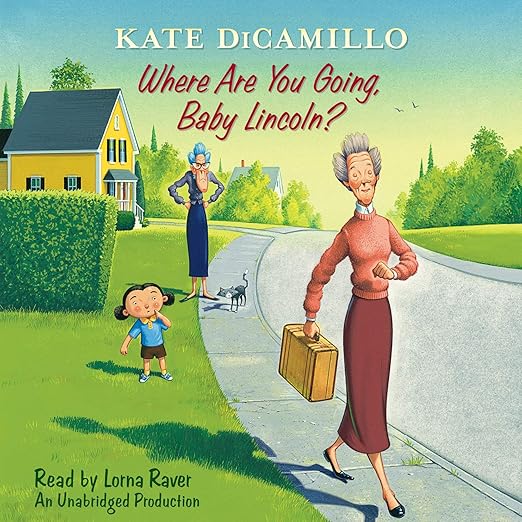
Baby Lincoln packs a bag without knowing where she is headed, only that a dream about a train under shooting stars felt more like home than her entire life spent obeying her older sister Eugenia, and that leap into the unknown carries this audiobook's entire fifty-eight minutes. Where Are You Going, Baby Lincoln? is the third entry in Kate DiCamillo's Tales from Mercy Watson's Deckawoo Drive series, narrated by Lorna Raver, and it follows Baby's self-declared Necessary Journey away from a lifetime of yes-sister obedience toward something she cannot yet name, sitting somewhere between adventure and simple self-discovery.
Great for Sisters, Parents, and Adventurers Alike
DiCamillo's real skill in this Deckawoo Drive spinoff is treating a timid, middle-aged woman's small act of rebellion with the same narrative weight a more conventional children's book might reserve for a dragon or a villain. Baby's entire conflict is internal, decades of yes-sister deference finally cracking, and the book never condescends to that stakes level just because the antagonist is a controlling sibling rather than a fantastical threat. Reviewer illirica titled her review of this franchise simply 'great for sisters, great for parents, great for adventurers,' three distinct audience angles packed into one short line, a sibling recognizing her own family dynamic, a parent scouting shared listening material, a young reader drawn to the adventure itself, that map cleanly onto why this small story keeps finding new listeners.
The book's brevity is entirely appropriate to its scope rather than a limitation to apologize for. This is an early-chapter-book runtime built for a single sitting, not a padded adventure stretched past its natural length, and DiCamillo's famously spare, rhythmic prose style depends on that restraint. Reviewer WENDY said she especially loved this book, describing 'sweet redemption for Baby and a wonderful journey of learning for other characters in the book,' a testament to how much emotional ground fifty-eight minutes can cover when the writing itself never wastes a sentence.
Raver's Deadpan Eugenia Lets Every Age Catch the Joke
Lorna Raver's narration of this series has a specific, well-earned reputation worth knowing about directly: her deadpan delivery of Eugenia Lincoln, Baby's bossy older sister, is precisely calibrated for DiCamillo's curmudgeonly supporting characters, controlled micro-adjustments rather than big dramatic swings, which lets both a child listener and an accompanying adult catch different layers of the same joke simultaneously. Reviewer rstack specifically mentions doing different voices while reading these books aloud as a family activity, and Raver's own audio performance sets a genuinely strong template for that kind of shared, read-aloud-style engagement even in the pre-recorded audio format.
Kate DiCamillo's own credentials are worth stating plainly for any listener unfamiliar with her wider body of work: she has won the Newbery Medal twice, for The Tale of Despereaux and Flora and Ulysses, and served a term as the National Ambassador for Young People's Literature, making her one of the most decorated living authors working in children's fiction. That pedigree matters here specifically because it confirms Baby Lincoln's quiet, internal journey is a deliberate craft choice by a writer who has already proven she can build a much larger, more dramatic children's epic, not a smaller story because she could not manage a bigger one.
A fifty-eight-minute runtime carries a specific, underrated value for reluctant or easily distracted young listeners: it is short enough to finish completely in one sitting without losing the thread, which matters enormously for building listening stamina and confidence before attempting a longer middle-grade audiobook. A child who successfully finishes this story start to finish gets a genuine sense of accomplishment that a fifty-eight-minute chunk of a much longer book would not provide in the same way, and that completed-story feeling is worth real consideration for parents specifically building a young listener's audiobook habit from scratch.
Vehicles and Transportation Is a Loose Fit Here
At fifty-eight minutes, this is a single-sitting listen rather than a multi-session commitment, and parents or gift-buyers expecting something closer to a full-length middle-grade novel should recalibrate accordingly. This runtime is standard and appropriate for the Deckawoo Drive spinoff format specifically, which trades the more antic, animal-centered comedy of the core Mercy Watson books for quieter, more character-driven material, and listeners coming from the pig-centric main series expecting the same broad slapstick energy may find Baby Lincoln's more internal, gentler story a deliberate tonal shift rather than a lesser entry.
The Vehicles and Transportation tag attached to this listing is a loose fit at best; while Baby's pivotal dream involves a train and her journey does eventually involve real travel, this is fundamentally a character-driven story about breaking free from a controlling relationship rather than a book organized around vehicles or transportation as a subject. Listeners or parents browsing specifically for transportation-themed children's content should not expect that focus here, though the train imagery does function as a genuinely lovely, recurring visual thread throughout Baby's arc toward independence.
DiCamillo's Deckawoo Drive books typically pair her prose with charming illustrations in the print edition, and audio necessarily loses that visual layer entirely. For a series built partly around visual character comedy, the exact look of Eugenia Lincoln's disapproving expression, for instance, families who have enjoyed the illustrated print editions should know the audio experience shifts weight entirely onto narration and prose to carry character comedy the pictures previously helped deliver, which Lorna Raver's performance handles capably but differently than a page a child can study and giggle over independently.
Fifty-Eight Minutes Fits a Dinner Table Gathering
This suits families already working through the Mercy Watson and Deckawoo Drive catalog, young listeners around the early-chapter-book age range ready for quieter, more character-focused stories, and any adult listener who enjoys DiCamillo's spare, precise prose regardless of the book's marketed age category. Reviewer illirica's note about a three-year-old and six-year-old responding differently to different entries in this franchise is a useful reminder that individual books within Deckawoo Drive vary meaningfully in tone, and this one rewards a listener, child or adult, drawn to small, internal courage over big external stakes.
This also suits families specifically looking for a shared listening experience rather than independent solo listening, given how many reviewers across this franchise mention doing character voices together or listening as a group activity. The story's brevity makes it realistic to actually gather and listen together in one sitting, a dinner table or car ride length commitment, rather than requiring a multi-night listening schedule the way a longer chapter book would, which suits families wanting a genuine shared experience over an extended solo assignment for one child.
Skip this as a starting point if you are hoping to hit the ground running with Mercy Watson's more manic pig-and-toast comedy specifically, since Baby Lincoln's story runs quieter and more introspective than that flagship tone. It is also simply too short to satisfy anyone wanting a substantial single listen rather than a brief one, fifty-eight minutes suits a bedtime story or a short car ride far better than an extended road trip, and buyers should set that runtime expectation clearly before purchasing this as a standalone gift.
Key Details
- Narration: Lorna Raver's calibrated deadpan makes Eugenia's bossiness land for adults and children at once.
- Themes: Sibling rebellion, quiet self-discovery, small-town found family
- Mood: Gentle and warmhearted
- Verdict: A brief, tender listen for existing Deckawoo Drive fans, not the place to start with Mercy Watson's louder comedy.