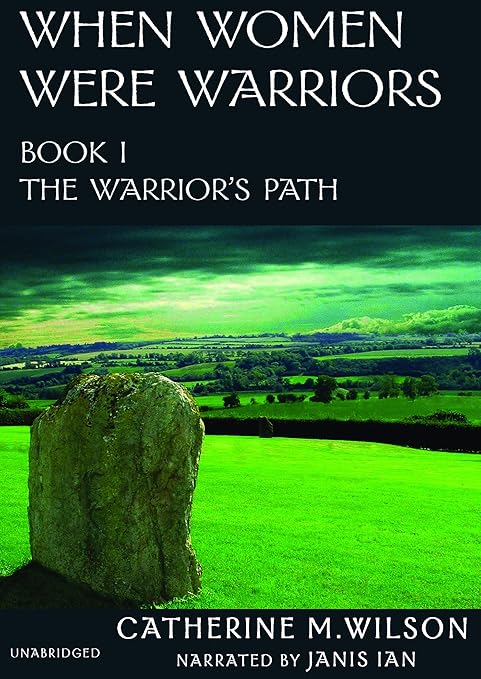
Small stature is the obstacle this book hands its hero on page one, and it is not working as a metaphor. Tamras arrives at Merin's house to train as a warrior, and almost everyone, Tamras included, doubts she will ever handle a sword competently. Ten hours and forty-five minutes of audiobook follow from that doubt, and very little of it takes place anywhere near a battlefield.
Our Take on When Women Were Warriors Book I
The plot is a sequence of small demotions. Tamras expects a warrior's apprenticeship and receives the position of companion instead, which the copy calls, accurately, little more than a personal servant. The woman she is assigned to arrived at Merin's house the previous winter, seemingly out of nowhere, and wants nothing to do with her. What follows is a year of performing humble tasks as well as they can be performed, and of earning, in that order, trust and then friendship.
Catherine M. Wilson builds the whole first volume out of decisions that look insignificant while they are being made. The description says as much outright: the choices flow from character and from good intentions, and they settle a destiny. That is a promise about structure rather than about incident, and it explains why a book with warriors in its title spends so much of its ten and three quarter hours on domestic ground.
The genre question gets settled better by a buyer than by the copy. That response places the story among ancient Celtic tribes and then says what it is not: not a blockbuster fantasy, not the historical epic that young adult shelves usually stock, not a chosen-one narrative out to save a world. Slower, character-driven, built from the smaller moments that define Tamras as a young woman and as a warrior. If that reads as a warning to you, it is one. If it reads as relief, this is your book.
Why Listen to When Women Were Warriors Book I
Prose shaped like speech is what carries the length. The response headed Mystical storytelling from the soul puts a finger on it: the evocative language establishes from the opening that this is a world of women warriors and that Tamras belongs to a family inside that tradition, and the writing weaves a spell close to sitting with a storyteller. That entry also supplies the name the description withholds, Maara, and the detail that her past stays a mystery. A prose style already built for the ear gives a reader something to stand on.
The reading credit goes to Janis Ian, one voice across ten hours and forty-five minutes of first-person recollection. What the material demands is consistency rather than range, since Tamras tells her own year and Lady Merin, Maara and the rest arrive inside that telling rather than beside it. The listing does not settle whether the same voice continues into the two volumes that follow, and that is the question worth asking before you commit to the first installment of anything in audio.
Length works in the book's favor. Ten hours is enough room for an apprenticeship to feel like an apprenticeship, with the tedium of the tasks left in rather than summarized away, and a friendship earned at roughly the pace friendships get earned. Novels that compress this arc into a training montage lose the only thing that makes the arc land. Wilson refuses to compress it, and a format you cannot skim suits that refusal better than a paperback ever will.
What to Watch For in When Women Were Warriors Book I
The one four-star response in the column is also the most useful one. It admits to doubts at the beginning before being won over, which is worth knowing in advance, because the opening stretch asks for patience while the shape of the thing establishes itself. That entry also pins down the age question the copy leaves vague, describing Tamras as an early teen leaving home and family, and it treats the first-person construction as the defining formal choice rather than as a flourish.
The record itself needs a warning label. The identifier field carries a ten-digit book number of the kind printed on a paperback copyright page rather than anything belonging to a recording, the publisher field sits blank, and the star average at the top of the page falls below almost every grade in the written column, which tells you the tally and the column are not describing the same set of buyers. None of that touches the novel. All of it limits how much this page can be made to prove.
Two further mismatches deserve mention. The listing files this under LGBTQ+ while the description offers nothing that would confirm the shelf, so a buyer arriving from that category is trusting the filing rather than the evidence. And the written column spans three marketplaces, with entries filed in the United States, in Germany and in Australia, which speaks well of the book's reach and complicates any attempt to read the page as a verdict on one particular edition of it.
Who Should Listen to When Women Were Warriors Book I
This suits listeners who want a coming-of-age story where the stakes are internal and the world stays complete without being explained. The entry filed from Australia names the appeal precisely: the dramatic interludes of training, and the business of finding oneself inside a world while holding on to your own perspective. Anyone who prefers an apprenticeship to a war, and who likes a fantasy setting presented as ordinary by the people living in it, will settle in fast.
Give it a miss if you need incident, because swordplay sits on the cover while patience is the actual experience. Give it a miss too if an opening volume that closes on a threshold rather than on a resolution frustrates you, since the copy frames this as one year inside a trilogy. Price the other two volumes before you begin, since this is a story built to be finished rather than sampled.