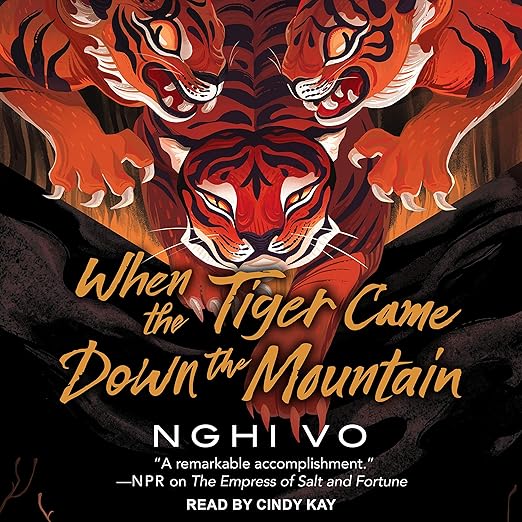
Nghi Vo constructs stories the way a master calligrapher holds a brush: every line is considered, and the economy of the form is part of its meaning. This audiobook, narrated by Cindy Kay, runs two hours and twenty minutes, which is exactly as long as it needs to be. When the Tiger Came Down the Mountain is the second novella in Vo's Singing Hills Cycle, and like its predecessor The Empress of Salt and Fortune, it understands that compression is not a limitation but a discipline. The art of this series is in what it refuses to explain and what it trusts the reader to carry.
Cleric Chih, the wandering record-keeper who uses they/them pronouns, and their companion Si-yu, a mammoth rider, are captured in the mountains by a band of tigers who can shift between human and animal form. To survive until the mammoths arrive to rescue them, Chih must tell the story of the tiger and her scholar lover, a human woman of intelligence and courage from the empire of Ahn. The structural premise is recognizably Scheherazade, and Vo is explicit about the debt rather than trying to disguise it. What makes the novella genuinely interesting rather than merely clever is the way it complicates the frame: the tigers argue with Chih's version of the story. They have their own account of what happened between the tiger and the scholar, and their version differs from the human record in pointed ways.
The conversation between these competing accounts, between the archive and the living memory of those who were there, is what the Singing Hills Cycle is actually about. Chih's role as a cleric who collects stories and places them in a temple archive is not just background; it is the philosophical engine of the series. This novella advances that argument more directly and more provocatively than the first installment, using the tigers' corrections to Chih's narrative as a sustained interrogation of what it means to write history and whose memories get institutionalized as truth. The LGBTQ representation in the series extends to the scholar and her tiger lover, whose relationship is central to the story Chih tells, and Vo handles it with the same matter-of-fact care that characterizes Chih's own identity.
What Stands Out
Cindy Kay's narration suits the material's register: quiet, precise, and alert to the shifts in tone that distinguish Chih's voice from the tiger's challenge and the scholar's story-within-the-story. For a novella this dense with nested narrative, a narrator who can hold the frames distinct without over-performing them is essential, and Kay manages it well. The two-hour-twenty-minute runtime should not be mistaken for slight content: this novella packs more genuine thematic argument into its runtime than most full-length fantasy novels achieve. Listeners who prefer epic scale in their fantasy will find this format unfamiliar, but listeners who appreciate the novella as a form with its own logic will find it a complete and rigorous reading experience.
The audio format allows the frame narrative's recursive quality to register in a way that the print experience does not fully replicate. Hearing the story-within-a-story structure performed makes the layering more immediate, and Kay's handling of the transitions between Chih's present-tense danger and the historical narrative Chih is constructing gives the book an extra dimension of tension that print sometimes smooths over.
Vo's LGBTQ representation deserves specific mention because it operates so naturally within the world of Ahn. The tiger and her scholar lover are central to the story Chih tells, and their relationship is presented as part of the fabric of the empire rather than as a deviation from it. Chih's own non-binary identity functions similarly: it is simply part of who Chih is, as unremarkable within the world of the story as the mammoths that serve as transportation or the archive that holds the world's accumulated narratives. That kind of naturalized inclusion is harder to achieve than it appears, and it is one of the reasons the Singing Hills Cycle has found a devoted readership among listeners who are tired of representation that functions primarily as spectacle.
Things to Know Before Starting When the Tiger Came Down the Mountain
Listeners who did not read The Empress of Salt and Fortune can follow this novella, but the full weight of Chih's role and the Singing Hills archive will have more resonance with prior series context. The story functions as a standalone in the sense that its plot is self-contained, but the thematic accumulation of the series benefits from reading in order. The novella's density also means it rewards more attention than its runtime suggests: this is not background listening. The competing versions of the tiger's story require tracking, and the payoff depends on following the argument rather than just the plot. Listeners seeking a more traditional fantasy adventure arc will find the philosophical framing dominant over action.
Best Suited For
This audiobook is ideal for listeners who appreciate literary fantasy with genuine thematic ambition, readers who enjoy LGBTQ-centered narratives with non-binary protagonists, and anyone who has been following the Singing Hills Cycle and wants to continue with Chih's journeys. It is also a strong choice for listeners who want to encounter a fantasy novella that demonstrates what the form can do when it is working at full capacity. Cindy Kay's narration makes the audio experience a worthy way to receive a story that is ultimately about the act of telling stories and the stakes of who gets to write them down.
Key Details
- Voice: Cindy Kay holds the nested story-within-a-story frames distinct without over-performing them, which is exactly the right approach for this material.
- Big ideas: The conflict between archive and living memory, competing versions of the same story, and the political stakes of who gets to write history.
- Atmosphere: Precise and layered, with the cool intellectual energy of a story that knows exactly what it is doing at every level.
- Worth it?: A dense, rigorous fantasy novella that rewards close attention; two hours twenty minutes of content that outargues most full-length fantasy novels on its core themes.
Do I need to have listened to The Empress of Salt and Fortune before this audiobook?
The novella works as a standalone, but series context enriches the experience. Chih's role as a cleric-archivist and the significance of the Singing Hills archive carry more weight if you have read the first installment.
Does this audiobook handle Chih's non-binary identity naturally?
Yes. Chih's they/them pronouns are used consistently and naturally throughout, and the story does not make Chih's gender identity a plot point or source of conflict. It is simply part of who Chih is.
How does this audiobook fit into the broader Singing Hills Cycle series?
This is the second of Vo's Singing Hills novellas. Each installment is relatively self-contained in plot while building thematically on the archive-versus-living-memory argument that runs through the series. Reading in sequence is worthwhile.