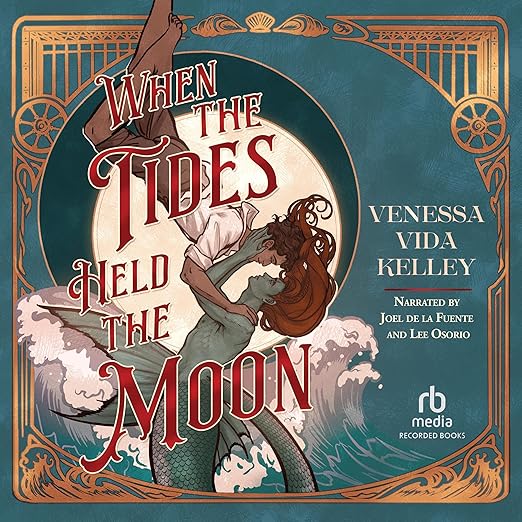
Coney Island's Luna Park in the 1910s is real, brick-and-plaster spectacle, and When the Tides Held the Moon drops a captured merman into the middle of it, which is the kind of premise that could tip into gimmick if the audiobook did not commit so fully to its own two central characters.
Is When the Tides Held the Moon Worth Your Time?
Benigno "Benny" Caldera is a Puerto Rican immigrant blacksmith working in 1910s New York, and the ironwork tank he builds for Luna Park earns him a place inside a Coney Island sideshow crew and their closely guarded secret: the tank holds a living, breathing merman named Rio, stolen from the East River. What starts as professional pride curdles fast into something Benny cannot look away from, since Rio turns out to be, in the book's own terms, a "clever philosopher" and "kindred spirit" rather than a curiosity to display, and Benny's growing feelings force him to confront exactly what kind of cage he helped build. Freeing Rio means more than defying his employer; it means betraying the sideshow crew that gave Benny his first real welcome in New York City, bankrupting the makeshift family that took him in, and risking the only home he has managed to build since arriving from Puerto Rico. That tension, between the family that rescued him and the captive that family profits from, is the book's actual engine, more than the fantasy premise alone would suggest. Venessa Vida Kelley's publisher has pitched this as The Shape of Water meets The Greatest Showman, and the comparison holds up structurally: a captive, othered figure, a spectacle economy profiting from him, and a human being inside that economy who has to decide whether loyalty to his new found family outweighs the wrongness of what they are doing. THE NEW YORK TIMES BOOK REVIEW called it "A lushly historical romance" and, separately, "a charming fable, an elemental dance of fire and water," a description that gets at how deliberately the book leans into fable logic rather than strict historical realism, even while grounding Benny's specific circumstances, an orphaned Boricua blacksmith with no family safety net, in real period detail.
The Best Parts of When the Tides Held the Moon
Lee Osorio narrates. Nothing prior turns up for this specific performer, so genre fit has to carry the assessment: a dual-engine historical romance like this one needs a narrator who can hold Benny's guarded, hardened voice, shaped by loss and immigrant precarity, against Rio's stranger, more lyrical register as an outsider to the entire human world, without letting either performance flatten into the other.
One review title actually says the quiet part out loud without quite delivering on it: Mom Needs Coffee's review is headlined "Gorgeous writing, Wonderful Audiobook, Brilliant story," yet the body never once names Osorio or describes a specific choice in the reading itself, focusing instead on craft elements like the slow burn pacing and Rio's short, poetic chapters. That is worth flagging rather than assuming: "Wonderful Audiobook" reads here as general enthusiasm for the format and the experience of listening, not a verifiable claim about performance technique, and no other review closes that gap either.
Chella's review supplies a different kind of listening context, tracking the book down through Libby, ordering a hardcover keepsake, and even finding Kelley's Etsy shop for signed extras, engagement that spans several formats rather than sticking to one. Chella is candid that "the book began a little slowly," which is worth setting expectations around going in, but adds that "by the end it was really everything that I could want in a novel," a payoff-over-setup structure worth knowing about before the early chapters test your patience.
Before You Commit to When the Tides Held the Moon
The rating badge does not add up. It shows 4.5 from a single counted vote, yet five full written reviews are visible, a spread no lone rating can mathematically produce. Unlike some listings in this genre, the visible reviews are not uniform either, four sit at five stars and one, from KJ, at four, with KJ specifically flagging that "the book misses the mark at the very end," so the mismatch here is about the vote count, not about manufactured unanimity.
A review from Spain, written in Spanish, praises "las ilustraciones y el formato del libro" (the illustrations and the book's format), calling the whole package "¡Precioso!" (gorgeous). That is unmistakably a response to a physical, illustrated print edition rather than to this audio recording, and it is worth knowing this listing has at least one review pooled in from a different format before treating the full review set as evidence about the audiobook specifically. Recorded Books published this edition, at twelve hours and twenty-three minutes, a substantial runtime for a genre romance that gives Kelley real room to develop Benny's blacksmith trade and the sideshow crew's internal politics alongside the central relationship, rather than compressing the historical setting into background color.
Should You Listen to When the Tides Held the Moon?
Readers drawn to the queer historical romance space, and anyone who wants their period fiction to actually engage with immigration, labor, and spectacle economics rather than use the era as pure backdrop, are the clearest audience here. TJ Klune, whose own The House in the Cerulean Sea sits in similar found-family territory, blurbed the book directly: "Venessa gives life to the most unexpected things. I have a strong, strong feeling that this is the start of something special." Holly Pirie's review adds a useful comparison too, invoking The Night Circus for how fully the book "painted such a magical world before the reader's eyes," and specifically credits the tank-and-sideshow setup with letting Kelley build a fully imagined world around a fairly small cast rather than a sprawling ensemble. Listeners who gravitate toward slow-burn romance with real historical texture underneath the fantasy premise, rather than fantasy plotting with romance layered on top, will find the balance tilted the way they prefer here.
Skip it if the ending needs to land cleanly for you; KJ's four-star review is explicit that the conclusion is where the book loses its footing, even while praising everything that came before it. Skip it too if slow-burn pacing with limited relationship angst is not your preferred romance rhythm, since another reviewer flags exactly that pacing choice as a defining, deliberate feature rather than a flaw. Everyone else gets a genuinely well-reviewed entry in queer historical fantasy romance, backed by real critical attention rather than only reader enthusiasm.
Before You Press Play
- Performance: Lee Osorio narrates with no prior title logged in this catalog; one review's headline praises a 'Wonderful Audiobook' without ever describing a specific reading choice, so the claim reads as general enthusiasm rather than confirmed performance detail.
- What it covers: found family versus captivity, immigrant precarity, queer slow-burn romance
- Feel: Lush, melancholic, and fable-like
- Our call: A well-reviewed queer historical fantasy romance whose ending divides even its enthusiastic readers.
Frequently Asked Questions
Does the When the Tides Held the Moon audiobook work as a standalone romance?
Yes, it is a complete, standalone story rather than part of a series. Benny and Rio's arc, from the sideshow capture through Benny's decision about freeing Rio, resolves fully within this one twelve-hour-and-twenty-three-minute audiobook, with no cliffhanger carrying into a sequel.
Is the ending of this audiobook satisfying, based on the reviews?
Opinion splits. Four of five visible reviewers rate it five stars and praise the full arc, but reviewer KJ awards four stars specifically because, as the review puts it, the book 'misses the mark at the very end,' so expectations for the closing chapters vary among the visible listener reactions.
How historically grounded is this audiobook's Coney Island setting?
The blacksmithing trade, the Luna Park sideshow economy, and Benny's status as a Puerto Rican immigrant in 1910s New York are all treated with real period specificity, even though the merman premise itself is fantasy. One reviewer describes it as fable logic layered over genuine historical texture.
Does the narrator handle both lead characters distinctly in this audiobook?
No prior narration credit for Lee Osorio is logged elsewhere, so this cannot be confirmed against a track record. The book itself demands real differentiation, Benny's hardened, guarded voice against Rio's stranger, more lyrical register, a demand no visible review actually addresses in specific terms.