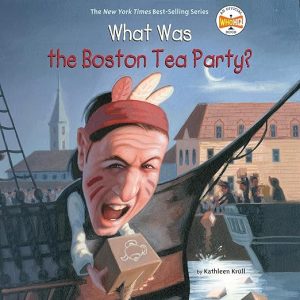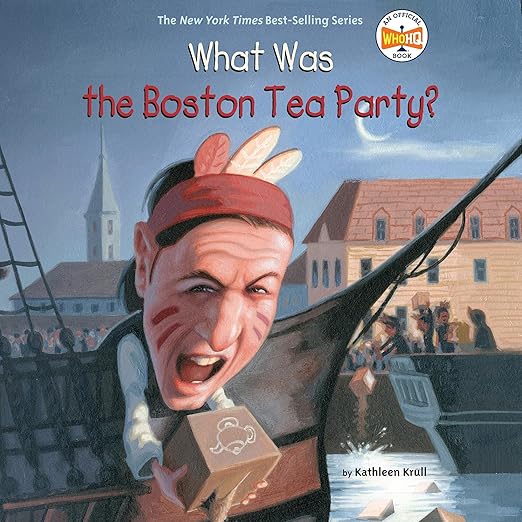
Boston Harbor in 1773 became the site of one of American history's most quotable protests, and Kathleen Krull's What Was the Boston Tea Party? turns that single act of defiance into a tight, 53-minute audiobook built for young listeners just meeting the American Revolution for the first time. Narrated by Shayna Small, this entry in the long-running What Was? series does not attempt the whole Revolution, only the specific grievance that helped set it in motion: colonists boarding ships in the harbor and dumping crates of British tea into the water rather than accept a tax on a product they had no voice in taxing, a grievance the synopsis sums up in five words, 'No Taxation without Representation.'
Five Words That Sum Up the Whole Grievance
What Was? books have a formula that works because it does not overreach, and this one follows it closely: establish the immediate cause, in this case colonial anger at a tax on tea, walk through the event itself in clear chronological steps, and connect it outward to the larger rebellion it helped spark. The synopsis promises to bring the Boston Tea Party 'to life,' and for an audience encountering the event for the first time, the appeal is less about density of detail and more about making a two-hundred-and-fifty-year-old protest feel immediate and understandable rather than like a paragraph memorized for a test.
The book leans into the material's inherent drama rather than softening it into something abstract. Colonial anger at an unfair tax gets treated as the genuinely dramatic standoff it was, not smoothed into a bland civics lesson, which is precisely the register that keeps young listeners engaged with material that could otherwise read as dry.
The grievance itself deserves a beat of context the brisk runtime does not have room to dwell on: colonists were not objecting to tea itself but to a tax passed without their consent or representation in Parliament, made worse by the sense that the British East India Company was being handed favorable treatment at colonial expense. Krull keeps that nuance simple enough for a young audience without flattening it into a cartoon of angry colonists dumping tea for no reason, which is a harder balance to strike in fifty-three minutes than it sounds.
Opening directly with the era's own rallying cry, rather than a dry setup line, is a smart structural choice, since it hands young listeners something quotable and memorable within the first minute rather than easing them in with background exposition they are likely to tune out. That same instinct for a strong hook extends to gift-giving use: grandparents and relatives looking for a meaningful, low-pressure present for a young reader will find this an easy, inexpensive way to spark interest in American history without the commitment of a longer book.
Small Finds a Third Option Between Flat and Overplayed
Shayna Small's narration is the reason this works as well as it does. She reads with an animated quality that never tips into condescension, and her contained sense of indignation suits the colonial-grievance material particularly well; she voices the injustice colonists felt rather than lecturing listeners about it after the fact. That distinction matters more than it sounds like it should in children's history audio, where narrators too often choose one register, either flat recitation or overplayed drama, and Small finds a third option that keeps facts clear without draining the story of its stakes.
The reviews back this up directly. One listener wrote, 'I LOVE the entire series and this book is no different,' adding that they wished these had existed when they were young because they would have read so much more history as a result. Another reviewer specifically mentioned donating multiple titles from the series to their child's school library, which says something real about how these books get used, not just consumed once but kept in circulation for other kids.
Krull has built a substantial career writing exactly this kind of accessible history and biography for young readers, and that experience shows in the pacing choices here. Rather than overwhelming a first-time listener with every date and name connected to the event, the book selects the handful of details that matter most, the tax, the ships, the harbor, the defiant act itself, and trusts that a young audience will seek out deeper detail later if the subject grabs them. That is a real skill, knowing what to leave out, and it is easy to underestimate in a format this short.
An Audio History Lesson Without the Read-Along
The What Was? series pairs text with cartoon illustrations in its print editions, and that visual half of the experience naturally does not carry over to audio. Nothing in this listening experience is diminished as pure narration, but parents expecting the same experience as flipping through the illustrated paperback with a child should know going in that this is a purely audio history lesson, not a read-along.
Scope is the other honest caveat. At under an hour, this covers exactly one event tightly rather than the broader Revolution, which is the right choice for its age group and format but means it works best as a starting point rather than a complete unit. Pairing it with other What Was? volumes on related Revolutionary War figures and events gives a fuller picture than any single title in the series can provide alone.
The What Was? series belongs to a much larger publishing phenomenon that now numbers well over a hundred titles across companion lines covering historical figures, places, and single dramatic events, and that scale is itself part of the appeal for parents and educators browsing the shelf. A format proven reliably across dozens of other subjects, ancient Egypt, the moon landing, the sinking of the Titanic, carries an implicit trust: if the approach already works elsewhere, it is a safe bet here too. Krull's entry into that broader library does nothing to break the pattern, delivering the same clear structure and appropriate tone the series has built its reputation on.
An Introduction for Curious Kids on Car Rides
This is a strong pick for homeschool units, classroom listening, or simply a curious kid on a car ride who just heard the phrase 'Boston Tea Party' somewhere and wants to know what it actually means. Families already collecting the What Was? series, evidently a common pattern among these reviewers, will find this a reliable continuation of a format that has clearly earned their trust.
Skip it if you are looking for a resource with real depth for an older student doing serious Revolutionary War research; this is an introduction, not a reference. Listeners who specifically want the illustrated print experience should also know that the visual component of the series does not translate to this audio edition.
- Narrator: Shayna Small keeps the tone animated and clear without ever condescending to her young audience, letting contained indignation carry the colonial-grievance material honestly.
- Subjects: colonial protest and taxation without representation, early American rebellion, civic courage as a teachable moment
- Tone: Brisk, spirited, and classroom-friendly
- Bottom line: A well-paced, honestly told introduction to a single Revolutionary event, best for young or first-time listeners rather than anyone wanting deep detail.
A Few Questions About What Was the Boston Tea Party?
How long is the What Was the Boston Tea Party? audiobook?
It runs 53 minutes, a single tight sitting that covers the lead-up, the event itself, and its immediate aftermath without padding.
Is this Boston Tea Party audiobook appropriate for young children?
Yes. It is written and narrated for the What Was? series' core young audience, with an energetic but never condescending tone suited to first-time history listeners.
Do I need to listen to other What Was? books before this one?
No. Each title in the series stands alone and covers a single historical event or figure, so this works as a first entry point into the series.
Does this audiobook include the illustrations from the print edition?
No. Like most audio adaptations of illustrated children's nonfiction, the visual component of the print book does not carry over, so this is narration only.