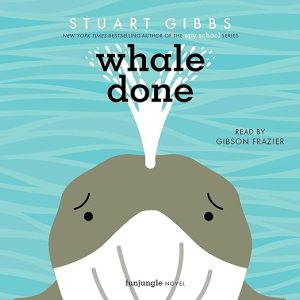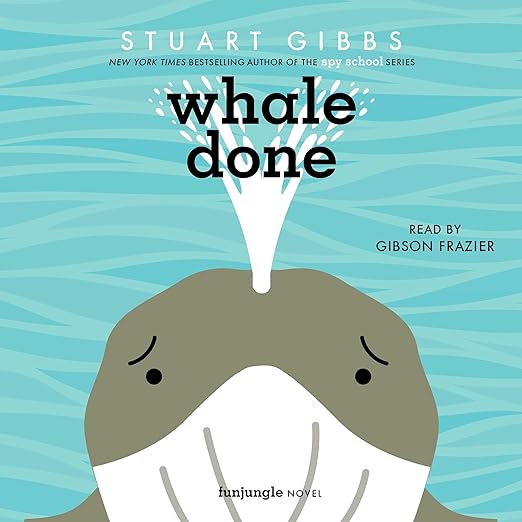
Teddy Fitzroy's house burns down in the first minutes of Whale Done, the eighth installment of Stuart Gibbs's FunJungle series, and Gibson Frazier narrates that misfortune with the cheerful resignation that has become Teddy's signature register across this audiobook series. By the time Teddy is on his way to Malibu with his girlfriend Summer and her mother Kandace, the listener already knows that relaxation is not on the agenda. An escaped kangaroo caused the fire, which is precisely the kind of narrative logic this series operates on.
Gibbs has built FunJungle on a reliable structural promise: Teddy goes somewhere, trouble finds him immediately, and the resulting investigation threads humor through genuine plot. Whale Done is book eight, which means both the formula and its audience are well established. What distinguishes this entry from earlier volumes is the double-mystery structure - the exploding whale and the stolen beach sand operate on parallel tracks that require different kinds of attention to unravel, and Gibbs manages the intercut pacing with the efficiency of a writer who understands how to serve a young audience without condescending to it.
A Joke Premise Hides a Serious Investigation
The exploding whale is the kind of premise that sounds like a joke and turns out to be the book's most serious thread. Doc, the head veterinarian from FunJungle, suspects foul play rather than natural decomposition, and Gibbs uses the investigation to introduce questions about marine biology and environmental accountability that sit just under the comic surface. The absurdity earns the listener's attention, and then the actual subject matter rewards it. The explanations Gibbs provides about what happens when large marine animals wash ashore are accurate and specific rather than hand-waved, which is characteristic of how he handles the science content across the FunJungle series.
The stolen sand subplot is lighter and slower to develop, but it feeds into a broader picture of Malibu as a place where visible wealth and hidden corruption coexist in ways that a fourteen-year-old sleuth is uniquely positioned to notice. Teddy's outsider status - he's a working-class kid from a wildlife park, not a Malibu local - gives him observational advantages that Gibbs deploys intelligently. The paparazzi subplot, which introduces strain between Teddy and Summer through rumors about Summer dating a celebrity, is handled with more care than this kind of middle-grade series usually affords romantic dynamics. Teddy's jealousy is real and briefly destabilizing, which gives the book a brief emotional register that its comic frame otherwise avoids.
Frazier's Straight-Faced Delivery of the Whale Scene
Frazier is one of those narrators whose consistency across a long series becomes a structural asset. Young listeners who have worked through multiple FunJungle audiobooks will hear Teddy and Summer and recognize them immediately, which matters in a series this far along. His pacing is quick without rushing the comedy, and he gives each of the Malibu characters a distinct enough register that the supporting cast never blurs together. The exploding whale scene itself, rendered with Frazier's straight-faced delivery, is among the more memorable moments in the series' audio catalog.
At seven hours and twenty-five minutes, this is a comfortable single-session or multi-session listen for middle-grade audiences. The chapter structure is tight - Gibbs is a former TV writer and it shows in how cleanly each scene ends with a pull toward the next - which makes this format particularly suitable for audio. Cliffhanger chapter endings work especially well when a narrator delivers them with the right amount of weight, and Frazier consistently does. Parents who listen alongside their children will find this rewards that double attention; there's enough adult-facing irony visible in Gibbs's observations about Malibu culture to keep a grown-up engaged.
Some Weight Falls on Knowing Earlier Books
New listeners to FunJungle should note that this is book eight of an ongoing series. Gibbs tends to front-load enough context to make individual entries followable, but some relationship dynamics between Teddy and Summer, and the recurring FunJungle personnel, will carry more weight for listeners who know the earlier books. The title itself is a pun - an explicit nod to both the cetacean content and the phrase of approval - which signals the book's tonal commitments accurately. This series doesn't pretend to be more serious than it is, but it's not as thin as its setups suggest either.
The paparazzi thread involving Summer's celebrity rumor introduces a mild note of interpersonal tension that resolves but doesn't fully disappear. Listeners around the target age of ten through thirteen may find this subplot more engaging than adults reading alongside them. Gibbs handles the jealousy angle without belaboring it, which keeps the book from tipping into drama it hasn't earned.
Eight Books of Consistent Middle-Grade Listening
This audiobook is built for FunJungle series regulars ages nine through thirteen, and it rewards that audience consistently. Parents looking for middle-grade mysteries with real environmental content and minimal content concerns will find this as reliable as the series has always been. Listeners new to FunJungle would be better served starting at book one - Belly Up - for full context, though Whale Done is followable standalone with a brief synopsis in hand.
Adults accompanying younger listeners through the series should expect to enjoy this more than they might predict. Gibbs keeps the adult-facing irony visible without condescending to the younger audience, and Frazier's narration maintains that balance throughout the runtime. Frazier's narration across eight books has made the FunJungle audio series one of the more consistent middle-grade listening experiences available.
Before You Press Play
- Performance: Gibson Frazier handles Teddy Fitzroy's wry middle-grade voice with ease, distinguishing the ensemble cast and maintaining the series' breezy, comic energy across the full seven-plus hours.
- What it covers: Amateur detection, friendship under pressure, environmental curiosity
- Feel: Lively and unpredictable, with a nose for absurdist setups
- Our call: Whale Done delivers exactly what eight books in this series have trained young listeners to expect - two overlapping mysteries, a steady protagonist, and at least one scene that's hard to forget.
Common Questions
Does the Whale Done audiobook require familiarity with the earlier FunJungle books?
Gibbs provides enough context to follow the main plot, but the relationship between Teddy and Summer, and the recurring FunJungle characters, will carry more meaning for listeners who know the series. Starting from book one gives the fullest experience.
Does the audiobook include any educational content about marine biology or environmental topics?
Yes. The exploding whale investigation includes accurate information about what happens when large cetaceans wash ashore and the biological processes involved. It's woven into the mystery plot rather than presented as a lesson, but the information is genuine.