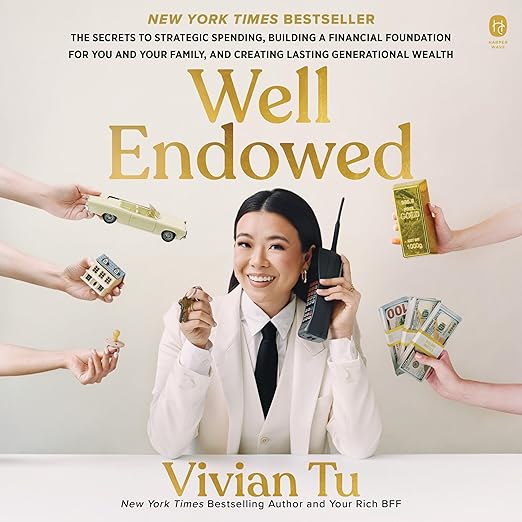
A former Wall Street trader turned New York Times bestselling author, Vivian Tu narrates her own second finance audiobook, moving past the basics covered in Rich AF into the bigger, messier decisions of a listener's late twenties, thirties, and beyond: homeownership, marriage, children, and long-term legacy planning. How do you actually decide between renting and buying, or between leasing and financing a car, once the basic budgeting is already handled? That is the exact kind of specific, practical tension this audiobook spends eight hours untangling, in Tu's familiar, direct-address style.
The Money Bestie Register Still Works at Length
Tu's narration is exactly what you would expect from someone who built an audience through short-form social content first: quick, conversational, confident, and comfortable cracking a joke in the middle of explaining amortization schedules or life insurance riders. That register, self-described as the internet's favorite money bestie, translates well to long-form audio specifically because Tu never lets a section run long enough to lose the casual, direct-address energy that made her following in the first place. Her former career as a Wall Street trader gives the material real technical grounding underneath the breezy delivery, so the friendliness never reads as a substitute for actual expertise.
Structurally, the book organizes itself around specific major life purchases and decisions rather than abstract financial principles, which makes it easy to mentally bookmark the sections most relevant to wherever you personally are: newly married, a first home purchase, a growing family, planning retirement contributions. That decision-by-decision structure means the audiobook works reasonably well out of sequence too, which matters given how differently timed these milestones land for different listeners even within the same general age range Tu is writing toward.
A Trader's Instinct Steers the Insurance Chapters
Tu's Wall Street background surfaces most usefully in the sections on insurance and risk, life insurance, pet insurance, renters insurance, where she applies an actual trader's instinct for weighing real probability against cost rather than defaulting to either blanket fear-based over-insuring or blanket dismissal. That specific expertise is where Well Endowed distinguishes itself most clearly from more generic personal finance content circulating on social media, since Tu can explain not just what a given policy covers but why the math behind it works out the way it does.
Raising Heirs Without Making Them Entitled
At 4.5 across 77 ratings, the reception here is strong, and the specific praise reviewers offer lines up closely with Tu's stated goal of leveling up beyond financial basics. One reviewer, describing themselves as not a financial whiz, specifically credits Tu's patience and articulate explanations across both this book and her first one, calling the material well worth the listen despite not having specialized financial background going in. Another reviewer describes planning to have their college-age child listen too, a small but telling signal that the material is landing as genuinely cross-generational rather than narrowly niche.
Tu's specific attention to the financial dimensions of major relationship and family decisions, prenups, generational wealth transfer without creating entitled heirs, balancing multiple insurance products against actual risk, fills a real gap in a personal finance genre that often stops at budgeting and investing basics and rarely goes further. For listeners who have already handled the fundamentals and are staring down a first home purchase or starting a family, that next-level focus is exactly the audiobook's reason to exist rather than a repeat of ground Tu, or dozens of other finance authors, already covered.
Tu's specific attention to preparing children for inherited wealth without making them entitled, one of the more unusual topics covered relative to typical personal finance content, reflects a genuine gap in the genre; most books in this category stop at building wealth and rarely address the harder question of what happens to it, and to the people receiving it, one generation later. For listeners already thinking seriously about legacy and estate questions, that specific chapter alone offers a genuinely different angle than the retirement-and-investing focus most comparable finance audiobooks default to.
A Trade-Off Comes With Hearing Tu Narrate It
One reviewer offers the most useful caveat on record, noting the advice here is well done but ultimately similar to what other financial books already cover, and specifically mentioning disappointment at not finding more new tips and tricks given how much they enjoy Tu's other content. That is a fair characterization of certain stretches; the core financial principles, prioritize high-interest debt, understand the true cost of a mortgage, do not skip retirement contributions, are not radically different from sound advice available elsewhere, even if Tu's specific delivery and framing around life milestones is genuinely her own.
Because Tu narrates this herself rather than handing it to a professional voice actor, listeners should expect the same rapid, conversational pacing familiar from her short-form content, which occasionally means dense financial concepts, particularly around insurance products and retirement contribution limits, move past quickly enough that a first-time listener may want to replay a section rather than absorbing every number on a single pass. This is a minor tradeoff for the authenticity her own voice brings, but it is worth knowing going in if you plan to actually apply specific figures rather than just absorb the general philosophy.
Listeners who have already closely followed Tu's social media content or read Rich AF cover to cover may recognize a meaningful portion of the underlying philosophy here, even as the specific application to homeownership, marriage, and legacy planning is new. This works best as a second act for an existing fan rather than a wholly independent discovery, and going in aware of that continuity will calibrate expectations more accurately than treating it as a completely standalone title.
New Listeners Should Start With Rich AF First
Listeners in their late twenties through forties facing genuinely major financial decisions, a first home, marriage, starting a family, estate and legacy planning, are the clear intended audience, and Tu's specific, question-driven structure, framed around the actual decisions named in the synopsis, means most listeners in that bracket will find their exact situation addressed directly rather than through vague generalities. Existing fans of Tu's social media presence or her first book will also get a comfortable, familiar continuation of a voice they already trust.
Tu's specific blend of Wall Street credibility and internet-native accessibility remains the throughline that makes even the more familiar stretches worth sitting through, since the delivery itself, not just the underlying financial content, is a meaningful part of what a listener is actually buying into with this particular audiobook.
Total beginners to personal finance, anyone who has not yet handled basic budgeting, saving, or debt questions, should probably start with Rich AF first, since Well Endowed is explicitly built as the sequel for someone who has already cleared those fundamentals. And anyone hoping for genuinely novel financial strategies rather than familiar principles applied to bigger life decisions should temper expectations somewhat, per the reviewer feedback above, even as the specific life-stage framing remains a real point in its favor.