In Brief
- Voice: Dr. Rocio Salas-Whalen narrating her own audiobook brings clinical authority and genuine warmth in equal measure. Her voice carries the patience of a physician explaining something complicated to a patient she actually has time for, which is a rarer quality than it sounds.
- Big ideas: GLP-1 medication optimization, the clinical reality of obesity treatment, sustaining weight loss after medication
- Atmosphere: Authoritative but accessible, with the measured confidence of a specialist who has worked in this field for years
- Worth it?: The most complete patient-facing guide to GLP-1 therapy currently available in audio, from a physician with direct clinical experience in this specific area.
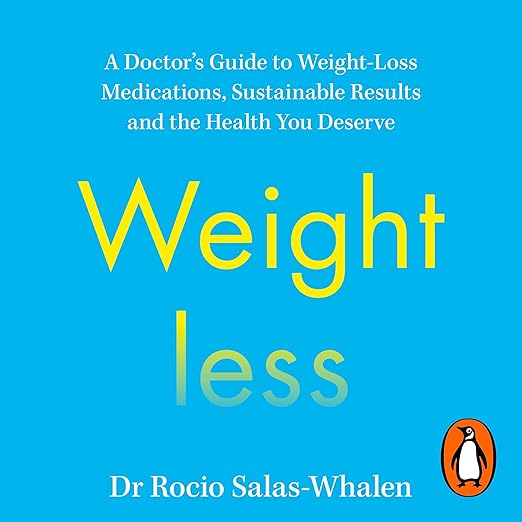
Dr. Rocio Salas-Whalen's Weightless arrives at a moment when GLP-1 medications like semaglutide and tirzepatide have moved from specialized obesity medicine into broad public conversation. The audiobook, which Dr. Salas-Whalen narrates herself, runs seven hours and seventeen minutes and was produced by Penguin Audio in 2026. It carries a foreword from Dr. Mary Claire Haver, whose work on menopause medicine has demonstrated what happens when a physician communicates directly with the patients the medical establishment has underserved. The comparison is apt. Salas-Whalen, an obesity medicine specialist, is writing for the patients who walk out of their doctor's office with a GLP-1 prescription and almost no guidance about what to do next.
Discontinuation Gets the Book's Most Valuable Chapter
The book's central argument is simple and clinically grounded: the medication is one part of a three-part approach. The other two are protein intake optimization and strength training. Salas-Whalen is explicit that patients who rely on GLP-1 therapy without these two additional practices risk losing muscle mass alongside fat, which undermines both the aesthetic result and the long-term metabolic outcome. This is not a fringe position, it reflects the current clinical consensus among obesity medicine specialists, but it is still routinely under-communicated at the point of prescription, and the audiobook exists to fill that gap.
The medication section covers what GLP-1 receptors actually do, how the drugs change the experience of hunger and satiety, and how to work with a physician to select the right medication and titrate the dose. This clinical grounding is what distinguishes "Weightless" from the diet industry books that have attached themselves to the GLP-1 conversation. Salas-Whalen is not a wellness influencer describing her own transformation. She is an obesity medicine specialist describing what she has observed across a clinical practice, and that distinction is audible in how she speaks about her patients.
The chapter on what happens when patients come off GLP-1 therapy is arguably the most valuable in the book and the most under-discussed aspect of this category. Most patient-facing content addresses whether and how to start these medications. Very little addresses what happens to the weight when you stop, or how to build the behavioral and physiological infrastructure to sustain results without indefinite pharmaceutical support. Salas-Whalen addresses this with the directness of someone who has watched patients navigate the discontinuation challenge repeatedly.
Salas-Whalen's Voice Shifts from Clinical to Caring
Salas-Whalen's self-narration is the primary advantage of the audio version. She speaks about her patients with genuine protectiveness, and her voice shifts register between the clinical explanation sections and the personal patient stories in ways that communicate care without sentimentality. The audiobook is also better suited to the book's structure than print might be, because the chapters flow conversationally rather than in a textbook format. Mel Robbins's blurb on the jacket calls it a book about what "too many people need to hear but rarely do," and Salas-Whalen's spoken delivery of the core clinical message has the authority of someone saying it from inside the examination room rather than from a general wellness platform.
Reviewers, including at least one board-certified obesity medicine physician, have praised the clinical accuracy and the compassionate framing. That professional endorsement matters in a category where a great deal of GLP-1 content is produced by people with financial interests in specific programs or products. Salas-Whalen's position as a physician with no obvious product affiliation gives the audiobook's clinical claims a credibility that consumer-facing wellness content often lacks.
The book also directly addresses what one reviewer called the emotional and relational dimensions of GLP-1 therapy: how the medication changes your relationship with food in ways that affect social situations, relationships with other people who are not on the medication, and your own sense of identity around appetite. These sections are less clinical and more personal, and they're some of the most practically useful in the audiobook for patients navigating the early weeks of treatment.
Weightless Assumes You've Already Started Treatment
The book is published in 2026 by Penguin Audio, which means it reflects the current state of clinical understanding around GLP-1 therapy at a rapidly evolving moment in the field. The specific medications, dosing protocols, and research findings cited may be superseded as new drugs enter the market and longer-term outcome data accumulates. Listeners should treat this as an accurate account of the field as of its publication date rather than a permanent reference. A follow-up appointment with an actual physician who specializes in obesity medicine remains the essential step that no audiobook can replace.
The book is also explicitly oriented toward patients who are already considering or have already started GLP-1 therapy, rather than toward those still evaluating whether the medications are appropriate for them. The decision to begin treatment, and the clinical assessment of candidacy, is treated as prior to the book's scope. Listeners who are in the "should I try this?" phase will find the opening chapters useful but the middle and later sections less directly applicable.
Current GLP-1 Patients Get the Most Value
This audiobook is most valuable for people who are currently on a GLP-1 medication and feel they lack adequate guidance from their prescribing physician, or who are preparing to start and want a comprehensive orientation before their first appointment. It's equally useful for healthcare providers who work with patients on these medications and want a patient-friendly resource to recommend.
The book is less relevant for listeners who are simply curious about GLP-1 medications as a cultural phenomenon rather than as personal medical options. And those who are opposed to pharmaceutical intervention for weight management will find the book's framework incompatible with their position, since Salas-Whalen treats the medications as effective and appropriate tools rather than as shortcuts to be discouraged.
Does Dr. Salas-Whalen's audiobook narration add clinical authority that a professional narrator couldn't provide?
Significantly. Her voice carries the specific patience of a specialist who has explained these concepts to confused patients many times, and the distinction she draws between what is medically established and what is still under investigation is more credible in her own voice than it would be coming from a narrator performing medical expertise. The self-narration also allows her to land the patient anecdotes with genuine protectiveness rather than performance.
Does this audiobook tell you which GLP-1 medication to choose?
It covers the major GLP-1 medications available and the factors that influence selection, including individual medical history, tolerance, dosing schedule, and patient goals. But it frames medication selection as a collaborative decision made with a physician rather than a self-directed choice, and it provides the questions to bring to that conversation rather than a prescriptive answer.
Is the audiobook useful for someone who has already been on a GLP-1 for several months?
Yes. The sections on optimizing results once on the medication, preventing muscle loss through protein and strength training, navigating the social and relational dimensions of the treatment, and planning for eventual discontinuation are directly applicable regardless of how long you've been on the medication. The early chapters on starting will be less novel for established patients, but the middle and later sections remain relevant throughout treatment.
Does the audiobook address the side effects of GLP-1 medications honestly?
Yes. Salas-Whalen covers the most common side effects, particularly gastrointestinal ones, with clinical directness and offers practical strategies for managing them. She does not minimize the challenges of the initial titration period or pretend that all patients tolerate these medications easily. Her clinical experience gives her the ability to distinguish between side effects that require medical attention and those that typically resolve with time and dose adjustment.