In Brief
- Performance: Josh Sundquist narrates his own memoir with the timing of a practiced stand-up comedian and the self-awareness of someone who has genuinely processed what he is describing, making the audiobook significantly more alive than print.
- What it covers: Adolescent social awkwardness, disability and identity, the gap between intention and perception
- Feel: Comedic and warm with real emotional undercurrent
- Our call: Teenagers and young adults who have ever felt fundamentally miscalibrated for social interaction will recognize themselves in Sundquist's investigation, and the audiobook's comedic energy makes the harder passages land more gently.
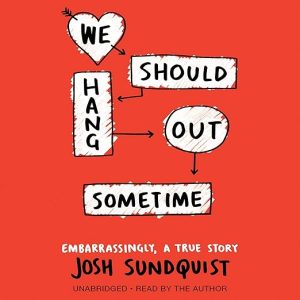
Josh Sundquist, Paralympic ski racer and YouTube personality, structures We Should Hang Out Sometime, the audiobook he narrates himself, around a genuinely odd social science experiment: at age twenty-five, he contacted every girl he had ever tried to date since middle school and asked each of them, directly, what went wrong. The results, delivered with the dry precision of someone who has been doing stand-up comedy for long enough to know how to pace a reveal, form the skeleton of a memoir about growing up as a one-legged teenager in a conservative family and discovering, repeatedly, that his read of social situations was slightly, consistently off.
Introducing CFD, or Close Fast Dancing
The interview-and-reflect structure is the book's cleverest formal choice. Each chapter establishes a relationship attempt from Sundquist's adolescence, lets you live inside his understanding of it, and then delivers the retrospective conversation that reveals what was actually happening from the other person's perspective. The gap between those two accounts is where the humor lives, and Sundquist exploits it with precision. The backward prosthetic foot incident at a Putt-Putt course, the misfired grand gesture at a Miss America pageant, and his introduction to CFD, Close Fast Dancing, are all rendered with timing that makes them work as comedy rather than just as self-deprecating autobiography.
What keeps the book from being purely comedic is Sundquist's willingness to take his own failure at social understanding seriously. He does not treat his obliviousness as simply funny. He connects it to his upbringing, to the specific social limitations imposed by his disability and his family's religious conservatism, and to a genuine question about the distance between what he was trying to communicate and what he actually communicated. That honesty gives the memoir weight underneath the humor. Reviewers who have connected to the book note feeling able to relate to the main character's experience, which is precisely the effect Sundquist is aiming for with his memoir's explicit closing message: there is nothing wrong with you.
The episodic format serves the audiobook well. Because each chapter is a complete story in itself, covering decades of time across Sundquist's adolescence and early adulthood, listeners can absorb the material in segments without losing thread between sessions. One reviewer noted that the book is broken into lots of different parts that allow readers to manage what is happening, and that structural clarity translates directly to the audio experience. Sundquist's narration treats each chapter as a self-contained performance, which matches both his comedy background and the book's design.
Self-Narration Makes the Comedic Beats Sharper
Sundquist's self-narration is the primary reason to choose the audiobook. He is a practiced public performer, and his delivery of his own material reflects someone who has told these stories live before committing them to audio. The comedic beats are sharper than they would be with a voice actor working from a script, and the emotional beats are more genuine because he is the one living inside them. The retrospective interview sections in particular benefit from his narration: the gap between his adolescent understanding and the adult perspective he now has on those situations is communicated through tone in ways that a straight reading of the text would struggle to achieve.
At 6 hours and 4 minutes, the runtime is well matched to the book's episodic structure. This is a comfortable audiobook for a weekend or a week of regular commutes, and the format makes it easy to pick up and put down without losing momentum. The YA crossover appeal is genuine: Sundquist's intended audience is teenagers who have wondered whether there is something wrong with them, but the memoir holds up for adult listeners who went through their own socially awkward adolescence and will recognize the material immediately.
More Cheerful Than Most Would Anticipate
The book is explicitly a young adult memoir, and its emotional range reflects that designation. Listeners expecting the depth and darkness that literary adult memoir reaches will find the book more cheerful than they anticipate. Sundquist's processing of his adolescent experiences is genuine but not agonizing, which is part of the book's point. The comedic architecture can occasionally soften what might be, in a different register, genuinely painful material about exclusion and misunderstanding during formative years.
The investigation structure also reaches its limits in a few chapters where the retrospective interview reveals less than expected. Not every conversation lands with the same clarity as the strongest chapters, and there are passages where the book covers familiar teenager-dating-awkwardness territory without the specific twist that makes the best chapters distinctive. These passages are minor in number but noticeable in pacing, and they are worth acknowledging for listeners who are drawn in primarily by the strongest story beats in the synopsis.
Significant Value From Sundquist's Own Delivery
Teenagers and young adults who have felt socially miscalibrated in ways they could not fully explain will find this audiobook speaks directly to them. Parents looking for content that discusses disability, identity, and adolescent social dynamics with humor rather than heavy-handedness will find it appropriate for middle school and above. Listeners who enjoy self-narrated memoirs where the author is also a performer will get significant value from Sundquist's delivery. Readers looking for a serious literary memoir about disability should look elsewhere; this is lighter in tone and more interested in comedy and connection than in excavating trauma, and that is precisely what makes it work for its intended audience.
Is the We Should Hang Out Sometime audiobook appropriate for middle school listeners, or is it aimed at older teenagers?
The content is appropriate for middle school and up. Sundquist's romantic misadventures are age-appropriate and the language is clean. The emotional content of disability and social awkwardness is presented in ways that younger teenagers will understand and older listeners will not find juvenile.
Does Josh Sundquist's disability play a central role in the audiobook, or is it more of a background element?
It is central rather than incidental. His prosthetic leg features directly in some of his most memorable dating misadventures, and the book is honest about how his disability, combined with his family environment, shaped his social development. It is present without being the only thing the book is about.
How does the audiobook's format serve the book's episodic interview-and-reflect structure?
Very well. Each chapter is complete in itself, making this an easy audiobook to stop and restart without losing thread. Sundquist's narration gives each retrospective interview a distinct energy from the original story being told, which the audio format makes more legible than print.