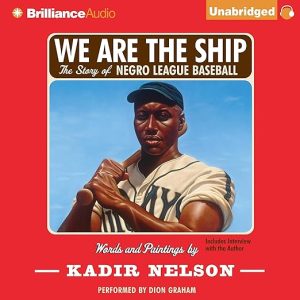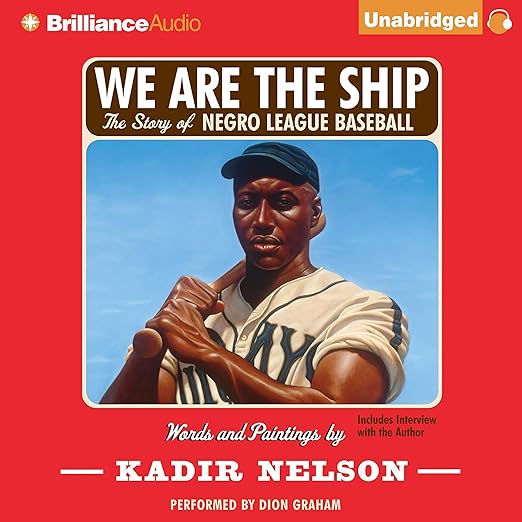
Rube Foster's own words open this audiobook: 'We are the ship; all else the sea,' the Negro National League founder's description of an institution built entirely by the players and owners inside it, with no outside safety net at all. How do you compress three decades of Negro League baseball, from its 1920s beginnings through Jackie Robinson's crossing into the majors in 1947, into under two hours without losing the people at the center of it? Kadir Nelson's answer is to filter the whole history through a single invented 'Everyman' player's memories, and narrator Dion Graham reads those memories like recollection rather than research, which turns out to be exactly right.
Nelson Fits Wide Scope Into a Picture Book
The scope is genuinely wide for a book this short: gifted athletes and determined owners, racial discrimination alongside genuine international sportsmanship, fortunes made and lost, wins and losses that mattered well beyond the scoreboard. Nelson frames the Negro Leagues as a near-perfect mirror of Black America's social and political history across the first half of the twentieth century, and the Everyman device lets that scope stay personal instead of turning into a list of names and dates.
It's worth remembering this is fundamentally a picture book, part of Nelson's American Sports Histories series, and its brevity relative to the sweep of its subject is a function of that format rather than a shortcoming. What the audiobook does with under two hours is impressive precisely because it never feels like a summary.
Foster's Ship-and-Sea Epigraph Explains the League
It's worth noting Nelson wrote and illustrated the book himself, a genuine dual role rather than an author working from someone else's commissioned art. That unity between text and image in the print edition is part of why the visual loss in audio format registers as more significant here than in a typical illustrated-nonfiction title where a separate illustrator's work sits alongside an author's prose.
Foster's epigraph, the ship carrying everything while all else is merely the sea around it, does real structural work beyond its opening flourish: it frames the league not as an underdog story waiting for outside validation but as a genuinely self-sufficient institution that built its own economy, its own barnstorming circuits, its own stars, entirely outside a segregated major league system that wanted nothing to do with it. Nelson's book keeps returning to that self-sufficiency as a source of pride rather than only grievance.
The synopsis's own framing, 'triumphs and defeats on and off the field,' signals early that this isn't only a sports book; the off-field material, ownership struggles, barnstorming logistics, the economic precarity of running a league with no institutional backing, gets equal narrative weight to the games themselves. The result reads as social history wearing a baseball book's clothes.
Dion Graham Sounds Like He's Remembering
Dion Graham is one of the strongest narrators working in African American historical nonfiction, and this book is close to a benchmark performance for him. He handles the Everyman conceit with what can only be described as memory-quality pacing, moving between personal recollection and broader statistical context so seamlessly that the whole book sounds like he's remembering it rather than reciting it.
The reviews back this up directly. One reader writes that the book 'has all the facts and figures to surely be a historical baseball book,' with just as much room made for 'a very personable and emotional read.' That dual identity, rigorous history and personal testimony at once, is precisely what Graham's narration is built to hold together.
Graham's specific challenge here is tonal: the Everyman narrator moves between recounting genuine on-field triumphs and describing the real economic precarity and discrimination that shaped the league's existence, sometimes within the same paragraph, and Graham calibrates both registers without letting either one undercut the other. The pride and the injustice sit side by side exactly as Nelson wrote them.
Pair the Audio With Nelson's Own Paintings
The print edition of We Are the Ship is built around dozens of full-page and double-page oil paintings that Nelson created himself, and one reviewer goes so far as to say 'The pictures are more telling than the text.' None of that art survives the transition to audio. If you're coming to this specifically for Nelson's paintings, the audiobook alone will leave a real gap; pairing it with the print edition, or playing the audio while paging through the book, is the only way to get the full experience.
At one hour and fifty-three minutes, this is a short listen relative to how sweeping its subject matter sounds on paper. That's appropriate to its picture-book format and its middle-grade-plus audience, but listeners expecting an exhaustive adult history of the Negro Leagues should recalibrate their expectations toward a concentrated, emotionally focused account rather than a comprehensive one.
For classroom or family use specifically, playing the audiobook while paging through or projecting Nelson's actual paintings gets closer to the full intended experience than either format alone; the words and the images were built to work together, and audio by itself is best understood as one half of a two-part experience rather than a complete substitute.
Robinson's Triumph Drained the Negro Leagues
The book also sits at a genuinely bittersweet hinge point: Robinson's own arrival in the majors is framed as a triumph for the sport and the country, but it directly precipitated the Negro Leagues' decline, since the very integration the leagues had fought for also drained them of their best talent and their reason to exist as a separate institution.
The book's stated audience, 'baseball lovers of all ages,' is worth taking literally rather than as a marketing nicety; nothing in the content is simplified for children specifically, and adult listeners with no particular nostalgia for picture-book formats will find the historical argument holds up entirely on its own terms.
Newly Interested Adults Get a Concentrated Bridge
Baseball fans of any age, families looking to introduce kids to segregation-era history through a genuinely well-crafted narrative rather than a dry timeline, and classroom use are all strong fits; for the last of those, playing the audio alongside Nelson's actual paintings projected or passed around gets close to the best of both formats at once.
This also works well as a first serious introduction to segregation-era Black history for listeners, young or adult, who find dry timelines hard to stay engaged with; the personal, testimonial structure does real work making the history stick.
For adult listeners newly interested in baseball history specifically, it works well as a bridge title too, something more concentrated and narratively driven than an academic survey before committing to a full-length treatment of the same era.
Art lovers hoping to fully experience Nelson's paintings through listening alone will come away wanting more; the audiobook carries the words with real skill, but the double-page paintings that anchor the print edition simply are not part of what plays through your headphones.
At a Glance
- Narration: Dion Graham delivers a benchmark performance, moving between personal memory and historical fact so smoothly the book sounds recalled rather than researched.
- Themes: Negro League baseball, segregation-era Black history, collective memory as a form of record-keeping
- Mood: Warm and personal despite the historical weight, more testimony than textbook
- Verdict: A genuinely strong short listen for baseball and history fans alike, best experienced alongside Nelson's actual paintings if you can manage it.
Does this audiobook include Kadir Nelson's paintings from the print edition?
No. The print edition is built around dozens of full-page and double-page oil paintings that reviewers specifically call out as a highlight, and none of that art carries over into the audio-only format.
Is this audiobook appropriate for kids, or is it really an adult history book?
It works for both. It's tagged as a children's audiobook and runs under two hours, but the reviews describe emotionally serious, adult-caliber storytelling, making it a genuine crossover title rather than a simplified kids' version of the history.
How historically accurate is We Are the Ship as an audiobook account of Negro League baseball?
Reviewers specifically praise its combination of solid facts and figures with personal, story-driven testimony, crediting it as both a real historical account and an emotionally engaging one, not one at the expense of the other.