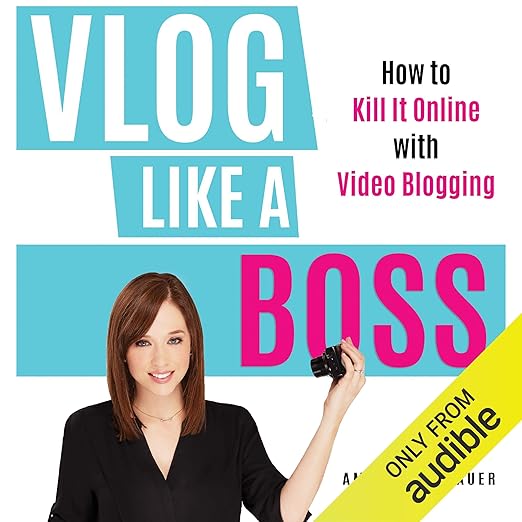
Quick Take
- Voice: Amy Schmittauer narrating her own audiobook is the correct choice - her YouTube-trained speaking confidence and easy directness remove any distance between the advice and the person giving it, and her delivery itself demonstrates the on-camera energy she is teaching.
- Big ideas: video content creation, brand-building through vlogging, on-camera confidence
- Atmosphere: Energetic and actionable
- Worth it?: A practical, well-organized guide to vlogging that delivers more than its title promises - the Authority Video Formula and community-building philosophy apply well beyond YouTube, though the tactical specifics need updating for 2026.
The Only Version That Makes Complete Sense
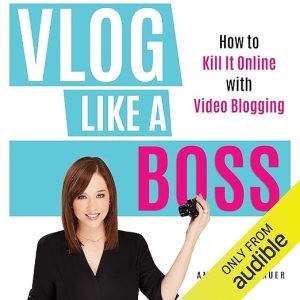
Amy Schmittauer built her audience before she wrote this book, which matters in a creator economy genre crowded with advice from people whose credentials begin and end with the book itself. Vlog Like a Boss - the audiobook narrated by Schmittauer in her own voice - opens with the authority of someone who created Savvy Sexy Social, built a global YouTube community with millions of views, and works as a keynote speaker, not someone presenting a theory of online video creation from a comfortable distance. That distinction is audible within the first minutes of listening, and it shapes everything that follows across the nearly five-hour runtime.
Self-narration here is not just appropriate - it is the only version of this audiobook that makes complete sense. Schmittauer's on-camera and on-stage confidence translates directly to the audio format in a way that is rare among business audiobook authors. Her pacing is natural, her delivery has the warmth of someone genuinely invested in helping the listener move past whatever is blocking them, and she avoids the self-congratulatory register that can make creator-written guides feel more like extended promotional content than actual education. The four hours and forty-eight minutes pass without the drag that is a persistent hazard of business audiobooks narrated by their authors, which means the coaching and the listening experience are aligned rather than at cross-purposes.
Fear, Foundation, Formula, Then Community
The book's structure follows a logical progression from fear to foundation to formula to community, and the progression is earned rather than imposed. Schmittauer spends real time on the three major fears that prevent people from making video content - fear of the camera itself, fear of technical complexity, and fear of audience judgment - and her treatment of these is one of the audiobook's genuinely strong sections. She does not dismiss the fears or offer a simple reframe that dissolves them in a paragraph. She addresses the specific cognitive and practical obstacles she has encountered in her own experience and in coaching others, and she offers approaches that have actually worked rather than approaches that sound reasonable.
The Authority Video Formula, which sits at the center of the book, is Schmittauer's framework for creating content that builds genuine engagement rather than just accumulating view counts. The distinction matters more than it might seem. The history of online video is full of creators who built large audiences without building loyal communities - Schmittauer is specifically interested in the second outcome, and the book's philosophy reflects that focus throughout. The formula itself is not complicated, which is a feature: it is actionable for someone who has not yet made a single video rather than requiring existing production proficiency.
One reviewer with extensive production experience - thousands of videos by the time he read the book - noted that Schmittauer gave him a different point of view he is actively implementing. That kind of review is meaningful precisely because it comes from someone with no novice's need for permission to start. The advice in Vlog Like a Boss is specific enough to land differently depending on where the reader is in their own practice. Another reviewer bought the book for their aspiring YouTuber son, read it before passing it on, and noted that the entrepreneurial and life lessons extended well beyond video blogging. That expansion is real and deliberate - the underlying thinking about audience relationships and consistent value creation applies across platforms and creative disciplines.
The self-narration also functions as a kind of live demonstration. When Schmittauer talks about on-camera energy, pacing, and the relationship between the speaker and the camera, you are simultaneously hearing those qualities in her own delivery. This is not available in a conventionally narrated audiobook, and it gives the coaching a credibility that print alone cannot provide.
Strategic Advice Ages Better Than Tactical Specifics
The book was published in 2016, which is worth flagging for any listener expecting current platform specifics. YouTube's algorithm, monetization structures, shorts format, and best-practice guidelines have changed significantly since then, and the tactical advice on topics like ideal video length, upload frequency, and thumbnail design may need recalibration against what works in the current environment. The strategic content - what makes a video worth watching, how to build a loyal community, how to overcome the specific fears that keep aspiring creators from starting - ages considerably better than the tactical. Treat the tactical sections as a starting framework and supplement with current resources for specifics.
At under five hours, the book is also necessarily higher-altitude on some subjects. Listeners who want deep technical instruction on lighting, camera equipment selection, or editing workflows will find the treatment lighter than dedicated production guides. This is a mindset and strategy book with tactical elements, not a production manual, and the difference matters for anyone coming to it with technical questions rather than strategic ones.
A Commute Listen for Creators Who Plateaued
This audiobook is for anyone at the beginning of their video content journey who needs both permission and a working framework to start - the sections on overcoming camera fear and the Authority Video Formula are particularly well-suited to people who have been hesitating. It is also useful for established content creators who have plateaued and want to think more deliberately about community-building rather than just output volume. The self-narration makes it an especially good commute listen - Schmittauer's energy and pacing are well-matched to the kind of focused attention available during transit time. Those looking for deep platform-specific tactics or production technique in 2026 should supplement with current resources, but the strategic foundation here remains sound.
Questions Listeners Ask
Is the Vlog Like a Boss audiobook still relevant given its 2016 publication date?
The strategic and psychological content - overcoming camera fear, building community loyalty, the Authority Video Formula - remains solid and platform-agnostic. The platform-specific tactics should be treated as a starting framework rather than current best practice, since YouTube and adjacent platforms have changed considerably. Use it for principles, supplement with current resources for tactical specifics.
Does Amy Schmittauer's self-narration add value to this audiobook compared to what a professional narrator would provide?
Schmittauer's narration is one of the audiobook's genuine strengths. Her speaker and video creator background means she understands pacing and direct address in a way that a narrator working from a cold script might not. She also functions as a live demonstration of the on-camera energy she is teaching, which a conventional narration cannot provide.
Is this audiobook only useful for aspiring YouTubers, or does it apply to other video platforms?
The underlying principles - community-building, on-camera confidence, the relationship between consistent value and audience loyalty - apply across video platforms. The specific examples and some tactical advice are YouTube-centric, but the strategic framework translates to any platform where video content and community matter.
How does Vlog Like a Boss compare to other creator economy audiobooks in terms of practical takeaways?
Schmittauer's book is more practically focused than many creator economy titles, which tend toward inspiration without implementation detail. The Authority Video Formula and the fear-addressing sections give listeners specific frameworks to apply. It is a how-to book with genuine strategic depth rather than a motivational manifesto dressed in practical language.