Before You Press Play
- Narrator: Scott Dikkers - co-founder of The Onion - brings dry precision to Shleyner's micro-lessons. The voice is crisp and knowing, and the humor implicit in many of the lessons lands better for it.
- Subjects: copywriting as a thinking discipline, persuasion through clarity and emotion, the gap between competent and memorable writing
- Tone: Crisp and energizing, like a very good brief
- Bottom line: Shleyner distills a decade of the copywriting industry's sharpest thinking into 207 lessons that work both as a linear listen and as material you return to repeatedly.
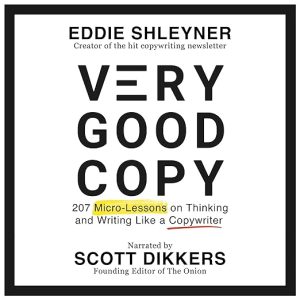
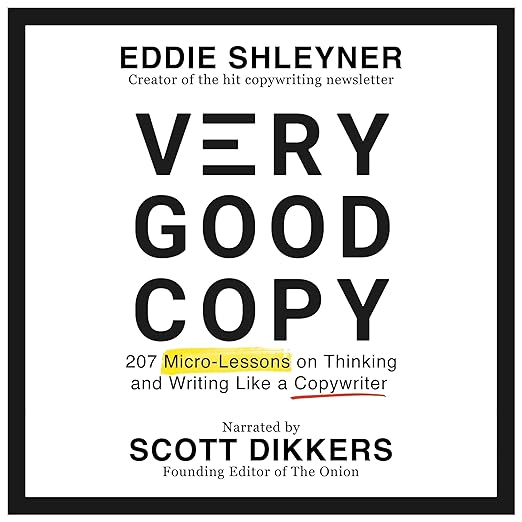
Eddie Shleyner built his newsletter Very Good Copy into one of the more respected voices in copywriting over the course of a decade, and this audiobook adapts more than ten years of that thinking into 207 micro-lessons across 6 hours and 33 minutes. Narrated by Scott Dikkers - one of the co-founders of The Onion - the audiobook is an unusual pairing of voice and subject. Dikkers brings a dry, knowing authority to the material that suits Shleyner's house style: precise, slightly irreverent, structurally tight. The book is divided into two halves - 110 lessons on thinking like a copywriter, and 97 lessons on writing like one - and that architecture is more useful than it first appears.
The 207 micro-lessons in Very Good Copy are not equal in weight, and Shleyner does not pretend they are. Some are compressed maxims of the kind that stick in memory after a single encounter; others are extended arguments that need the surrounding context to land fully. The division between mindset and execution is the book's most important structural choice. Most writing-improvement books jump straight to tactics - avoid passive voice, use active verbs, cut adverbs - without addressing the quality of thinking that determines whether any tactic will work. Shleyner's 110 thinking-oriented lessons cover creativity, research, ideation, influence, the ethics of persuasion, and the relationship between AI tools and the copywriter's core craft. Only after that groundwork does he move to execution. Reviewer Kaitlin Schneider, who followed the newsletter from its early days, calls this the best book she has ever read about life as a copywriter - high praise that reflects a real loyalty to Shleyner's accumulated output. Professional editor and reviewer AmazonAddict describes it as earning a permanent spot on the desk, which suggests it functions as a reference as much as a read-through. The productivity and research lessons in the thinking half are particularly strong: Shleyner argues that the ability to generate unexpected connections between ideas is the core skill that separates forgettable copy from memorable copy, and he works through that argument with specific examples rather than abstract principles. The lesson on research as the copywriter's deepest competitive advantage is one of the most practically transferable in the entire collection - it reframes research not as background work but as the activity that generates insight no competitor who skips it can replicate.
Dikkers Spent Decades Writing Comedy on Exactness
Dikkers as narrator is a genuine asset. His timing has the precision of someone who spent decades writing comedy that lives or dies on exactness of language - which, it turns out, is the same skill Shleyner is describing throughout the book. When a lesson is about the difference between a word that is almost right and the right word, having a narrator who embodies that distinction is quietly effective. The 6-hour-33-minute runtime moves faster than expected because the micro-lesson format prevents the kind of repetitive exposition that bloats most business and marketing audiobooks. Shleyner makes a point, illustrates it, and moves on. There is very little filler. The coverage of AI in copywriting is worth noting: Shleyner addresses the tools and their relationship to the copywriter's judgment without the panic or the boosterism that dominates most discussions of AI and creative work. He treats AI as one factor among many that the modern copywriter must reckon with, while arguing that the core judgment and emotional intelligence of good copy remains a human function. That measured take will hold up better over time than more breathless treatments of the same topic.
Two or Three Minutes per Compressed Argument
The micro-lesson format that makes Very Good Copy stimulating as a listen can also make it hard to absorb at depth. Some lessons are genuinely compressed - entire conceptual arguments about persuasion or research packed into two or three minutes - and the audio experience means you cannot linger on the sentence level the way you can in print. Listeners who learn through rereading or annotation will find the audiobook format limiting for this specific book. The material is also primarily written for professional copywriters and marketing writers rather than novelists, academics, or general nonfiction writers, though the thinking lessons have broader applicability than the execution half. Reviewer Larry F, describing the book as standing above the rest of the copywriting genre, is writing from within that genre's frame of reference. Listeners coming from literary fiction or academic writing will find the commercial orientation of the execution lessons more alien than the thinking lessons, which translate more freely across disciplines and contexts.
A Pairing That's Earned Rather Than Accidental
This audiobook rewards working copywriters, marketing writers, and content professionals who want a conceptually grounded education rather than a list of rules. The thinking-heavy first half will be particularly valuable for practitioners who have mastered the mechanical rules and are trying to understand why their copy still does not land with the force they want. Listeners who are new to copywriting will find it stimulating but may benefit from reading it alongside a more foundational text that covers the mechanics in more detail before the philosophy. The Scott Dikkers narration makes this notably more enjoyable than the average business audiobook - that pairing of Shleyner's precision and Dikkers' timing is earned rather than accidental, and it makes a real difference over six-plus hours. The micro-lesson format also means that even passive listening during a commute or workout accumulates value, since the brief, self-contained lessons do not demand the sequential attention that a linear argument requires.
Questions Listeners Ask
Is the Very Good Copy audiobook useful for writers outside the copywriting industry?
The 110 thinking-oriented lessons - covering creativity, research, persuasion, and storytelling - translate fairly broadly to anyone who communicates professionally in writing. The 97 execution lessons are more specifically aimed at marketing and commercial copy. Non-copywriters will find the first half more directly applicable than the second.
Who narrates the Very Good Copy audiobook and does the choice of narrator matter?
Scott Dikkers, co-founder of The Onion, narrates. The choice is meaningfully good - Dikkers has spent decades writing comedy that depends on precise word choice, and the precision in his delivery reinforces lessons about the difference between almost-right and exactly-right language. It is not a generic business narrator situation.