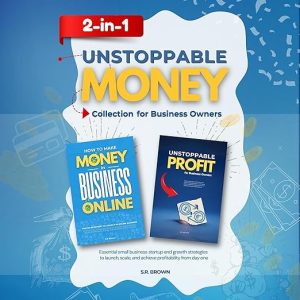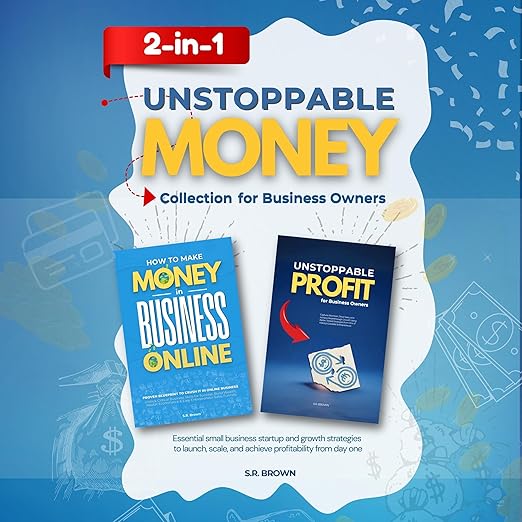
Two business guides for the price of one purchase is the pitch behind this audiobook, and S.R. Brown structures the five-and-a-half-hour runtime around exactly that split. Book One, How to Make Money in Business Online, covers digital income streams and online marketing frameworks. Book Two, Unstoppable Profit for Business Owners, promises systems drawn from what the synopsis calls 'one of history's most successful entrepreneurs who pioneered viral marketing before it existed,' though notably that entrepreneur is never actually named anywhere in the listing itself.
Brown narrates both halves personally, and the listing lists thirty-eight ratings averaging a full five stars, though no written reviews are attached to this listing for me to draw on, which is worth knowing upfront if you weight your buying decisions on reviewer detail rather than star averages alone.
Two and a Half Hours Per Complete Guide
Judged purely on the synopsis's own language, this leans heavily on the stacked-buzzword register common to self-published business audio: phrases like 'proven frameworks,' 'actionable frameworks,' and 'sustainable business models' repeat across both book descriptions without much in the way of a concrete case study or named company to anchor them. That is not automatically disqualifying for a business audiobook aimed at people who want quick, motivational momentum rather than an academic treatise, but it does mean this sits closer to the high-energy coaching end of the business genre than the deeply researched, source-heavy end.
An author narrating their own material usually signals real confidence in it, since they are willing to let their own voice carry the pitch rather than handing it to a professional reader. Without a track record of prior narration credits to point to, Brown's performance has to be judged fresh on this title alone, and the five-star average across thirty-eight ratings at least suggests listeners who did buy in came away satisfied, even without written detail on what specifically resonated.
Do the math on the runtime and a second observation emerges: five hours and twenty-nine minutes split across two books billed as complete guides works out to roughly two and a half hours apiece. That is short for something marketed as a full business book, closer to the length of a long-form audio essay or an extended podcast episode than a typical business audiobook, which usually runs six to eight hours on its own. Neither half claims to be exhaustive, but buyers expecting two full-length books bundled together should recalibrate that expectation before pressing play.
A Pioneer of Viral Marketing, Never Named
The stated audience list is broad by design: self-employed professionals, startup founders, small business owners ready to scale, CEOs, and general entrepreneurs are all named directly in the synopsis as intended listeners, which signals this is meant as a wide-net motivational and strategic primer rather than a narrowly targeted guide for one specific business stage. If you are early in a business idea and want a compact five-hour overview of both online income generation and broader profitability thinking, getting two books bundled into one purchase and one runtime is a genuinely efficient use of listening time.
The mystery entrepreneur referenced in Book Two, credited only as a pioneer of viral marketing before the term existed, is a curious choice to leave unnamed, since naming a real historical business figure would have given listeners a concrete framework to research further on their own. As written, that section functions more as an inspirational frame than a case study you can independently verify or dig deeper into after finishing the audiobook.
Approached as two separate short listens rather than one long one, the collection makes more sense structurally: Book One's online income streams material suits someone at the very beginning of a business idea, still deciding what to build, while Book Two's profitability systems assume a business already exists and needs protecting from burnout and margin erosion. Listening to them as sequential stages rather than one continuous argument, sampling whichever half matches your actual situation right now, is probably the more useful way to approach a bundle built this way rather than expecting one unified through-line across both halves.
Sales-Page Copy Built for Search Terms
The complete absence of written listener reviews on this listing means I cannot tell you which specific chapters or strategies other buyers found most useful, only that the aggregate rating is strong. Anyone who relies heavily on detailed reviewer testimony before committing to a business audiobook purchase should treat that gap honestly rather than assuming the high star average alone tells the full story.
Because this collection promises broad applicability across online marketing and general profitability strategy in a relatively short five-and-a-half-hour runtime, do not expect deep, step-by-step tactical instruction on any single platform or channel. This reads as a strategic mindset and framework primer rather than a granular how-to manual, and listeners wanting screenshot-level walkthroughs of, say, one specific ad platform will need to pair this with more specialized resources afterward.
The synopsis structures its pitch as a bulleted list, 'self-employed professionals,' 'startup founders,' 'small business owners,' 'CEOs,' 'entrepreneurs,' which reads more like sales-page copy built to catch as many search terms as possible than a description written with one specific reader in mind. That is common enough in the self-published business genre, where audiobooks are often produced quickly to accompany an existing course or coaching business, but it does mean listeners should treat the marketing language with a bit more skepticism than they would a title carrying a traditional publisher's editorial vetting.
'Unstoppable' shows up twice, once in the collection's own title and again inside Book Two's subtitle, Unstoppable Profit for Business Owners, and that repetition functions as a small branding signature rather than an accident, the kind of single-word hook an independent author leans on across an entire catalog to build recognizable identity. Listeners curious whether Brown has other titles built around the same word should expect to find it again if they look, since this kind of consistent branding is common practice among self-published audio entrepreneurs.
Newer Owners Who Want Momentum Over Depth
Entrepreneurs and small business owners who want a compact, high-energy overview covering both online income strategy and broader profit-protecting principles in a single purchase are the clear target, especially those newer to business ownership who want frameworks and momentum rather than academic depth. Anyone who responds well to self-narrated, personally-voiced business coaching content will likely find Brown's direct delivery an asset here.
Readers who need heavily sourced, case-study-driven business writing, with named companies and verifiable data behind every claim, should know this listing's own language leans more toward broad strategic encouragement than documented specifics, and the unnamed historical entrepreneur referenced in Book Two is a good early indicator of that same pattern throughout.
At a Glance
- Narration: S.R. Brown narrates both halves of this collection personally, with no prior narration credits to compare against yet.
- Themes: Online income strategy, business profitability systems, entrepreneurial mindset
- Mood: High-energy and motivational, framework-heavy
- Verdict: A broad, accessible two-in-one primer for newer entrepreneurs, though it leans more on momentum than documented case studies.
What are the two books included in this audiobook collection?
Book One, How to Make Money in Business Online, covers digital income streams, and Book Two, Unstoppable Profit for Business Owners, covers profitability systems, together running about five and a half hours.
Are there listener reviews available for this audiobook?
No written reviews are attached to this listing at review time, only an aggregate five-star rating from thirty-eight ratings, so specifics about which chapters resonated most are not available to draw on.
Who is the historically successful entrepreneur referenced in Book Two of this audiobook?
The synopsis never names this person directly, describing them only as a pioneer of viral marketing before the term existed, which listeners cannot independently verify from the listing alone.
Is this audiobook better for beginners or experienced business owners?
The synopsis casts a wide net, naming self-employed professionals, startup founders, small business owners, and CEOs alike, which makes it more of a broad strategic primer than a guide targeted at one specific business stage.