Quick Take
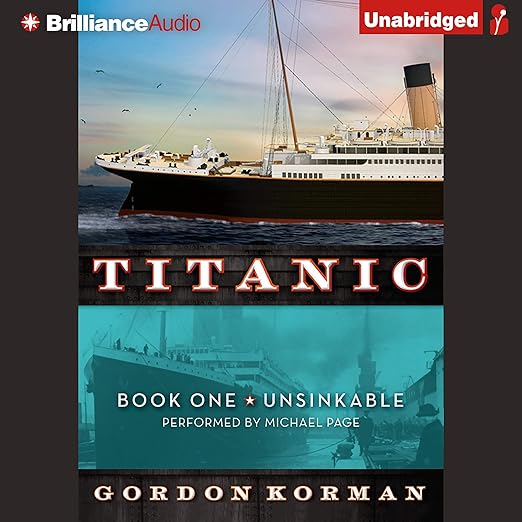
- Narration: Michael Page’s clean, character-distinct delivery keeps Gordon Korman’s four-strand structure from collapsing, he differentiates voices without overplaying any of them, which is exactly right for a thriller-paced middle-grade.
- Themes: Class and survival, secrets under pressure, fate versus choice
- Mood: Tense and fast-moving, with the weight of historical inevitability pressing from the background
- Verdict: A well-constructed middle-grade thriller that uses the Titanic as a pressure cooker rather than spectacle, strong series opener for ages 9 and up.
Gordon Korman has spent decades proving that he understands what middle-grade readers want from a thriller: stakes that feel real, characters with secrets that matter, and momentum that doesn’t apologize for itself. Unsinkable, the first book in his Titanic trilogy, uses one of history’s most documented disasters as its engine and trusts that the dramatic irony of a doomed ship, the reader knowing what the characters don’t yet know, is powerful enough to carry a story without melodrama. He’s right, and Michael Page’s narration keeps the thing moving with exactly the economy the material demands.
The structure is four-strand, following four young passengers whose paths intersect in ways that will only fully resolve across the trilogy. Paddy is a stowaway with a violent past he’s trying to outrun. Sophie is traveling with her mother, who was just released from police custody. Juliana’s father is wealthy and deteriorating, his eccentricity tipping toward something more dangerous. Alfie carries a secret that connects him to the ship’s crew in a way that could end his voyage before it properly begins. None of these characters share a backstory, and Korman is disciplined about keeping their storylines genuinely separate rather than forcing artificial convergence. Page handles the four voices with the practiced ease of a narrator who has spent real time thinking about character rather than just switching inflection.
What Historical Inevitability Does to a Plot
The most interesting formal decision Korman makes in Unsinkable is ending before the ship sinks. The first book covers the boarding and the early Atlantic crossing, all four characters maneuvering through their secrets and their proximity, and it closes at a point where the catastrophe is still coming but hasn’t arrived. One reviewer mentioned that her children “couldn’t wait to get book 2”, and that is precisely the emotional architecture Korman is building toward. The Titanic is not the story here; it is the pressure under which the story is being told. This structural choice separates this trilogy from simpler disaster narratives aimed at young readers.
The three-hour runtime is appropriate for the pace. This is not a book that lingers over description or character interiority; it moves, it reveals, it cuts to the next strand. For children who have had trouble finishing longer audiobooks, the compact duration and the chapter-ending hooks make this unusually easy to consume in sessions rather than all at once.
The Characters the Titanic Needs
What makes Korman’s fictional passengers work better than they might is that they are not representative types. Paddy’s Irish working-class background is not treated as local color; it is the reason the ship’s security treats him as disposable, which matters. Sophie’s arrested mother is a suffragette, and while the political dimension is handled lightly for the age level, it is not absent. Juliana’s wealthy American father is described as “eccentric” in the synopsis, but in practice his behavior sits closer to something the book lets readers name for themselves. These are characters with genuine specificity, not placeholders for historical scenery.
Michael Page gives each of them a voice that is distinct without being caricature. The moments of genuine fear in the later chapters of the book, as small dangers accumulate on a ship that the reader knows is heading toward the largest danger of all, land in his reading with genuine weight.
Who This Trilogy Is For
Unsinkable is well suited for readers aged 9 to 13 with an existing interest in the Titanic, an appetite for thriller structure, or both. It does not require prior knowledge of the historical event to be gripping, though familiarity adds the dramatic irony that gives the story its particular atmosphere. This is the first of three books; the series is designed to be read in order, and this opener does what a good first volume should do: it establishes four characters you have reason to follow, puts them in danger, and ends at a moment that makes continuing feel necessary rather than optional.
Frequently Asked Questions
Does Unsinkable show the actual sinking of the Titanic, or does it end before that?
The first book ends before the sinking. Korman structured the trilogy so that the disaster itself unfolds across later volumes. This makes the first book feel more like a thriller about secrets and class dynamics than a disaster narrative, which is part of what makes it work as well as it does.
Can Unsinkable be read as a standalone, or is it necessary to continue the trilogy?
It functions as the opening chapter of a longer story rather than a self-contained narrative. The four character storylines are established but not resolved in this volume. Most readers who enjoy it will want to continue; approaching it as a standalone would leave too many threads open.
How does Michael Page handle the four-character structure in his narration?
Page keeps the four voices distinct through subtle register shifts rather than dramatic character voices. His approach prioritizes clarity over performance, which is the right call for a thriller-paced middle-grade, you always know whose section you’re in without the narration becoming theatrical.
Does the book address the class disparities among Titanic passengers, or does it focus only on the adventure elements?
The class dynamics are woven directly into the plot. Paddy’s stowaway status, the different treatment of first- and third-class passengers, and Sophie’s socially complicated position are all narrative elements rather than historical footnotes. Korman uses the social structure of the ship as part of each character’s specific danger.