Quick Take
- Narration: Listed under the curious credit Howard. Health, likely a metadata anomaly or publishing entity name rather than a separate narrator; the narration is almost certainly by Schubiner or a professional hired for this edition.
- Themes: Neuroplastic pain theory, the mind-body connection in chronic pain, guided reprogramming of learned pain neural pathways
- Mood: Methodical and quietly transformative, with the careful patience of a clinician who has watched this approach change lives
- Verdict: One of the most evidence-grounded mind-body approaches to chronic pain available in audio, with a structured program that has a documented track record of results, the fourth edition is the version to start with.
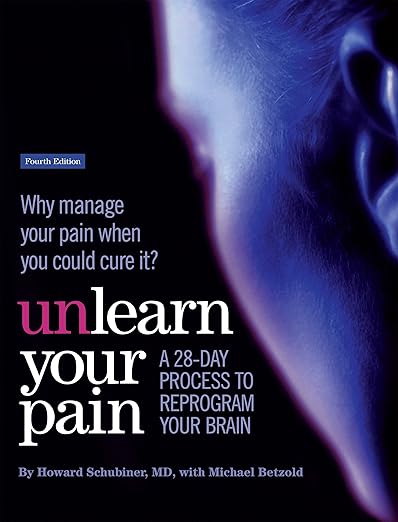
I was skeptical the first time I heard anyone describe their chronic back pain as being in their head in a way that was meant to be empowering rather than dismissive. That framing has been weaponized enough times against pain sufferers, used to suggest they are exaggerating, that the problem is psychiatric rather than physical, that willpower could fix what medicine cannot, that the legitimate neuroscience behind the concept gets buried under the baggage. Dr. Howard Schubiner’s Unlearn Your Pain is the book that most systematically addresses this problem, and the fourth edition, running 14 hours, represents his most complete articulation of the theory and the practice.
The narrator credit reads Howard. Health, which appears to be a metadata anomaly, possibly reflecting a publishing entity or platform registration rather than a separate narrator identity. The narration is likely Schubiner’s own voice or a professional narrator hired for this edition. The ambiguity is worth noting but should not deter potential listeners from the content, which carries 254 ratings at 4.6 stars, a substantial and meaningful data set for a health-and-wellness title in a specialized niche.
What Neuroplastic Pain Actually Means
The concept that drives this entire book is neuroplastic pain: pain that is real, physically experienced, and measurable in the nervous system, but that is generated by the brain rather than by ongoing tissue damage. This distinction matters enormously. It does not mean the pain is imaginary. It means the pain signal has become learned behavior, a neural pathway that fires habitually, in the same way that a musician’s fingers move through a piece they have practiced thousands of times, long after the original tissue damage that established the pathway has healed.
One reviewer spent ten years with chronic back pain, underwent physical therapy, used prescribed medications, tried alternative therapies, received rounds of injections, and had given up hope before Schubiner’s approach produced recovery. Another reviewer, who suffered from dizziness, migraines, severe fatigue, and abdominal pain alongside traditional pain symptoms, found that the same neural retraining protocol addressed all of these symptoms simultaneously. This cross-symptom efficacy is one of the strongest pieces of evidence for the neuroplastic model: if your dizziness and your fatigue and your abdominal pain all resolve with the same brain-based intervention, the probability that each was caused by a separate physical pathology is considerably lower than if only the primary pain improved.
The Program Structure and What Four Editions Have Refined
Unlearn Your Pain is not a passive listen. It is a guided program with audio meditation exercises accessible through a purchase-included online resource, structured writing exercises, and a sequential protocol for identifying and addressing the psychological drivers that maintain pain signals. The fourth edition contains substantial revisions to both the scientific framework and the clinical program, incorporating the research that has accumulated since earlier editions, including the influential 2022 randomized controlled trial that demonstrated significant pain reduction using Pain Reprocessing Therapy, which is closely related to Schubiner’s approach.
At 14 hours, the audiobook is long. It is long because the program is thorough. Schubiner is not offering a summary of neuroplastic pain theory with a brief exercise at the end, he is providing the complete framework and the guided practice necessary to actually shift a pain pattern that may be decades old. The online meditation exercises are described as included with purchase, which raises the point relevant to any audio program with supplementary materials: the full value of this book is audio-plus-exercises, not audio alone.
The Evidence Base and Why It Matters for This Category
The mind-body pain space includes a significant amount of content that draws on anecdote, testimonial, and loosely applied psychological concepts. Schubiner is a physician at a major medical center with peer-reviewed publications in this area. The framework he works within has been tested in randomized controlled trials with statistically significant outcomes. This matters not because anecdote is worthless, the reviewer accounts of recovery from decade-long pain are clearly real, but because the scientific grounding distinguishes Unlearn Your Pain from the many titles in this category that are making similar claims without comparable evidence infrastructure.
The relationship to John Sarno’s work is worth noting. Sarno pioneered the concept that chronic pain is often produced by tension myositis syndrome, essentially a brain-generated response to repressed emotional conflict. Schubiner studied Sarno directly, and his framework refines and updates that lineage with current neuroscience while preserving its core insight. For listeners who have worked with Healing Back Pain, Unlearn Your Pain represents the fourth-edition evolution of that tradition, with more complete science and a more structured clinical program.
Who Should Listen, Who Should Skip
Listen if you have chronic pain that has not responded to standard medical interventions, especially if multiple specialists have been unable to identify a clear structural cause, or if your pain moves, changes character, or responds disproportionately to stress and emotional state. These are markers for neuroplastic pain, and this program has the strongest evidence base in the audio space for addressing it. Skip if your pain has a clear, active tissue damage cause that is currently being treated, this approach is designed for pain that has outlasted its original cause, not for acute injury management.
Frequently Asked Questions
Who actually narrates Unlearn Your Pain, the Howard. Health credit is confusing?
The Howard. Health credit appears to be a metadata anomaly, possibly a publishing entity name registered on the platform. Based on context, the narration is likely either Schubiner himself or a professional hired for this Audible edition. Sampling the audio before purchase will confirm the actual narration quality.
How is this different from simply being told that your pain is psychological?
Neuroplastic pain is physically real pain generated by learned neural pathways, not a psychological symptom in the sense of being imaginary or exaggerated. Schubiner’s framework uses neuroscience to explain why the brain continues generating pain signals after the original tissue injury has healed, and the treatment addresses the neural pathway directly rather than dismissing the pain. The documented recoveries in controlled trials involve people whose measurable pain reduces, not just people who stop complaining.
What are the online audio meditation exercises and are they included with purchase?
Yes, the synopsis states that access to online audio meditation exercises is included with purchase of the fourth edition. These exercises are part of the structured program and are integral to the full protocol rather than optional supplements. Listeners who engage with the program rather than treating this as passive informational audio will need to use the online resources to complete the recommended practice.
Is this specifically about back pain, or does it address other types of chronic pain?
While Schubiner’s clinical background includes significant focus on back pain, the neuroplastic framework addresses any chronic pain condition generated by the same mechanism. Reviewers report success with migraines, dizziness, fibromyalgia-pattern fatigue, abdominal pain, and other multi-system chronic symptoms. The fourth edition has been revised to reflect research across the full range of conditions where this approach has been studied.