Quick Take
- Narration: Jessica Almasy brings Theodora a reserved, self-sufficient quality that suits the character perfectly, her performance understands that Theo does not perform emotions, she accumulates them.
- Themes: Hidden history, the grief of unexpected loss, building community from self-reliance
- Mood: Clever and a little melancholy, with Manhattan as a character in its own right
- Verdict: A tightly constructed debut mystery that earns its comparisons to Konigsburg and still feels like its own original thing.
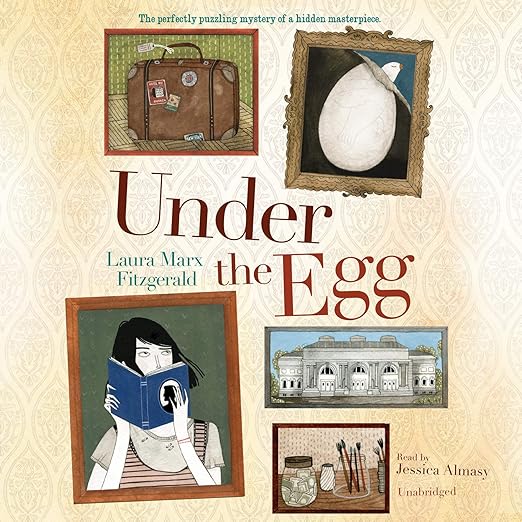
I listened to Under the Egg on a Sunday afternoon that turned into a Sunday evening without my quite planning it. Laura Marx Fitzgerald’s debut middle grade novel is the kind of story that catches you off guard with how much you’re invested in it. The setup sounds modest: a thirteen-year-old girl discovers what might be a stolen Renaissance masterpiece under the layer of paint on her late grandfather’s canvas. But what makes it work is everything around that premise, the specific texture of Theodora Tenpenny’s situation, her grief, her mother’s instability, the two-hundred-year-old Manhattan townhouse that she’s trying to hold onto on a legacy of exactly .
Fitzgerald’s debut was compared on publication to both From the Mixed-Up Files of Mrs. Basil E. Frankweiler and Chasing Vermeer, which is accurate in the sense that all three involve art mysteries navigated by young protagonists in or around major cultural institutions. But Under the Egg is tonally darker than either, at least initially. Theo has just lost the grandfather who was her primary caregiver and emotional anchor. She’s been managing her mother for what sounds like years. She is self-reliant in the way that children who have learned they cannot fully rely on adults become self-reliant: efficiently, guardedly, and at some cost.
The Grandfather Who Left a Painting and a Question
The late grandfather, a security guard at the Metropolitan Museum of Art, is present throughout the novel in his absence. He prepared Theo, in ways she is still discovering, for exactly this situation. He gave her a painting. He gave her fragments of history she did not know she needed. And he gave her a mystery she can only solve by talking to other people, which is the one thing her self-sufficiency has taught her to avoid. The emotional arc of the novel is essentially about Theo learning to accept help, to build community one serendipitous friendship at a time. That arc is never stated as a lesson. It emerges from what the plot requires of her.
A content note worth flagging: at least one parent reviewer notes that the story touches on Holocaust history and includes a brief passage involving an adult historical figure’s romantic behavior. For a fifth or sixth grade classroom context, this is worth knowing in advance. The Holocaust thread is handled with age-appropriate care and gives the story genuine historical weight without overwhelming the middle grade register.
Jessica Almasy’s Portrait of a Self-Sufficient Kid
Jessica Almasy is a capable narrator who has worked across the middle grade and YA audiobook landscape with consistency. Her reading of Theo is controlled, slightly formal, with a dry humor that surfaces occasionally and then retreats. Theo is not a warm narrator in the effusive sense, and Almasy does not try to warm her up artificially. The emotional moments, when they arrive, hit because they have been earned through restraint. The supporting characters, including the unusual new friends Theo accumulates through the investigation, have sufficient differentiation to be tracked without confusion.
The runtime of under six hours is well-paced for the story’s scope. The Manhattan geography is rendered with affection and specificity: Fitzgerald clearly loves the city, and the audio version captures the sense of Theo moving through neighborhoods she knows as a native rather than a tourist.
What the Mystery Actually Solves
The art mystery is real and well-constructed, with enough historical texture to be satisfying. But the mystery the novel is actually solving is an interior one: who was Theo’s grandfather, really, and what did he know, and what did he choose, and what does she do with a legacy that is more complicated than she thought? That second mystery, the one about identity and inheritance and what we owe the past, is what gives the book its staying power beyond a tidy plot resolution. SLJ’s Fuse 8 called it uniquely readable and a pleasure from start to finish, which is accurate but undersells the emotional undertow.
Who Should Listen, Who Should Skip
Ages 10 through 14 who enjoy clever mysteries with historical layers and emotionally complex protagonists will find this absorbing. It works particularly well for kids who prefer quiet, observant characters over loud, extroverted heroes. Parents of younger readers should preview the Holocaust content and the historical figure passage before assigning it. Adult listeners will find it a surprisingly affecting read on its own terms, not just as children’s fiction.
Frequently Asked Questions
Does the Holocaust history thread require prior knowledge, or is it explained within the story?
It is explained within the story through Theo’s investigation, so no prior knowledge is required. The thread is handled carefully and adds genuine historical depth without being traumatizing or overwhelming for the middle grade audience.
How does Under the Egg compare to From the Mixed-Up Files of Mrs. Basil E. Frankweiler as a listening experience?
Both involve art mysteries in or around the Met, but Under the Egg has a darker emotional register. Theo is carrying real grief and real financial precarity. The mysteries in Mixed-Up Files are more playful. Both reward careful listening, but this one is somewhat more emotionally demanding.
Is this appropriate for a fifth grade book club, given the content note about mature themes?
With awareness of the relevant passage around page 95 in the print edition, it works well for a fifth grade context. The Holocaust content is age-appropriate and handled with care. The overall tone and reading level suit grades 5 through 8.
How does Jessica Almasy handle the shifts between the mystery plot and the more emotional moments about Theo’s mother and grandfather?
She handles them with restraint rather than heightened performance. The emotional weight builds through accumulation. Almasy does not telegraph the emotional beats in advance, which makes them more affecting when they arrive.