Quick Take
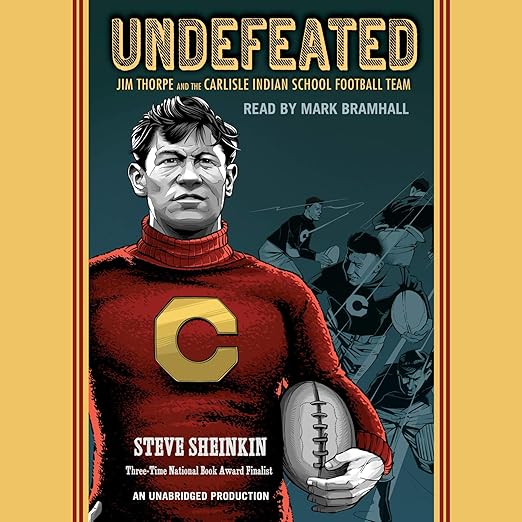
- Narration: Mark Bramhall narrates with the quiet authority this material demands, his delivery honors both the athletic story and the political history without letting either overwhelm the other.
- Themes: Native American persecution and resilience, the origins of modern football, underdog triumph as political act
- Mood: Urgent and grounded, with the unflinching quality of serious historical nonfiction
- Verdict: Steve Sheinkin at his best, Undefeated is a sports history that refuses to be only a sports history, and Bramhall’s narration gives every layer of it its due weight.
I came across Undefeated on a shelf between two other Steve Sheinkin titles and almost missed it. I had been working through his catalog after reading Bomb a few years earlier, if you haven’t encountered Sheinkin’s nonfiction, he writes with the structural precision of a thriller writer and the research discipline of a historian, and his young readers work is among the most substantive in the genre. Undefeated was the title I’d somehow saved for last, and when I finally started the audiobook on a rainy Wednesday afternoon, I understood immediately why people talk about it the way they do.
The book covers Jim Thorpe and Pop Warner’s partnership at the Carlisle Indian Industrial School in Pennsylvania, beginning in 1904. The Carlisle football team, the sons of Native Americans who had been forcibly placed in an institution explicitly designed to erase their culture, became one of the most successful football programs in America, defeating establishment schools like Harvard and Army in a series of games that had meaning far beyond the scoreboard. At the center of this is Jim Thorpe, whose name most young listeners may know as the greatest all-around athlete of the early twentieth century, but whose story involves suffering and exploitation that the sports mythology rarely includes.
Sheinkin’s Method and Why It Works in Audio
Steve Sheinkin writes narrative nonfiction that reads like it was written to be heard. His sentences have rhythm, his chapter breaks are designed to propel forward motion, and his research appears in the text as vivid detail rather than as footnote-adjacent information dumps. Bramhall’s narration suits this method precisely. He has the pace and intelligence to let Sheinkin’s prose do what it’s designed to do without adding theatrical overlay that the material doesn’t need.
The reviewer who compared this to Seabiscuit, another story about improbable athletic achievement carrying social meaning well beyond the sport, identified something real. Both books understand that the best sports history is always about the culture around the sport as much as the sport itself. Carlisle’s football team was playing in an era when their existence as Native Americans was treated as something to be corrected or eliminated. Winning against Harvard was not simply athletic achievement. It was argument.
The Parts the Sports Coverage Doesn’t Tell You
What makes Undefeated more demanding than a standard sports biography is that Sheinkin refuses to separate Jim Thorpe’s athletic greatness from the context of Native American persecution in which it occurred. The Carlisle school itself, designed around the principle of forced assimilation, is treated with the horror that history has increasingly recognized it deserved. Thorpe’s later exploitation, his Olympic medals stripped, his professional contracts manipulated, is not softened. This is a book that tells you the truth about American history while it tells you the story of an extraordinary team, and it trusts young readers to hold both at once.
That trust is the book’s defining quality. Sheinkin does not condescend to his audience by making the history comfortable. The reviewer who called this a well-written tragedy had it right, it’s a story of triumph and loss, simultaneous, and the listening experience holds that complexity without resolution.
Jim Thorpe’s Legacy and How Bramhall Carries It
Thorpe won both the pentathlon and decathlon at the 1912 Stockholm Olympics, achievements that led to King Gustav V of Sweden calling him the greatest athlete in the world. He was also stripped of those medals over a professional eligibility technicality that was later widely acknowledged as unjust. He played professional football for money he desperately needed because of economic circumstances that were the direct result of policies designed to impoverish Native Americans. The book holds all of this. Bramhall navigates the complexity with care, moving between the celebratory and the tragic without losing the thread of Thorpe’s individual humanity.
Who Should Listen and Who Should Skip
Undefeated is best suited for ages 10 and up, it does not soften the historical violence of Native American persecution, and younger listeners need appropriate context. It works powerfully in classrooms studying American history, the origins of football, or the intersection of race and sport. Football fans who want the history of the game from its unconventional origins will find this genuinely revelatory. Skip this if you want a feel-good sports story without complication, Sheinkin offers something more honest and more lasting than that.
Frequently Asked Questions
Is Undefeated appropriate for elementary school students, or is it better suited to middle school?
Sheinkin and the publisher target this at middle school, roughly ages 10 and up. The subject matter, Native American persecution, the Carlisle school’s forced assimilation methods, and Jim Thorpe’s later exploitation, is handled with factual directness that requires some maturity to process. Younger students can engage with it with adult guidance, but the material is richer for listeners who have enough historical context to hold the complexity.
Does the audiobook cover what happened to Jim Thorpe’s Olympic medals?
Yes. The stripping of Thorpe’s Olympic medals over professional baseball eligibility is part of the book’s account of his life and legacy. Sheinkin does not present this as a footnote, it’s central to the story of how American institutions treated one of its greatest athletes. The medals were posthumously restored by the IOC in 1982; the audiobook’s coverage of Thorpe’s legacy includes the context around that injustice.
How does Mark Bramhall’s narration compare between this and The Boys in the Boat Young Readers Adaptation?
Bramhall narrates both titles, and the performance on each is strong. Undefeated requires him to navigate more political and historical complexity, and he does so with the same measured authority. His restraint is an asset in both cases, he never over-emotes or signals to the listener how they should feel, which allows the material to develop its own emotional power.
Is the Carlisle Indian Industrial School covered in depth, or just as background context?
The school is central to the book’s argument, not background context. Sheinkin treats Carlisle’s founding philosophy, the explicit attempt to erase Native American identity through forced assimilation, as an essential part of understanding why the football team’s wins carried the meaning they did. Listeners who come for the football will get a substantial history of the institution alongside the athletic story.